
 college preparation
Budgeting and financial managementTextbook
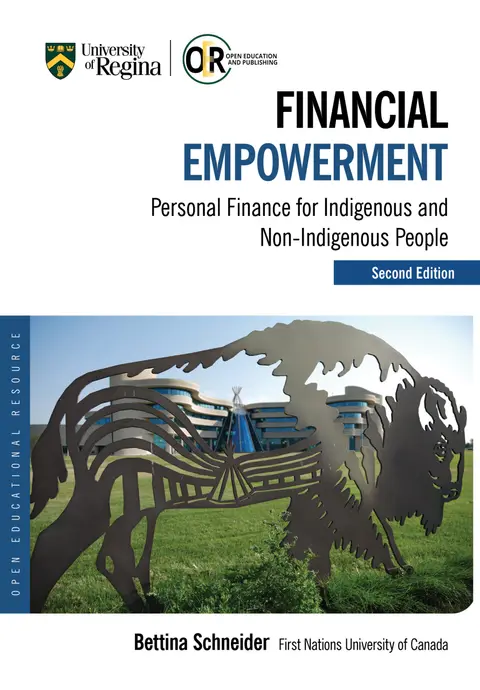
Financial Empowerment (2nd Edition)
Not rated yetRate this bookFinancial Empowerment, second edition, approaches personal finance through the experiences and values of Indigenous and non-Indigenous people in Canada. This guide follows its 15 chapters and Elders’ interview resources, connecting practical calculations with personal goals, community responsibilities, and the effects of financial exclusion.
Free reading is available at the official source. Opens in a new tab.
 Free
About this book
Financial Empowerment, second edition, approaches personal finance through the experiences and values of Indigenous and non-Indigenous people in Canada. This guide follows its 15 chapters and Elders’ interview resources, connecting practical calculations with personal goals, community responsibilities, and the effects of financial exclusion.
How to study this book
Use fictional figures for practice and state every assumption. Read the cultural context and Elders’ perspectives alongside the numerical examples. Keep a financial vocabulary list, a calculation notebook, and a reflection on how values affect decisions. Treat the edition’s tax, benefit, and product examples as dated learning material.
Chapter-wise explanations and study tasks
1. Personal Financial Planning
Planning begins with circumstances, goals, and values rather than with choosing a product. Life stages and changing responsibilities alter what a useful plan must accomplish. Connect individual goals with family and community priorities while recognizing that access to opportunities is not equal.
Study task: Develop a fictional person’s short-, medium-, and long-term goals and explain how one family or community responsibility changes the plan.
2. Basic Ideas of Finance
Finance involves allocating limited resources under uncertainty. Risk, return, economic conditions, and the financial system help explain the choices individuals face. Learn these relationships before comparing particular financial products, and distinguish an expected outcome from a guaranteed one.
Study task: Compare two hypothetical uses of a fixed amount of money, identifying opportunity cost, uncertainty, and the time horizon.
3. Financial Statements
Income statements, cash-flow statements, and balance sheets describe different aspects of a financial position. Assets and liabilities reveal accumulated wealth and obligations, whereas income and cash flows show movement over a period. A person can have positive net worth and still face a cash shortage.
Study task: Prepare a simple balance sheet and monthly cash-flow statement for a fictional household and explain one difference between their messages.
4. Evaluating Choices: Time, Risk, and Value
Amounts received at different times are not directly equivalent. Present and future value calculations make the interest rate and timing assumptions explicit. Connect the arithmetic to risk and alternatives instead of assuming that a larger future amount is automatically a better choice.
Study task: Compare a hypothetical payment today with a later payment using an explicitly chosen discount rate, then show how a different rate affects the comparison.
5. Financial Plans: Budgets
A budget turns priorities and expectations into an actionable plan for income and spending. Comparing actual results with the plan reveals where assumptions or behaviours need revision. Allow for irregular expenses and changing circumstances rather than treating each month as identical.
Study task: Create a three-month fictional budget with an irregular expense and revise it after a reduction in expected income.
6. Taxes and Tax Planning
Taxation affects available income and financial decisions, but its application depends on jurisdiction and individual circumstances. The Canadian and First Nations context is especially important in this adaptation. Distinguish the general planning concepts from the edition’s specific rules, examples, and thresholds.
Study task: List the information a fictional Canadian taxpayer would need to verify before using an example from the chapter; do not assume a blanket First Nations tax exemption.
7. Financial Management
Financial management connects routine transactions, financial institutions, borrowing, and the organization of resources. Evaluate access, cost, convenience, and the fit with a person’s needs. The book’s discussion of Indigenous financial institutions broadens the range of contexts that mainstream examples often overlook.
Study task: Compare two fictional account or borrowing arrangements using total cost, access requirements, and suitability for the stated user.
8. Consumer Strategies
Consumer decisions involve information quality, financing, timing, and the total cost of ownership. Advertising and convenient payment arrangements can obscure trade-offs. Apply the chapter’s decision process to a significant purchase by separating needs, preferences, and the consequences of borrowing.
Study task: Prepare a comparison sheet for buying a fictional appliance, including cash price, financing cost, maintenance, and one nonfinancial criterion.
9. Buying a Home
Housing decisions combine affordability, financing, transaction costs, and ongoing obligations. Renting and owning expose a household to different risks and responsibilities. Compare complete scenarios rather than treating a mortgage payment as equivalent to the entire cost of ownership.
Study task: Build a hypothetical rent-versus-buy comparison that includes maintenance and transaction costs, then identify the assumptions that most affect its conclusion.
10. Personal Risk Management: Insurance
Insurance transfers specified financial risks under a contract; it does not eliminate every potential loss. Coverage, exclusions, deductibles, and premiums determine how protection works. Begin with the risk a household faces and assess whether a hypothetical policy addresses it.
Study task: Create a risk inventory for a fictional household and match three risks to possible responses, explaining what an insurance contract would still need to specify.
11. Retirement and Estate Planning
Long-term planning links future income needs, accumulated resources, dependants, and the transfer of assets. Retirement and estate arrangements address different questions but interact through family circumstances. Treat the chapter’s Canadian instruments and legal examples as requiring current verification.
Study task: Draw a planning map for a fictional household connecting retirement income sources, dependants, beneficiary intentions, and questions for qualified professional advice.
12. Investing
Investment choices depend on objectives, time horizon, uncertainty, and diversification. Different assets expose investors to different sources of risk. The chapter’s overview provides a framework for understanding instruments, not a promise that a particular strategy will produce a stated return.
Study task: Describe a fictional investor’s objective and compare the relevant risks of three asset types without selecting a real investment product.
13. Owning Stocks
Stock ownership represents an interest in a business and exposes the holder to changes in its performance and valuation. Share prices, distributions, and company information provide different perspectives on an investment. Separate a business’s merits from the price paid for its shares.
Study task: Using invented figures, distinguish a stock’s price change from its total return and identify two business risks that a past price chart cannot resolve.
14. Bonds and Mutual Funds
Bonds and mutual funds have different structures, income patterns, fees, and risks. Diversification through a fund does not make its holdings risk-free, and a bond’s market value can change. Connect each product’s mechanics with the decision it is intended to support.
Study task: Compare a fictional bond and a mutual fund in terms of ownership claim, sources of return, liquidity, fees, and possible loss.
15. Career Planning
Career choices influence income, education costs, working conditions, and future flexibility. Financial planning should incorporate interests and values as well as expected earnings. Consider alternative paths and uncertainty rather than projecting one uninterrupted employment trajectory.
Study task: Compare two fictional education or career paths using direct costs, time, likely opportunities, and personal or community priorities.
Elders’ Perspectives and Interviews
The interview resources connect financial decisions with lived experience, values, and community knowledge. Approach them as distinct perspectives rather than treating Indigenous peoples as one uniform group. Use the reflections to revisit assumptions made in the numerical chapters.
Study task: Summarize one available interview in your own words and explain how it changes the priorities or assumptions in your fictional financial plan.
Applied assignment
Prepare a fictional household plan containing goals, a balance sheet, a budget, a major-purchase comparison, and a risk inventory. Explain how cultural context and family or community commitments influence the choices. List all tax, legal, benefit, and product details that would require current verification.
Suggested reading plan
Study chapters 1–5 for planning and calculation, 6–9 for taxes and everyday financial decisions, 10–11 for risk and long-term responsibilities, and 12–15 for investments and careers. Return to the Elders’ resources throughout and revise the fictional plan after each block.
Questions for reflection
- Which financial goals reflect personal values rather than a generic definition of success?
- What does cash flow reveal that net worth alone cannot?
- How do historical barriers to financial access change the assumptions in a planning example?
Edition and source notes
Based on the linked second edition and its 2024 preface. This Canadian adaptation includes Indigenous perspectives and 15 numbered chapters, followed by interview resources. These are educational exercises using hypothetical situations, not individualized financial recommendations. Verify current jurisdiction-specific rules and product terms before real decisions.
About access & copyright
This page provides book information and study material. Full-text access is provided by the original publisher or authorised source; a listing does not grant permission to republish the book.
Read our Library Access & Copyright policyExplore the contents
Check the chapters covered in this edition.
Visit the official source
See reading, preview or purchase options.
Save for later
Keep this textbook in your saved collection.
Reader ratings & reviews
Share your thoughts
Your review helps other students choose the right resources.
KEEP LEARNING
Your next great read
college preparation Business and Economics
Essentials of Project Management (v. 1.2 – January 22, 2024)
View Essentials of Project Management (v. 1.2 – January 22, 2024) — book Business and Economics
Pop-up Retail Strategies in an Omnichannel Context
View Pop-up Retail Strategies in an Omnichannel Context — book Law, Economics and Social Sciences
Research Methods: Exploring the Social World in Canadian Context
View Research Methods: Exploring the Social World in Canadian Context — book Communication Science/Journalism
Professional Communication Skills for Health Studies
View Professional Communication Skills for Health Studies — book Communication Science/Journalism
Write Like a PR Pro
View Write Like a PR Pro — book Business and Economics
Understanding Business
View Understanding Business — book Law, Economics and Social Sciences
Principles of Social Psychology - 1st International Edition
View Principles of Social Psychology - 1st International Edition — book Business and Economics
Sales Leadership Management
View Sales Leadership Management — book Early childhood care and education