
 Business
Conflict managementTextbook
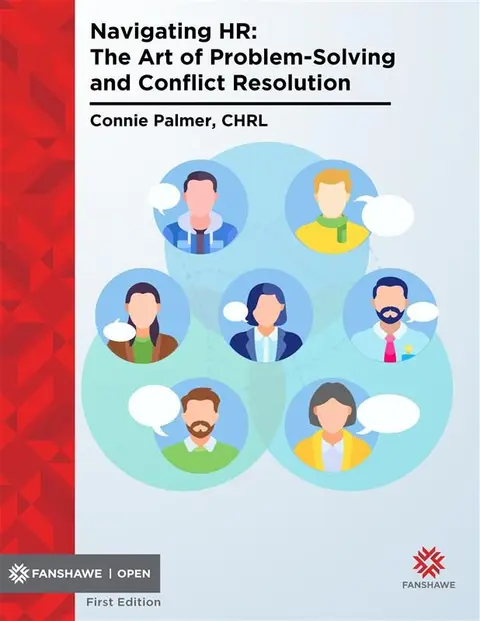
Navigating HR : The art of problem-solving and conflict resolution
Not rated yetRate this bookConnie Palmer’s Navigating HR develops conflict-resolution and problem-solving skills through workplace examples, graduate perspectives, and recurring cases at Runners Relay Ltd. This guide follows all 14 chapters, including three extended cases about harassment, investigations, and workplace violence.
Free reading is available at the official source. Opens in a new tab.
 Free
About this book
Connie Palmer’s Navigating HR develops conflict-resolution and problem-solving skills through workplace examples, graduate perspectives, and recurring cases at Runners Relay Ltd. This guide follows all 14 chapters, including three extended cases about harassment, investigations, and workplace violence.
How to study this book
Work through each chapter’s learning outcomes, lesson, skills spotlight, case, and application questions. Keep facts, interpretations, interests, and proposed actions in separate columns. Use role play for ordinary conflict, while recognizing that harassment, threats, and safety concerns require formal protective and investigative responses.
Chapter-wise explanations and study tasks
1. It Comes with the Territory
Workplace conflict can arise from differences in interests, expectations, resources, and relationships. HR practitioners need competencies that help them respond constructively without assuming that every disagreement is harmful. The Runners Relay staff introduction supplies a shared context for later cases.
Study task: Create a stakeholder map for Runners Relay and distinguish a potential constructive disagreement from a situation requiring protective intervention.
2. Approaches to Conflict Resolution
The Thomas–Kilmann framework considers approaches according to assertiveness and cooperation. No single style suits every circumstance. The escalation discussion adds a temporal dimension: a response that is possible early may be less effective once distrust and hostility have intensified.
Study task: Analyse a fictional disagreement using two conflict styles and explain which situational factors support each choice.
3. Collaboration: Let’s Work Together
Collaboration involves jointly exploring a problem rather than merely dividing a contested resource. Listening and participation help parties understand what a workable solution must achieve. Distinguish collaboration from a superficial compromise that leaves the underlying concerns unexplored.
Study task: Script a short collaborative opening, three listening questions, and a summary that checks your understanding of both parties’ concerns.
4. Interest-Based Conflict Resolution
Positions describe the outcomes people demand; interests explain the concerns behind those demands. Exploring interests can reveal options that fixed positions hide. A useful process also needs criteria for judging alternatives and clarity about which decisions the participants can actually make.
Study task: Rewrite two opposing workplace demands as possible interests and propose three options that address at least one concern on each side.
5. HR’s Proactive Approach
Prevention depends on organizational practices and early attention, not only on responding after conflict becomes visible. Clear expectations, communication channels, and supportive management can reduce avoidable friction. Consider how HR can detect recurring issues without treating every difference as a disciplinary matter.
Study task: Design an early-response process identifying a reporting route, a responsible role, and a method for checking whether the response helped.
6. Strengths for Effective Conflict Resolution
Recognizing strengths can help people contribute to a resolution, but strengths need to be applied in context. Reflection on one’s own tendencies supports better listening and judgment. Avoid turning a strengths label into an excuse for harmful conduct or a fixed prediction of behaviour.
Study task: Identify a strength you could bring to a mediation exercise and explain how overusing it might become a barrier.
7. Generational and Cultural Dimensions
People bring different experiences and expectations to work, but age and cultural categories do not explain every individual response. The chapter invites attention to perspective and communication. Use differences as reasons to ask questions rather than as evidence that a person fits a stereotype.
Study task: Rewrite a stereotyped explanation of a workplace disagreement into a set of neutral questions about expectations, experience, and needs.
8. HR’s Role in Problem Solving
Problem solving requires a clear definition, relevant information, alternatives, evaluation, and follow-through. Symptoms can mislead HR into addressing the wrong issue. Use the case material to connect a proposed solution to an identified cause and an observable result.
Study task: Write a problem statement for a Runners Relay issue and compare two possible solutions using explicit criteria and a follow-up measure.
9. Navigating Communication in Conflict
Listening, verbal and nonverbal messages, and emotional awareness shape difficult exchanges. Intent and impact can differ, particularly under stress. Practise language that describes observations and needs without attributing motives that have not been established.
Study task: Turn an accusatory statement into an observation, its impact, and a clarification request; rehearse a response that demonstrates active listening.
10. Investigations in Workplace Conflict
Formal investigations address allegations that cannot be resolved safely or appropriately through ordinary coaching. A fair process distinguishes allegations, evidence, findings, and actions. Understand the importance of impartiality, documentation, and appropriate confidentiality without promising absolute secrecy.
Study task: Outline an investigation plan for a fictional complaint, identifying evidence sources, fairness safeguards, and the separation between interim protection and final findings.
11. Psychological Safety
Psychological safety affects whether people can raise concerns, ask questions, and acknowledge mistakes. Difficult conversations require attention to power and the consequences of speaking up. An agreeable meeting does not by itself demonstrate that participants feel able to disagree.
Study task: Draft a manager’s response to an employee raising a concern and propose a follow-up action that tests whether speaking up was supported.
12. Hotel-Dieu Grace Hospital Case Study
The Lori Dupont case examines missed opportunities to respond to harassment and violence risks in a workplace. It requires distinguishing serious protective responsibilities from routine interpersonal conflict. Focus on the organizational information and response opportunities presented, avoiding hindsight claims of certainty.
Study task: Create a chronology of reported warning signs and identify decision points where a documented protective response should have been considered.
13. Wal-Mart Canada Corp Case Study
The Boucher case centres on harassment, organizational response, and the treatment of an employee who raised concerns. It provides a way to analyse investigation quality and accountability. Keep the source’s reported facts and legal outcomes distinct from your recommendations for organizational practice.
Study task: Compare the complaint response described in the case with a fair investigation process and propose two changes tied to specific failures.
14. OC Transpo Case Study
The OC Transpo case examines workplace violence and the organizational context discussed in the source. Analyse the information and institutional responsibilities without implying that harassment excuses violence or that a single factor explains a complex event. Connect prevention, reporting, and response planning.
Study task: Develop a prevention-and-response framework showing reporting, assessment, protective action, and review, and identify the limits of what the case evidence establishes.
Applied assignment
Write an HR case portfolio with a stakeholder analysis, an interest-based conversation plan, a formal-investigation decision, and a follow-up proposal. Use the Runners Relay cases for skills practice and one extended case to explain when safety and formal accountability take priority over collaborative resolution.
Suggested reading plan
Study chapters 1–4 for conflict foundations, 5–8 for prevention and problem solving, and 9–11 for communication, investigations, and psychological safety. Read chapters 12–14 separately, allowing time for evidence-based analysis of their serious subject matter.
Questions for reflection
- When is collaboration unsuitable as the first response?
- How do interests differ from positions and allegations?
- What evidence would show that an organization’s reporting process is trusted?
Edition and source notes
Based on Connie Palmer’s 2024 Fanshawe College edition and its 14 chapters. The final three chapters discuss real cases involving harassment and serious violence. This is a study guide to the source, not current legal advice or a substitute for organizational emergency and investigation procedures.
About access & copyright
This page provides book information and study material. Full-text access is provided by the original publisher or authorised source; a listing does not grant permission to republish the book.
Read our Library Access & Copyright policyExplore the contents
Check the chapters covered in this edition.
Visit the official source
See reading, preview or purchase options.
Save for later
Keep this textbook in your saved collection.
Reader ratings & reviews
Share your thoughts
Your review helps other students choose the right resources.
KEEP LEARNING
Your next great read
Business Business
Beginning Management of Human Resources
View Beginning Management of Human Resources — book Business
Human Relations
View Human Relations — book Business
Health and Safety in Canadian Workplaces
View Health and Safety in Canadian Workplaces — bookHair and Scalp Disorders
Hair and Scalp Disorders
View Hair and Scalp Disorders — book Complex analysis
Mathematical Methods for Physics
View Mathematical Methods for Physics — book Biophysics
Principles of Development : An Inquisitive Journey into Embryology
View Principles of Development : An Inquisitive Journey into Embryology — book Communication écrite
Le Littéraire dans le quotidien : Resources for a transdisciplinary approach to reading/writing at the first and second year levels of college French
View Le Littéraire dans le quotidien : Resources for a transdisciplinary approach to reading/writing at the first and second year levels of college French — book Operations Management
View Operations Management — book Communication



