
 Marine biology
Microbiology (non-medical)Textbook
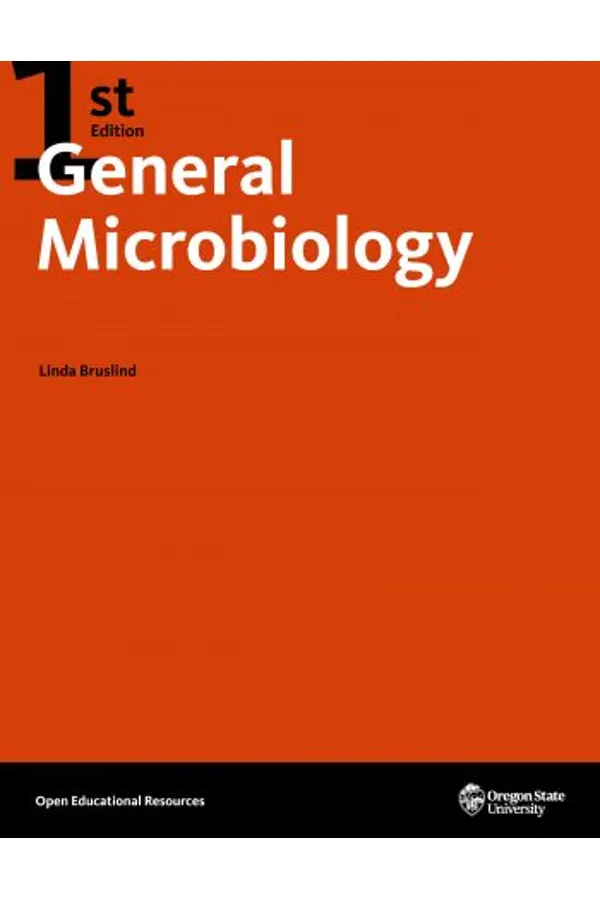
General Microbiology, 1st edition
Not rated yetRate this bookLinda Bruslind’s General Microbiology introduces the structures, growth, metabolism, genetics, and ecological relationships of microorganisms. This guide follows all 22 chapters, connecting cellular mechanisms with the evidence used to understand microbial diversity and function.
Free reading is available at the official source. Opens in a new tab.
 Free
About this book
Linda Bruslind’s General Microbiology introduces the structures, growth, metabolism, genetics, and ecological relationships of microorganisms. This guide follows all 22 chapters, connecting cellular mechanisms with the evidence used to understand microbial diversity and function.
How to study this book
Draw structures and pathways, keep comparisons between organism groups explicit, and explain mechanisms before memorizing terminology. For each metabolic strategy, identify energy source, electron donor, electron acceptor, and carbon source. Use conceptual or supplied-data exercises; practical culture work belongs in appropriately supervised laboratories.
Chapter-wise explanations and study tasks
1. Introduction to Microbiology
Microbiology includes cellular organisms and acellular agents at very different scales. Historical discoveries depended on observation and methods that could distinguish competing explanations. Clarify what the book includes before using microbe as if it named one biological group.
Study task: Compare cellular and acellular examples and convert their illustrative dimensions between micrometres and nanometres.
2. Microscopes
Magnification, resolution, and contrast are different properties. Microscopy methods reveal different kinds of information and may alter the specimen. Select an approach according to the question rather than the largest magnification label.
Study task: Compare two microscopy methods for a stated observation and explain one preparation or interpretation limitation.
3. Cell Structure
Cell organization provides a framework for comparing microbial groups. A diagram should show functional relationships as well as labels. Avoid treating the absence of a familiar organelle as the absence of the corresponding biological task.
Study task: Draw a comparative cell diagram and link three structural differences to functional consequences.
4. Bacterial Cell Walls
Wall architecture influences shape, integrity, and interactions with the environment. Gram-positive and Gram-negative descriptions concern structural patterns, not complete classifications of behaviour. Relate staining outcomes to architecture while noting exceptions.
Study task: Compare the two wall organizations and explain why a staining result alone cannot establish an organism’s identity.
5. Bacterial Internal Components
Internal structures support genetic information, protein production, storage, and survival. Different components have distinct roles and distributions. Relate each structure to a biological problem rather than learning an unconnected inventory.
Study task: Build a structure–function table and explain how two internal components support different survival demands.
6. Bacterial Surface Structures
External structures contribute to movement, attachment, and interactions. Similar-looking appendages may perform different functions. Connect a structure with the evidence needed to establish its role in a particular organism.
Study task: Compare two surface structures and propose an observation that would distinguish their functions.
7. Archaea
Archaea share some broad organizational features with bacteria but differ in important molecular characteristics. Environmental reputation is not a sufficient definition of the group. Compare membranes, walls, and information-processing features without assuming all archaea are extremophiles.
Study task: Create a bacteria–archaea comparison that includes molecular features and one misleading generalization to avoid.
8. Introduction to Viruses
Viruses depend on host systems and vary in genome and particle organization. Distinguish a virus particle from the processes occurring during infection. Connect structural features with the stages needed for replication.
Study task: Draw a generic infection sequence and identify which stages require host-cell functions.
9. Microbial Growth
Growth can refer to population increase rather than enlargement of one cell. Measurement methods and growth phases answer different questions. Interpret a curve through conditions and assumptions instead of treating it as an inevitable pattern in every environment.
Study task: Analyse a fictional growth curve and distinguish total-cell estimates from evidence of viable cells.
10. Environmental Factors
Temperature, pH, water availability, and other conditions influence microbial function and growth. An organism’s tolerance range differs from its optimum. Examine interacting factors rather than assuming one environmental measure predicts the whole response.
Study task: Sketch a hypothetical response curve and explain the difference between tolerance limits and optimum conditions.
11. Microbial Nutrition
Nutrients supply matter and support biological processes, while nutritional categories distinguish sources used by organisms. Transport and availability affect what cells can obtain. Separate carbon acquisition from energy acquisition.
Study task: Classify source examples by carbon and energy sources and explain why those categories are independent.
12. Energetics and Redox Reactions
Energy transformations depend on coupled reactions and electron movement. Electron donors and acceptors have different roles, and ATP links energy conservation with cellular work. Track matter and electrons rather than describing energy as a substance consumed.
Study task: Identify donor, acceptor, and energy-conserving step in a conceptual redox pathway.
13. Chemoorganotrophy
Organic compounds can provide electrons and support energy metabolism through different routes. Respiration and fermentation differ in how electron balance and energy conservation are achieved. Compare pathways using their mechanisms rather than oxygen presence alone.
Study task: Contrast a respiratory and a fermentative example in terms of electron handling and ATP-generating processes.
14. Chemolithotrophy and Nitrogen Metabolism
Inorganic electron donors support metabolic strategies important in elemental cycling. Nitrogen transformations involve different substrates, products, and ecological conditions. Distinguish energy-yielding transformations from acquisition of nitrogen for biosynthesis.
Study task: Draw a nitrogen-transformation map and annotate two processes with donors, acceptors, and ecological roles.
15. Phototrophy
Light-driven energy conservation varies among microbial groups. Oxygenic and anoxygenic systems differ in electron sources and photosystem arrangements. Separate capturing light energy from obtaining carbon.
Study task: Compare two phototrophic strategies and explain which features determine whether oxygen is produced.
16. Taxonomy and Evolution
Classification and evolutionary inference use evidence that may not coincide with superficial resemblance. Microbial relationships require careful comparison of characters and molecular information. Distinguish a naming system from a claim about ancestry.
Study task: Compare a phenotype-based grouping with a molecular relationship and explain a possible disagreement.
17. Microbial Genetics
Genetic information changes and moves through multiple mechanisms. Mutation, inheritance, and horizontal transfer have different implications. Connect a genetic event with a phenotype only when an appropriate mechanism and evidence support the link.
Study task: Compare three routes of genetic change and explain how one could spread a trait through a population.
18. Genetic Engineering
Genetic-engineering concepts connect molecular tools with questions about gene function and modification. Planning requires a target, a method, controls, and a way to evaluate the outcome. A conceptual design is not a laboratory protocol.
Study task: Outline a hypothetical gene-function study with appropriate comparison groups and a clear interpretation limit.
19. Genomics
Genome-scale information supports questions about sequence, function, and relationships, but a sequence alone does not establish expression or activity. Distinguish what different analytical approaches measure. Annotation is an interpretation requiring evidence.
Study task: Build a sequence-to-function evidence chain and identify two steps that cannot be assumed from sequence alone.
20. Microbial Symbioses
Microbial relationships vary in consequences for the partners and depend on context. Categories such as mutualism and parasitism describe effects rather than permanent moral qualities of organisms. Consider the environment when interpreting a relationship.
Study task: Analyse one source example from both partners’ perspectives and predict how changing conditions might alter the relationship.
21. Bacterial Pathogenicity
Disease-related outcomes depend on microbial traits, host conditions, and interactions. Presence, colonization, and disease are not interchangeable observations. Follow mechanisms and evidence without using a textbook description to diagnose an individual.
Study task: Create a conceptual host–microbe interaction map distinguishing exposure, colonization, damage, and host response.
22. The Viruses
The final chapter extends viral diversity and replication beyond the opening framework. Genome strategies and host interactions create different requirements for producing new particles. Compare representative cycles using consistent stages.
Study task: Compare two source-described viral strategies by genome, replication steps, host dependence, and the evidence needed to observe each stage.
Applied assignment
Create a comparative microbial profile for two organisms and one virus discussed in the book. Include structure, environment, energy or replication strategy, genetics, interactions, and an evidence-based explanation of one important difference. Use diagrams and a glossary of potentially confused terms.
Suggested reading plan
Study chapters 1–8 for scale, observation, and structure; 9–11 for growth and nutrition; 12–15 for metabolism; 16–19 for evolutionary and genetic evidence; and 20–22 for interactions and viral diversity. Revisit the comparison profile after each block.
Questions for reflection
- Which measurement supports the biological claim being made?
- How do energy, electron, and carbon sources differ?
- What additional evidence connects a gene or structure with a proposed function?
Edition and source notes
Based on the linked first-edition Oregon State University text by Linda Bruslind, listed as 2020 in the library. It contains 22 chapters. These original tasks support conceptual study and evidence interpretation; they do not replace laboratory supervision or current clinical guidance.
About access & copyright
This page provides book information and study material. Full-text access is provided by the original publisher or authorised source; a listing does not grant permission to republish the book.
Read our Library Access & Copyright policyExplore the contents
Check the chapters covered in this edition.
Visit the official source
See reading, preview or purchase options.
Save for later
Keep this textbook in your saved collection.
Reader ratings & reviews
Share your thoughts
Your review helps other students choose the right resources.
KEEP LEARNING
Your next great read
Marine biologyMathematical Methods for Physics
Mathematical Methods for Physics
View Mathematical Methods for Physics — bookPrinciples of Development : An Inquisitive Journey into Embryology
Principles of Development : An Inquisitive Journey into Embryology
View Principles of Development : An Inquisitive Journey into Embryology — bookLe Littéraire dans le quotidien : Resources for a transdisciplinary approach to reading/writing at the first and second year levels of college French
Le Littéraire dans le quotidien : Resources for a transdisciplinary approach to reading/writing at the first and second year levels of college French
View Le Littéraire dans le quotidien : Resources for a transdisciplinary approach to reading/writing at the first and second year levels of college French — bookOperations Management
Operations Management
View Operations Management — bookAdvanced professional communication : A principled approach to workplace writing
Advanced professional communication : A principled approach to workplace writing
View Advanced professional communication : A principled approach to workplace writing — bookChildren’s learning through play
Children's learning through play
View Children's learning through play — bookFinancial Empowerment (2nd Edition)
Financial Empowerment (2nd Edition)
View Financial Empowerment (2nd Edition) — bookNavigating HR : The art of problem-solving and conflict resolution
Navigating HR : The art of problem-solving and conflict resolution
View Navigating HR : The art of problem-solving and conflict resolution — bookMedical mathematics



