
Hair and Scalp Disorders
Human AnatomyTextbook
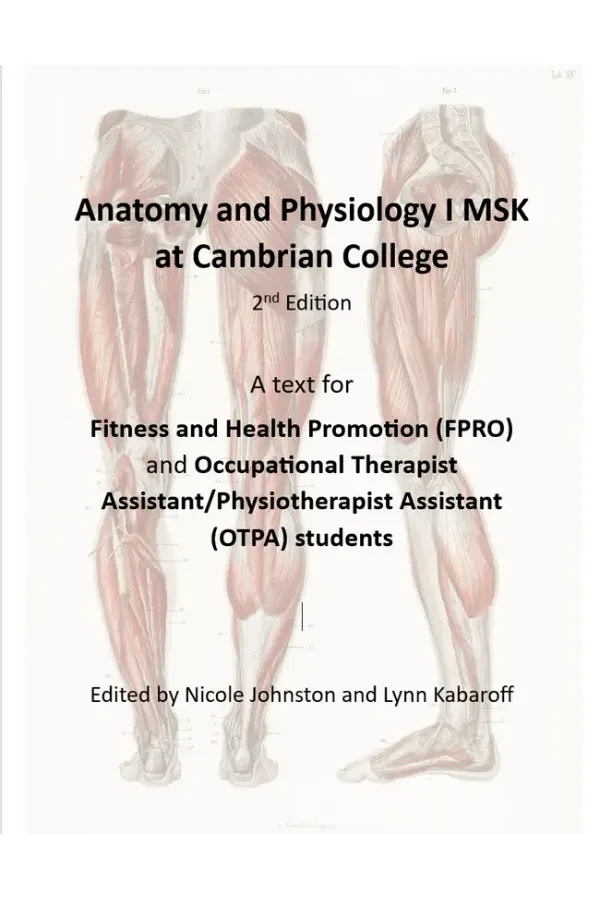
Anatomy and Physiology 1 MSK at Cambrian College
Not rated yetRate this bookAnatomy and Physiology I MSK at Cambrian College adapts OpenStax material for FPRO and OTPA students, concentrating on movement and the musculoskeletal and nervous systems. This guide follows the customized edition’s eight chapters and connects anatomical vocabulary with joint function, muscle action, and neural control.
Free reading is available at the official source. Opens in a new tab.
 Free
About this book
Anatomy and Physiology I MSK at Cambrian College adapts OpenStax material for FPRO and OTPA students, concentrating on movement and the musculoskeletal and nervous systems. This guide follows the customized edition’s eight chapters and connects anatomical vocabulary with joint function, muscle action, and neural control.
How to study this book
Use diagrams, models, and repeated retrieval practice rather than memorizing lists in isolation. Describe structures in anatomical position, distinguish left from right, and connect names with location and function. For each movement, identify the joint, direction, participating muscles, and relevant neural activity.
Chapter-wise explanations and study tasks
1. An Introduction to Movement
Anatomical terminology supplies a consistent reference for position, direction, planes, and movements. Everyday descriptions can become ambiguous when body position changes. Learn movement terms through specific joints and planes so that a description communicates exactly which segment moves and how.
Study task: Describe five ordinary movements using anatomical terminology and label the plane and participating joint for each.
2. An Introduction to Bones and Joints
Bone functions extend beyond support to protection, movement, and physiological roles. Classification and structure connect bone form with its tasks, while development explains change over time. Fibrous, cartilaginous, and synovial joints provide a structural framework for understanding different movement possibilities.
Study task: Compare the structure and functional implications of one fibrous, one cartilaginous, and one synovial joint, adding a labelled long-bone diagram.
3. Muscle Tissue
Muscle-tissue organization links microscopic structures with contraction and whole-muscle performance. Skeletal-muscle mechanisms, contraction types, and fibre differences explain how force can be produced during different activities. Distinguish muscle activation from a visible change in muscle length.
Study task: Explain an isometric, concentric, and eccentric action in a simple movement sequence, then relate each to force production rather than movement alone.
4. The Nervous System
Nervous tissue communicates through changes in membrane potential and interactions between cells. Basic organization provides the framework for understanding how information reaches and leaves the nervous system. Connect the action potential with neural function without equating it to a muscle contraction.
Study task: Draw a neuron, label the direction of information flow, and outline the main stages of an action potential in words.
5. The Axial Skeleton
The skull, vertebral column, and thoracic cage provide protection and a central framework for movement. Regional differences in shape reflect different mechanical and protective demands. Study articulations and landmarks in context rather than attempting to memorize an unconnected inventory.
Study task: Compare cervical, thoracic, and lumbar vertebral features and explain how their differences relate to regional function.
6. The Appendicular Skeleton
The pectoral and pelvic girdles connect the limbs to the axial skeleton in different ways. Upper- and lower-limb organization reflects different balances of mobility, stability, and load bearing. Follow bones and their articulations from girdle to digits on both sides of the body.
Study task: Produce labelled upper- and lower-limb diagrams and compare how the two girdles support their respective movement demands.
7. The Muscular System
Fascicle arrangement, attachments, and lever relationships help explain muscle action. Naming conventions can encode location, shape, attachments, or function. Study axial and appendicular muscles through actions and relationships rather than assuming that a muscle performs only one role in every task.
Study task: Choose a functional movement and identify its main muscles, relevant attachments, joint actions, and possible stabilizing roles.
8. Joints of the Body
Selected synovial joints bring movement terminology, bone anatomy, and soft-tissue structures together. Shape and supporting structures constrain possible motion and contribute to stability. Compare joints by their actual articulations and movements instead of relying solely on their classification name.
Study task: Compare shoulder, hip, and knee anatomy using a table of articulating bones, main movements, stabilizing structures, and mobility–stability considerations.
Applied assignment
Create an illustrated analysis of a sit-to-stand, reach, or step-up movement. Identify planes, bones, joints, muscle actions, and nervous-system contributions. Include one microscopic explanation of force or signalling and one comparison of joint stability, using the source’s terminology.
Suggested reading plan
Study chapters 1–2 for terminology and structural foundations, 3–4 for muscle and nervous tissue, 5–6 for regional bones, and 7–8 for integrated muscles and joints. Revisit diagrams without labels at the end of every block and correct them against the source.
Questions for reflection
- How does structure limit or permit a particular movement?
- Why can an activated muscle produce force without shortening?
- Which anatomical details explain a joint’s balance of mobility and stability?
Edition and source notes
Based on the linked 2024 Cambrian adaptation by Nicole Johnston and Lynn Kabaroff of OpenStax Anatomy and Physiology 2e. It contains eight customized chapters rather than all 28 chapters of the parent textbook. These are study activities about anatomy and physiology, not clinical assessment or treatment instructions.
About access & copyright
This page provides book information and study material. Full-text access is provided by the original publisher or authorised source; a listing does not grant permission to republish the book.
Read our Library Access & Copyright policyExplore the contents
Check the chapters covered in this edition.
Visit the official source
See reading, preview or purchase options.
Save for later
Keep this textbook in your saved collection.
Reader ratings & reviews
Share your thoughts
Your review helps other students choose the right resources.
KEEP LEARNING
Your next great read
alopecia, hair loss, alopecia areata, hair follicle, depression, pathogenesis
 Complex analysis
Mathematical Methods for Physics
View Mathematical Methods for Physics — book Biophysics
Principles of Development : An Inquisitive Journey into Embryology
View Principles of Development : An Inquisitive Journey into Embryology — book Communication écrite
Le Littéraire dans le quotidien : Resources for a transdisciplinary approach to reading/writing at the first and second year levels of college French
View Le Littéraire dans le quotidien : Resources for a transdisciplinary approach to reading/writing at the first and second year levels of college French — book Operations Management
View Operations Management — book Communication
Advanced professional communication : A principled approach to workplace writing
View Advanced professional communication : A principled approach to workplace writing — book Early Childhood Education
Children's learning through play
View Children's learning through play — book Budgeting and financial management
Financial Empowerment (2nd Edition)
View Financial Empowerment (2nd Edition) — book Conflict management
Navigating HR : The art of problem-solving and conflict resolution
View Navigating HR : The art of problem-solving and conflict resolution — book Algebra



