
First Amendment: Cases, Controversies, and Contexts
ReligionTextbook
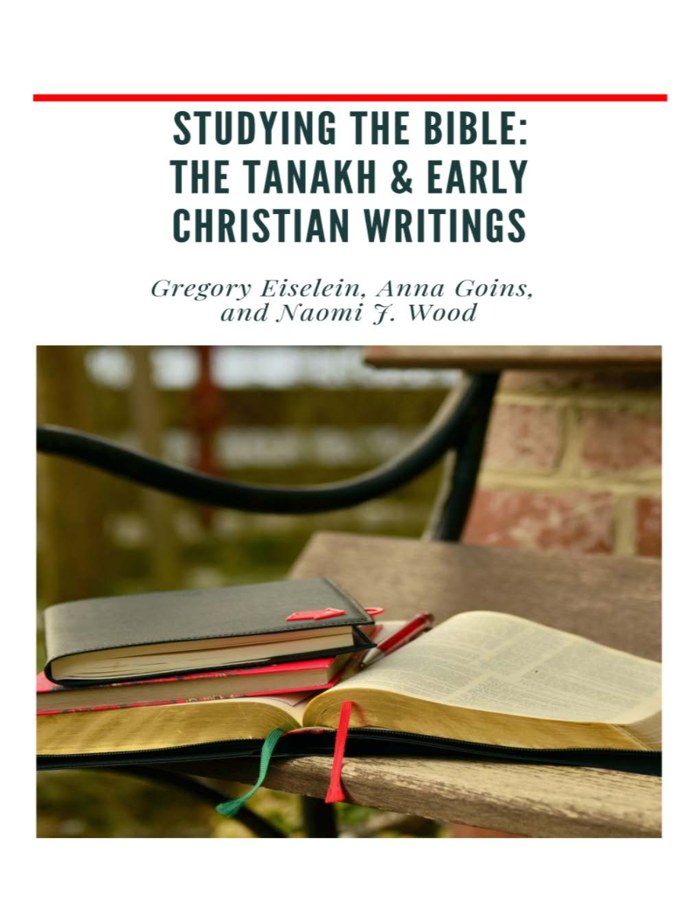
Studying the Bible: The Tanakh and Early Christian Writings
Not rated yetRate this bookAbout this book Gregory Eiselein, Anna Goins, and Naomi J. Wood introduce the Bible as a collection of writings with varied literary forms, histories, and interpretive traditions. The 2019 textbook…
Read on the publisher’s website. Opens in a new tab.
 Free
About this book
About this book
Gregory Eiselein, Anna Goins, and Naomi J. Wood introduce the Bible as a collection of writings with varied literary forms, histories, and interpretive traditions. The 2019 textbook is organized into an introductory section, six chapters on the Hebrew Bible and related literature, and four chapters on early Christian writings. Its university literature-course perspective asks how narratives, laws, poetry, prophecy, visions, and letters produce meaning in context. This guide follows all twelve chapters of the complete 190-page PDF. It supports academic reading without assuming that all readers share a religious commitment or that historical-literary analysis settles questions of faith.
Use the chapter guide and study instructions below alongside the complete text. Attempt the suggested practice independently, check your reasoning against the source, and revisit topics identified by the reflection questions.
Cover: original author or publisher material for book identification. Book details and source.
Book summary
Chapter-by-chapter study guide
Chapter 1: The Bible and Literature
The opening chapter explains why the Bible is studied in a literature department and why defining the Bible requires attention to different collections and traditions. Literary form affects interpretation: a poem, legal passage, narrative, and letter make meaning in different ways. Begin by identifying the text, its genre, and the question being asked. Distinguish what a narrator says, what a character says, and what an interpreter concludes from the passage.
Chapter 2: Composition, Editing, and Transmission
The chapter introduces the long processes through which writings were composed, collected, edited, transmitted, translated, and recognized within canons. A modern printed Bible is the result of those histories rather than a transparent view of a single moment of authorship. Build a diagram separating composition, manuscript transmission, translation, and canon formation. When comparing versions, identify the actual difference before proposing whether it reflects wording, interpretation, selection, or arrangement.
Chapter 3: The Torah
The five books of the Torah establish recurring themes involving creation, ancestry, covenant, law, departure, wilderness, and community. The chapter connects narrative with instruction and introduces scholarly questions about compilation. Track how a theme develops across more than one episode instead of reducing a book to a single lesson. Compare the role of repetition, genealogies, speeches, and legal material, and ask how each shapes the community represented by the text.
Chapter 4: The Former Prophets
Joshua, Judges, Samuel, and Kings form a broad narrative about land, leadership, monarchy, division, and catastrophe. The chapter examines the relationship between storytelling and interpretations of Israel’s national past. Distinguish narrative sequence from independent historical reconstruction. For one ruler or episode, identify the criteria by which the narrative evaluates conduct, the voices it includes, and tensions between political achievement and the theological or ethical judgments presented.
Chapter 5: The Latter Prophets
The prophetic books shift attention toward collections of oracles and carefully shaped written messages. The chapter examines their composition, literary features, historical pressures, and themes of judgment and restoration. Identify the addressee, imagery, accusation, and hoped-for response in a selected passage. Avoid assuming that prophecy is only prediction; analyze how the text addresses its audience’s conduct and circumstances and how editorial arrangement contributes to its meaning.
Chapter 6: The Writings
The Writings include diverse genres such as poetry, wisdom, narratives, and reflections that do not speak with one uniform voice. The chapter makes this diversity central to interpretation. Compare a proverb with a passage that questions easy explanations of suffering or prosperity. Ask what each form can express and what assumptions it challenges. A productive reading preserves differences among texts rather than forcing every passage into an identical philosophical position.
Chapter 7: Apocalypse
Apocalyptic literature uses visions, symbolic imagery, cosmic conflict, and disclosure to address questions of history and judgment. The chapter connects biblical and related examples across traditions, including Revelation. Describe the narrative situation and symbolic patterns before assigning a modern referent to an image. Consider how a vision can speak to a community experiencing uncertainty or oppression. Genre and historical setting help explain its force without requiring speculative predictions about present events.
Chapter 8: Apocrypha and Post-Exilic Literature
The chapter examines writings whose place differs among Jewish and Christian collections and introduces the settings in which they circulated. Canonical status depends on tradition and historical process; the term apocryphal should not be used as a shortcut for literary worth or historical reliability. Compare the treatment of one work in two traditions, then examine its themes and genre on their own terms. This separates collection history from interpretation of the actual writing.
Chapter 9: The Gospels
The chapter compares the Synoptic Gospels and John as distinctive narrative accounts of Jesus. Shared episodes and differences in wording, arrangement, and emphasis invite close comparison rather than automatic harmonization. Read one episode in parallel columns and record what each account includes, omits, or changes. Then ask how those choices affect characterization, audience expectations, and larger narrative themes. A difference is evidence to investigate, not an inconvenience to erase before analysis begins.
Chapter 10: Acts of the Apostles
Acts continues the narrative associated with Luke and follows the development and geographic expansion of early Christian communities. The chapter emphasizes plot, characters, speeches, and movement, including Paul’s role. Map the narrative’s journeys alongside changes in audience and conflict. Distinguish the account’s literary organization from a claim that it records every early Christian experience. Explain how an episode contributes to the book’s broader presentation of community and mission.
Chapter 11: The Pauline Letters
Letters associated with Paul address particular communities and questions while contributing to later Christian thought. The chapter encourages attention to correspondence as a form shaped by occasion, audience, argument, and persuasion. Identify the problem a letter appears to address and trace how its reasoning responds. Avoid reading an isolated sentence as though it were written without a recipient or situation, and distinguish the text’s immediate argument from its later interpretive history.
Chapter 12: The General Letters
The final chapter examines letters and related writings associated with a broader readership and diverse early Christian concerns. Questions of authorship, communal identity, conduct, endurance, and authority require attention to each work’s form and setting. Compare two texts by their implied audience and rhetorical purpose rather than assuming they make the same argument. Use the chapter to consolidate the distinction between naming a collection and understanding the individual writings within it.
Timeline and Integration
The supporting chronology helps readers relate texts, empires, communities, and interpretive developments. Use it as an orientation and keep uncertain dates visibly uncertain. An integrative essay can trace one theme across a Torah narrative, prophetic passage, wisdom text, Gospel episode, and letter. Explain the differences in genre and context before drawing connections, and make clear when a claim concerns the ancient text, a scholarly reconstruction, or a later reader’s interpretation.
Study instructions
Read the assigned biblical passages alongside each textbook chapter rather than relying on the guide as a substitute. Keep a reading journal with four fields: textual observation, literary technique, contextual question, and interpretation supported by evidence. Record book, chapter, verse, and translation for quotations. Compare short passages before comparing whole traditions, and avoid treating a selected passage as representative of every Jewish or Christian interpretation. Use parallel readings for the Gospels and a thematic index for recurring ideas such as covenant, wisdom, justice, exile, or community. Answer the chapter’s discussion questions using specific details, then test an alternative reading. Finish with a short comparative essay that states its method, respects differences among genres and canons, and distinguishes evidence from personal conviction. Use the source’s bibliography and notes to pursue historical questions that the introductory chapters cannot settle fully.
Questions for reflection
- How does genre change what a reader should ask of a passage?
- What is the difference between composition, transmission, translation, and canon formation?
- Why should Gospel differences be examined before harmonizing accounts?
- How can an interpretation acknowledge religious significance while remaining academically evidence-based?
Sources and coverage
Coverage follows all twelve chapters, the timeline, and supporting material in the complete 2019 text. Literary and historical interpretations are presented as subjects of inquiry, not as judgments about a reader’s religious commitments.
This is an AI-assisted original, condensed study guide based on the source contents, chapter introductions, and selected explanations, examples, and review activities. It is not a page-by-page substitute for the book, and no human or expert review is claimed.
About access & copyright
This page provides book information and study material. Full-text access is provided by the original publisher or authorised source; a listing does not grant permission to republish the book.
Read our Library Access & Copyright policyExplore the contents
Check the chapters covered in this edition.
Visit the official source
See reading, preview or purchase options.
Save for later
Keep this textbook in your saved collection.
Reader ratings & reviews
Share your thoughts
Your review helps other students choose the right resources.
KEEP LEARNING
Your next great read
Administrative Law
Applied Developmental Systems Science: Everything You Always Wanted to Know About Theories, Meta-Theories, Methods, and Interventions but Didn’t Realize You Needed to Ask. An Advanced Textbook
Applied Developmental Systems Science: Everything You Always Wanted to Know About Theories, Meta-Theories, Methods, and Interventions but Didn't Realize You Needed to Ask. An Advanced Textbook
View Applied Developmental Systems Science: Everything You Always Wanted to Know About Theories, Meta-Theories, Methods, and Interventions but Didn't Realize You Needed to Ask. An Advanced Textbook — bookInternational Relations
International Relations
View International Relations — bookIntermediate Biblical Greek Reader: Galatians and Related Texts
Intermediate Biblical Greek Reader: Galatians and Related Texts
View Intermediate Biblical Greek Reader: Galatians and Related Texts — book Humanities
Theological Questions
View Theological Questions — bookThe Process of Research Writing
The Process of Research Writing
View The Process of Research Writing — bookCommunication in the Real World – An Introduction to Communication Studies
Communication in the Real World - An Introduction to Communication Studies
View Communication in the Real World - An Introduction to Communication Studies — bookFundamentals of Business
Fundamentals of Business
View Fundamentals of Business — bookSales and Leases: A Problem-based Approach
Sales and Leases: A Problem-based Approach
View Sales and Leases: A Problem-based Approach — bookTorts: Cases, Principles, and Institutions



