
Reading for Academic Success – An OER Textbook for Reading 7
HumanitiesTextbook
Intermediate Biblical Greek Reader: Galatians and Related Texts
Not rated yetRate this bookIntermediate Biblical Greek Reader: Galatians and Related Texts, edited by Nijay K. Gupta and Jonah M. Sandford, develops reading after introductory Greek. The 2018 reader contains twenty-one lessons: fifteen work through Galatians, followed by textual criticism, related Septuagint passages, James, Chrysostom, and Marcion. English explanations support Greek texts through syntax, morphology, vocabulary, and interpretive questions. The imported PDF link led to an unrelated publishing brochure; this guide uses the actual reader. Parse before consulting helps, and distinguish a grammatical observation from a theological conclusion that requires further argument.
Read on the publisher’s website. Opens in a new tab.
 Free
About this book
Intermediate Biblical Greek Reader: Galatians and Related Texts, edited by Nijay K. Gupta and Jonah M. Sandford, develops reading after introductory Greek. The 2018 reader contains twenty-one lessons: fifteen work through Galatians, followed by textual criticism, related Septuagint passages, James, Chrysostom, and Marcion. English explanations support Greek texts through syntax, morphology, vocabulary, and interpretive questions. The imported PDF link led to an unrelated publishing brochure; this guide uses the actual reader. Parse before consulting helps, and distinguish a grammatical observation from a theological conclusion that requires further argument.
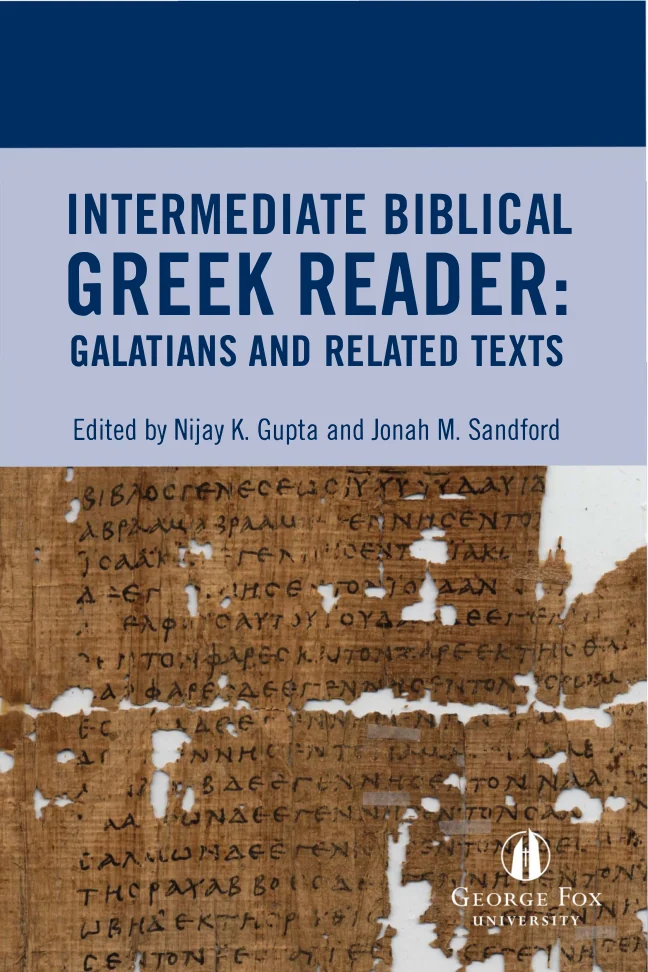
Cover: source-edition cover, displayed to identify the linked book. Publisher and third-party rights remain with their respective holders.
Book summary
Intermediate Biblical Greek Reader: Galatians and Related Texts, edited by Nijay K. Gupta and Jonah M. Sandford, develops reading after introductory Greek. The 2018 reader contains twenty-one lessons: fifteen work through Galatians, followed by textual criticism, related Septuagint passages, James, Chrysostom, and Marcion. English explanations support Greek texts through syntax, morphology, vocabulary, and interpretive questions. The imported PDF link led to an unrelated publishing brochure; this guide uses the actual reader. Parse before consulting helps, and distinguish a grammatical observation from a theological conclusion that requires further argument.
Chapter-by-chapter summaries
1. Galatians 1:1–9
The opening connects Paul’s identification and greeting with a sharp response to an alternative proclamation. Identify the main clauses and the relationships expressed by modifying phrases. Distinguish the text’s claim about authority from the translator’s own endorsement. Follow changes in tone and addressee rather than treating each sentence as an isolated exercise. The lesson introduces the reader’s note system while encouraging a first attempt at the Greek before using assistance.
2. Galatians 1:10–17
Paul’s account of the origin of his message and calling provides practice in narrative, contrast, and reported purpose. Trace the finite verbs and temporal relationships before producing fluent English. A familiar account can tempt a reader to supply meaning from memory. Use grammatical evidence to decide what is asserted, denied, or contrasted. Compare lexical alternatives in context and distinguish what the passage states from later historical reconstruction.
3. Galatians 1:18–24
Visits, contacts, and reports continue the autobiographical argument. Mark time expressions and identify who knows or reports each event. Pronouns require clear antecedents, particularly where people’s direct knowledge differs from what they have heard. The lesson links chronological reading with rhetorical purpose. Construct a simple sequence from the Greek, then explain how that sequence supports Paul’s surrounding argument without adding unstated details.
4. Galatians 2:1–10
The Jerusalem meeting introduces reported interactions, recognition, and disputed expectations. Map participants and distinguish Paul’s narration from claims attributed to others. Long clauses require careful attachment of participles and modifiers. Identify the grammatical basis for each relationship before translating institutional or theological significance. Compare an initial literal analysis with polished English, checking that qualifications and contrasts survive. The passage develops both syntactic endurance and awareness of how narrative supports argument.
5. Galatians 2:11–21
The confrontation and ensuing reasoning connect narrative with claims about justification, faith, law, and Christ. Track where speech or argumentative voice shifts. Important expressions admit interpretive discussion, so a translation should not conceal a debated grammatical choice as obvious. Compare possible relationships among key nouns and modifiers and explain the evidence for your decision. Distinguish parsing from exegesis: identifying a form narrows possibilities without settling every larger theological question.
6. Galatians 3:1–9
Questions about experience lead into Abraham and scriptural argument. Identify rhetorical questions, contrasts, and the relationships between quoted and surrounding material. A key term’s meaning must be tested in this context rather than imported unchanged from another passage. Map the argument’s sequence from experience to scriptural example. The lesson encourages readers to explain why a connective matters and how individual grammatical decisions affect the perceived relationship between faith, blessing, and participation.
7. Galatians 3:10–18
Law, curse, promise, and covenant are developed through quotations and logical connections. Separate the cited wording from Paul’s use of it. Track conditions, negation, and temporal reasoning carefully. A prooftext’s role in an argument is not identical to its function in its earlier context. The lesson prepares for later Septuagint comparisons by making quotation and intertextual language visible. Record ambiguities rather than resolving them solely through a familiar doctrinal summary.
8. Galatians 3:19–29
The passage asks about the law’s role and develops images of custody, promise, and shared identity. Identify questions and their proposed answers before translating the whole paragraph. Metaphorical terms may not fit the first modern equivalent offered by a dictionary. Compare a narrowly literal rendering with one explaining the image, marking what interpretation each adds. Syntax, argument, and historical vocabulary must cooperate to justify a translation rather than letting one familiar phrase dominate the entire passage.
9. Galatians 4:1–11
Heirship, minority, guardianship, adoption, and a warning about returning to former practices extend the argument through analogy. Identify where the illustration changes into direct address. Track temporal clauses and the perspective of each participant. Terms describing elemental or former powers require contextual examination rather than an assumed single meaning. Explain how the analogy functions, while keeping its legal or household imagery distinct from a claim that every detail maps mechanically onto the theological argument.
10. Galatians 4:12–20
Personal appeal, recollection, and images of attachment interrupt a purely abstract reading of the letter. Identify shifts in address, emotion, and stated desire. Compare the contribution of tense and aspect with the passage’s rhetorical setting rather than assigning emotion to a verb form alone. The lesson develops sensitivity to register and discourse. A translation should retain the personal relationships that give the appeal its force without adding psychological certainty the wording does not establish.
11. Galatians 4:21–31
The reading develops an interpretive comparison involving Hagar, Sarah, and communities identified through the argument. Distinguish quoted material, narrative reference, and Paul’s allegorical use. Map corresponding elements before judging the comparison. Grammatical precision does not require endorsing the interpretive method, but it does require representing it accurately. The lesson encourages readers to explain how the passage constructs relationships rather than flattening a complex comparison into a general statement about freedom.
12. Galatians 5:1–15
Freedom, circumcision, obligation, faith, love, and community responsibility form a tightly connected exhortation. Identify imperatives and the grounds offered for them. Conditional and contrastive relationships affect how the warning is understood. Compare different uses of a recurring term within the argument rather than assuming one English gloss always works. The lesson links clause-level decisions with the passage’s movement from a disputed practice to obligations toward neighbours.
13. Galatians 5:16–26
The contrast between flesh and Spirit leads into descriptions of conduct and communal life. Classify grammatical forms before deciding how lists and exhortations connect. A lexical contrast may carry meanings broader than a modern physical-versus-spiritual opposition. Track agency and the relationship between instruction and description. The reading shows why lists still require syntactic and rhetorical analysis: translating each item separately can miss the argument organizing them.
14. Galatians 6:1–10
Restoration, burdens, self-examination, sharing, and sowing-and-reaping images bring argument into community practice. Identify changes between singular and plural address and the relationships among instructions. Compare repeated terms in nearby sentences before assuming a contradiction or identical meaning. The lesson develops attention to how an exhortation distributes responsibility. Its discussion of bearing burdens also prepares the later encounter with Chrysostom’s reception of this passage.
15. Galatians 6:11–18
The closing section revisits disputed practices, the cross, and new creation within a personal conclusion. Identify emphasis and the connections between warning, contrast, and blessing. Compare the close with the letter’s opening to understand thematic coherence. Do not let familiarity with a concluding formula obscure its grammatical structure. Finishing the entire letter allows a cumulative reading in which earlier lexical and syntactic decisions can be revisited against the whole argument.
16. Introduction to textual criticism
Textual criticism evaluates variation among witnesses rather than assuming every printed wording has an identical transmission history. Distinguish evidence about manuscripts from interpretation of the selected text. External and internal considerations require reasoned comparison, not a rule that the oldest or shortest reading must always win. The lesson introduces a method and vocabulary for responsible uncertainty. Record what a variant changes grammatically or semantically before claiming that it transforms an entire argument.
17. Septuagint Genesis 12:1–3 and Leviticus 18:1–5
These readings supply fuller contexts for passages associated with Galatians. Compare wording, syntax, and argumentative use across texts. A shared term does not prove that every contextual meaning is carried unchanged into a quotation. Work from each passage’s local structure before drawing intertextual conclusions. The lesson broadens reading beyond one author while retaining a coherent relationship with the letter already studied.
18. Septuagint Habakkuk 2:1–5 and Psalm 142:1–6
Further scriptural readings develop comparison of vocabulary and claims invoked in Pauline discussion. Use the source’s Septuagint numbering when locating the psalm. Identify the speaker, setting, and clause relationships in each passage. Then compare the function of related language in Galatians. Intertextual reading becomes stronger when both resemblance and difference are recorded rather than treating every repeated word as evidence of the same proposition.
19. James 2:14–24
Shared language concerning faith, works, justification, and Abraham creates an instructive comparison with Galatians. Identify the question James addresses and the meaning of terms within that argument. Similar vocabulary does not establish either agreement or contradiction automatically. Compare rhetorical questions and examples before drawing a theological conclusion. The lesson extends reading skill while demonstrating why context and discourse matter as much as recognition of familiar individual words.
20. Chrysostom on Galatians 6:2
A patristic commentary introduces a later writer’s style and reception of the letter. Separate Chrysostom’s explanation from the wording he interprets. The change in genre and period requires renewed attention to syntax and vocabulary rather than assuming New Testament habits transfer without adjustment. Compare the commentary with your own earlier analysis of bearing burdens. This makes reception a subject of evidence and interpretation, not merely a later paraphrase of an unchanged meaning.
21. Marcion’s redaction of Galatians
The final lesson examines editing and reconstruction through historical witnesses, including opponents’ accounts. Distinguish an extant text from a reconstruction dependent on indirect evidence. A reported omission or alteration needs a source and an argument about reliability. The lesson differs from ordinary translation practice and reinforces caution about certainty. Compare what the evidence establishes, what is probable, and what remains disputed, keeping historical inference separate from assumptions about motive.
Study instructions
- Attempt each passage without helps, then annotate syntax, morphology, lexical decisions, and remaining uncertainty.
- Maintain a recurring-vocabulary record that includes contextual differences rather than one fixed gloss.
- Use the glossary to resolve specific questions and write a reasoned explanation of each major translation choice.
- After Galatians, compare related readings by local context, shared wording, genre, and later interpretive use.
Questions for reflection
- When does parsing constrain but not settle interpretation?
- How can identical vocabulary serve different arguments?
- What distinguishes a manuscript reading from a reconstruction through later witnesses?
Sources and coverage
This original reading guide follows the linked source edition’s chapter, module, unit, or lesson structure. Consult the source for full arguments, cases, worked examples, exercises, illustrations, and references. 2018 reader edited by Nijay K. Gupta and Jonah M. Sandford. The instructional language is English. The correct complete PDF replaces an unrelated publishing brochure. Read the source edition.
About access & copyright
This page provides book information and study material. Full-text access is provided by the original publisher or authorised source; a listing does not grant permission to republish the book.
Read our Library Access & Copyright policyExplore the contents
Check the chapters covered in this edition.
Visit the official source
See reading, preview or purchase options.
Save for later
Keep this textbook in your saved collection.
Reader ratings & reviews
Share your thoughts
Your review helps other students choose the right resources.
KEEP LEARNING
Your next great read
Languages
Empowering Learners of Spanish
Empowering Learners of Spanish
View Empowering Learners of Spanish — bookEthical Explorations: Moral Dilemmas in a Universe of Possibilities
Ethical Explorations: Moral Dilemmas in a Universe of Possibilities
View Ethical Explorations: Moral Dilemmas in a Universe of Possibilities — bookA Foundation Course in Reading German
A Foundation Course in Reading German
View A Foundation Course in Reading German — book Languages
Beginning Japanese for Professionals II
View Beginning Japanese for Professionals II — book Languages
Studying and Living in the US, Low-Intermediate Novel and Textbook for University ESL Students
View Studying and Living in the US, Low-Intermediate Novel and Textbook for University ESL Students — book Humanities
Introduction to Humanities
View Introduction to Humanities — book Languages
Speaking, Listening and Pronunciation Projects for ELLs - Intermediate Level
View Speaking, Listening and Pronunciation Projects for ELLs - Intermediate Level — book Chinese
Learning Chinese: A Foundation Course in Mandarin
View Learning Chinese: A Foundation Course in Mandarin — book Cognitive Science



