
Advanced Spanish Language and Composition
HumanitiesTextbook
The Process of Research Writing
Not rated yetRate this bookSteven D. Krause’s The Process of Research Writing presents research as inquiry that develops through writing and revision. Twelve chapters connect critical reading, source discovery, responsible source use, collaboration, a working thesis, and several exercises that lead toward a sustained research project. The distinctive feature is the relationship among the assignments: an annotated bibliography, critique, antithesis, and categorization each help the writer discover something the final essay needs. This guide follows the Spring 2007 online edition. Search interfaces and citation examples belong to that period; use current course requirements for formatting.
Read on the publisher’s website. Opens in a new tab.
 Free
About this book
Steven D. Krause’s The Process of Research Writing presents research as inquiry that develops through writing and revision. Twelve chapters connect critical reading, source discovery, responsible source use, collaboration, a working thesis, and several exercises that lead toward a sustained research project. The distinctive feature is the relationship among the assignments: an annotated bibliography, critique, antithesis, and categorization each help the writer discover something the final essay needs. This guide follows the Spring 2007 online edition. Search interfaces and citation examples belong to that period; use current course requirements for formatting.
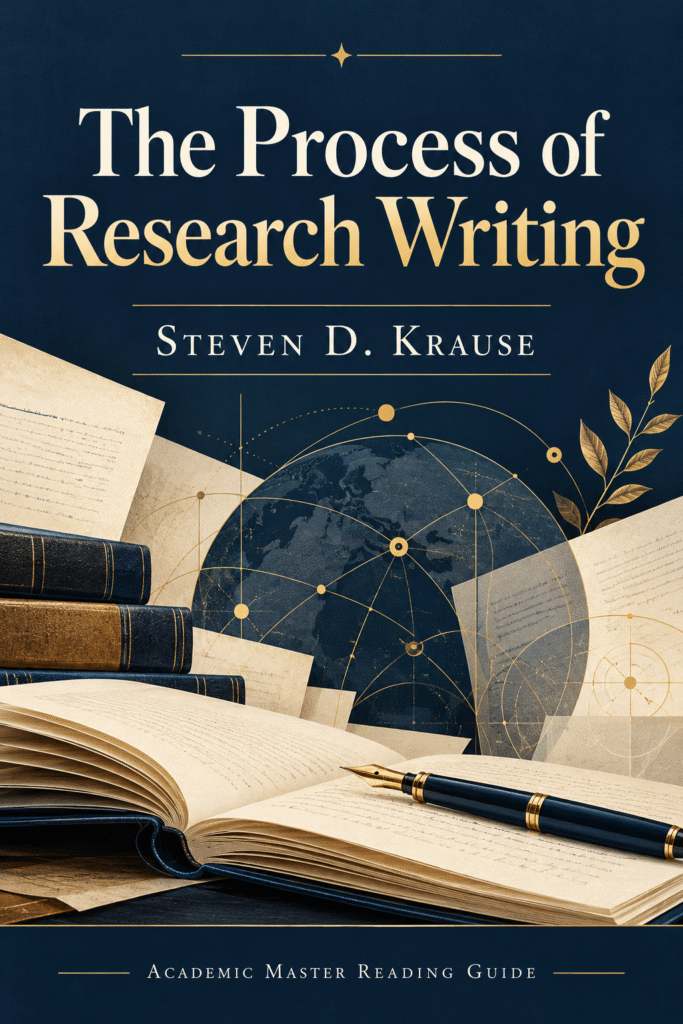
Cover: original Academic Master reading-guide design. The linked textbook remains the source edition described above.
Book summary
Steven D. Krause’s The Process of Research Writing presents research as inquiry that develops through writing and revision. Twelve chapters connect critical reading, source discovery, responsible source use, collaboration, a working thesis, and several exercises that lead toward a sustained research project. The distinctive feature is the relationship among the assignments: an annotated bibliography, critique, antithesis, and categorization each help the writer discover something the final essay needs. This guide follows the Spring 2007 online edition. Search interfaces and citation examples belong to that period; use current course requirements for formatting.
Chapter-by-chapter summaries
1. Thinking Critically About Research
Research is more than collecting facts to decorate an answer already chosen. Critical thinking involves asking what evidence supports a claim, what alternatives exist, and how assumptions influence interpretation. Writing participates in this inquiry because explaining a point exposes gaps and contradictions. Start with a question and record what evidence could change your initial answer. A project becomes stronger when revision responds to what is learned rather than merely polishing the language of an unchanged opinion.
2. Understanding and Using the Library and the Internet
Catalogs, indexes, databases, reference sources, and web searching provide different routes into a topic. Finding an item and establishing its usefulness are separate tasks. Krause’s discussion encourages a search strategy that fits the kind of evidence needed. Identify whether the question calls for scholarship, primary records, data, or a contemporary public discussion. Keep a record of productive terms and related sources. The edition’s named services may have changed, but matching a discovery method to a research need remains essential.
3. Quoting, Paraphrasing, and Avoiding Plagiarism
Quotation preserves exact wording, paraphrase restates a passage in a new structure, and summary condenses its main ideas. Each needs acknowledgment and a clear purpose in the writer’s discussion. Replacing a few words is not adequate paraphrase. Read a passage, set it aside, explain its meaning independently, and compare the result for accuracy. In notes, visibly distinguish exact quotation from your own response. These habits prevent confusion later and help readers see where the source’s contribution ends and your analysis begins.
4. How to Collaborate and Write with Others
Peer review and shared projects work best when participants understand their roles and the kind of response required. Useful feedback describes a reading problem and explains its importance, rather than simply rewriting someone else’s sentences. Ask a peer to identify the thesis and the least supported inference. In joint writing, establish responsibilities, deadlines, and a way to resolve disagreements. Collaboration becomes a method of inquiry when different readers reveal assumptions the original writer cannot easily see.
5. The Working Thesis Exercise
A working thesis gives research a provisional direction. Topic selection, brainstorming, and exploratory searching turn a broad interest into a manageable claim. The claim should remain open to qualification or replacement as evidence accumulates. Draft a thesis alongside the questions it leaves unresolved, and return to both after each important source. A useful revision explains what changed and why. This makes the working thesis a tool for learning rather than a promise to defend an initial idea regardless of what research reveals.
6. The Annotated Bibliography Exercise
Annotations combine source identification, explanation, and evaluation. They help a writer remember an argument, assess its evidence, and determine its role in the project. A list of enough sources does not establish that the relevant conversation has been understood. Compare several annotations to locate agreement, disagreement, repeated coverage, and gaps. State both what a source says and how it may be used. That distinction prepares the writer to synthesize sources instead of assembling disconnected summaries.
7. The Critique Exercise
Critique evaluates a text through explicit criteria and close reading. It is neither automatic criticism nor a statement of whether the reader likes the conclusion. Identify the purpose, audience, reasoning, evidence, and assumptions before judging success. Support an evaluation with a specific feature of the text, and explain why the criterion is appropriate. Keeping summary separate from judgment lets a reader assess the critique fairly. The exercise also improves later source selection by making standards of credibility and usefulness visible.
8. The Antithesis Exercise
The antithesis tests a working position against serious opposition. A strong counterargument represents an informed alternative rather than a weak objection designed for easy dismissal. Identify the best challenge to the thesis and investigate its support. The response may require rebuttal, concession, qualification, or a revised claim. Krause emphasizes that not every reader can be convinced. The educational goal is a defensible account of disagreement and a stronger argument with acknowledged limits, not the illusion that an essay can settle every dispute.
9. The Categorization and Evaluation Exercise
Grouping research reveals relationships that a pile of notes may conceal. Categories can organize evidence by explanation, method, position, implication, or another relevant distinction. Try two schemes for the same material and compare what each reveals. Explain why a source belongs in a category and preserve exceptions. The exercise helps revise the thesis and plan the eventual essay. Categories should serve the emerging argument rather than force complex sources into convenient boxes that erase disagreement.
10. The Research Essay
The research essay integrates inquiry, a focused claim, evidence, analysis, opposition, and documentation. Organizing around the reader’s questions is more effective than assigning one paragraph to each source. Check whether every important inference has support and whether that support is interpreted. Background should prepare the argument without overwhelming it. A conclusion develops the significance of what has been established. Drafting may reveal a need to research again, demonstrating that the process is recursive rather than a rigid sequence completed only once.
11. Alternative Ways to Present Research
Portfolios, research narratives, web projects, and posters communicate findings through different arrangements. A new medium changes the audience’s route through the material and the role of images, links, and oral explanation. Choose a format by specifying what the audience needs to understand and how it will encounter the work. Preserve access to evidence even when the presentation is brief. The technical examples are dated, but the central lesson remains useful: presentation choices should follow purpose rather than technology for its own sake.
12. Citing Research Using MLA or APA
Documentation identifies borrowed words and ideas and lets readers retrieve the evidence. Parenthetical references and source lists are connected parts of that system. Audit a draft by tracing each borrowed contribution to an identifiable source, then checking that the reference list matches the text. Krause’s abbreviated style examples explain the function of citation but reflect 2007 conventions. Apply the current MLA or APA edition specified by the instructor when formatting a present assignment.
Study instructions
- Maintain a log of the question, working thesis, searches, source decisions, and reasons for changing direction.
- Complete the bibliography, critique, antithesis, and categorization exercises on one topic so that each produces material for the final project.
- Record exact wording and publication details while taking notes; keep your interpretation in a separate field.
- Ask a peer to explain your argument back to you, then revise where their reading differs from your intention.
- Finish with an evidence audit and current-style citation check after revising the reasoning.
Questions for reflection
- What evidence would make you change the thesis?
- How does an annotation differ from a source summary?
- When does opposition require qualification rather than rebuttal?
- What must change when an essay becomes a poster?
Sources and coverage
This original study guide covers all main chapters of the linked edition, or all instructional sections where the work has no numbered chapters. The explanations and suggested practice are written for study; consult the full source for cases, worked examples, illustrations, exercises, and references. Spring 2007 edition; use current course-specified citation manuals and software guidance. Read the source edition.
About access & copyright
This page provides book information and study material. Full-text access is provided by the original publisher or authorised source; a listing does not grant permission to republish the book.
Read our Library Access & Copyright policyExplore the contents
Check the chapters covered in this edition.
Visit the official source
See reading, preview or purchase options.
Save for later
Keep this textbook in your saved collection.
Reader ratings & reviews
Share your thoughts
Your review helps other students choose the right resources.
KEEP LEARNING
Your next great read
Humanities
Annotated and Translated Odyssey with Undergraduate Critical Introduction and Activities
Annotated and Translated Odyssey with Undergraduate Critical Introduction and Activities
View Annotated and Translated Odyssey with Undergraduate Critical Introduction and Activities — bookENGL 3330: Approaches to Literature
ENGL 3330: Approaches to Literature
View ENGL 3330: Approaches to Literature — bookPHIL 300: Introduction to Philosophy
PHIL 300: Introduction to Philosophy
View PHIL 300: Introduction to Philosophy — book Humanities
ENGL 95S Corequisite
View ENGL 95S Corequisite — bookLIBR 318: Library Research and Information Literacy
LIBR 318: Library Research and Information Literacy
View LIBR 318: Library Research and Information Literacy — bookReadings on Roman Men and Women
Readings on Roman Men and Women
View Readings on Roman Men and Women — bookBad Ideas About Writing
Bad Ideas About Writing
View Bad Ideas About Writing — bookDevelopmental Reading
Developmental Reading
View Developmental Reading — book Humanities



