
Digging into Archaeology: A Brief OER Introduction to Archaeology with Activities
Curriculum & InstructionTextbook
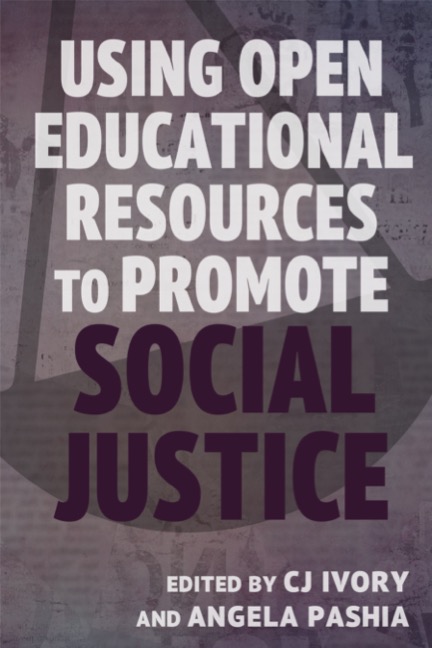
Using Open Educational Resources to Promote Social Justice
Not rated yetRate this bookThis edited collection considers how open educational resources can support social justice beyond reducing textbook costs. Its introduction connects openness with authorship, curriculum, representation, and institutional practice.
Free reading is available at the official source. Opens in a new tab.
 Free
About this book
About this book
Using Open Educational Resources to Promote Social Justice examines the promise and limits of openness through sixteen contributions. The collection moves from copyright and curriculum questions to teaching cases, experiences in the Global South, institutional policy, and platform design. It repeatedly distinguishes removing a price barrier from achieving representation, participation, and justice. This guide follows every chapter in the reviewed ACRL edition. Contributors retain different contexts and approaches, so their examples should be compared rather than treated as one universally tested intervention. Readers can use the collection to ask who creates knowledge, who is visible in it, and what conditions make meaningful reuse possible.
The detailed guide below follows the book’s chapter, unit, or section structure. Read it alongside the study instructions and the complete official text.
Book summary
Chapter-by-chapter summaries
Chapter 1: The unrealized promise of OER
The opening chapter examines definitions and the aspirations of the open movement in relation to systems such as copyright, academia, and scholarly communication. Open availability can remove an important barrier while leaving other structures intact. The author asks where the promise of broader participation falls short. Readers should distinguish permission, practical access, and the power to contribute. This creates a critical foundation for the collection: an open license is a tool whose effects depend on the institutions and practices around it, not a guarantee that the resulting educational experience is just.
Chapter 2: Repairing the curriculum
The curriculum communicates which knowledge and ways of thinking an institution values. This chapter considers how OER can help address gaps rather than simply replace a purchased text with a free equivalent. Adaptation creates opportunities to question inherited selection and authority. Readers should identify the actual absence being addressed and who participates in deciding what belongs. The chapter’s broader implication is that curricular repair requires more than adding content at the edges. It involves examining the relationships through which some knowledge becomes central and other knowledge is treated as supplementary or absent.
Chapter 3: On being visible
The chapter examines heteronormativity and the hidden curriculum, connecting representation with the assumptions educational materials make about their readers. Inclusion involves ordinary examples and language as well as explicit coverage of LGBTQ+ topics. OER can allow revision and sharing, but the opportunity must be used deliberately. Readers should ask which identities are treated as normal, which appear only as exceptions, and who has authority to revise the material. The contribution shows why cost and visibility are related yet distinct questions: a resource can be freely accessible while still excluding some learners from its account of the world.
Chapter 4: Centering justice in content development
The Police Brutality Teach-Out supplies a case of creating a short, open learning experience around a salient social issue. The chapter connects rapid response with choices about contributors, framing, and audience. Urgency does not remove the need for responsible design and contextual understanding. Readers can examine how the team defined the purpose and assembled the content rather than assume the format alone produced justice. The case illustrates that openness can support public learning, while the quality of that opportunity depends on whose knowledge is centered and how participants are invited to engage.
Chapter 5: Pay it forward
This contribution explores how educational work can benefit later learners rather than end with one course or cohort. The pay-it-forward idea connects present participation with the continuing life of a shared resource. Readers should examine what is created, how it becomes reusable, and what support allows another learner or teacher to build on it. A contribution does not become useful simply because it is posted online. The chapter encourages attention to stewardship, purpose, and the relationship between the immediate learning task and its potential value beyond the original classroom.
Chapter 6: Reframing social-work education
The chapter connects OER with a professional field explicitly concerned with justice and the reduction of oppression. Educational materials shape how future practitioners understand communities and their own responsibilities. The authors examine opportunities to align resource choices with those commitments. Readers should distinguish the profession’s stated values from evidence that a particular curriculum enacts them. The useful question is how a resource affects participation, representation, and learning in its specific setting. Open permissions can support revision, but thoughtful use still requires subject expertise and attention to the people described by the material.
Chapter 7: Deconstructing textbooks for equity
The authors move from affordability initiatives toward examining the structure and assumptions of course materials. Culturally responsive pedagogy provides a lens for asking whose experience is included and how learners can connect with the curriculum. Adaptation changes the teacher’s relationship with the text: it becomes something to evaluate and reshape rather than an unquestioned sequence to deliver. Readers should identify concrete changes and the reasons for them. The chapter emphasizes that equity work is interpretive and ongoing; a revised resource needs examination of its effects, not merely a new label.
Chapter 8: Open textbooks, intuitive pedagogy, and social justice
This contribution examines the relationship between open textbooks and educational practice in a context that complicates dominant accounts of the open movement. Affordability is important, but the authors ask how pedagogical possibilities and local conditions shape the result. Readers should attend to the connection between the resource and the teaching that surrounds it. A book’s permissions do not determine how it will be used. The chapter broadens the collection’s perspective by making context central to an account of openness, rather than assuming that a model developed elsewhere transfers without adjustment.
Chapter 9: Development and use of open textbooks
The chapter examines opportunities and challenges in higher-education adoption and development. Resource costs create an important motivation, while infrastructure, skills, institutional support, and awareness affect what educators can actually do. Readers should distinguish the existence of an openly licensed resource from its effective availability in a particular institution. The contribution invites a practical analysis of barriers and enabling conditions. A sustainable initiative requires more than an initial production effort; people need routes to find, evaluate, adapt, and maintain the material in relation to their teaching and learners.
Chapter 10: Where are we on the map?
The chapter examines OER in Africa and questions patterns of visibility and participation in the wider movement. Mapping activity is not neutral if some institutions or forms of contribution are easier to record than others. Readers should consider both what the account reveals and what its evidence can capture. The chapter’s value lies in broadening the frame beyond highly visible initiatives in Europe and North America. It encourages asking who receives support, whose work circulates, and how local priorities shape an open-education agenda rather than treating geographic inclusion as a matter of adding more entries to a list.
Chapter 11: Institutional organization of knowledge
Academic structures can create barriers to constructing and adopting OER even when individuals support openness. The chapter examines how disciplinary boundaries, authority, and institutional arrangements influence what is recognized and rewarded. Readers should connect resource work with the conditions under which faculty and staff operate. A problem framed as individual reluctance may involve incentives or assumptions built into the institution. The contribution shifts attention from the product to the system that governs it, asking what kinds of collaboration and knowledge become possible or difficult under existing organizational practices.
Chapter 12: Beyond affordability
Policy can frame OER as a cost-saving measure or connect it with broader goals of diversity, inclusion, and socially conscious teaching. This chapter examines how that framing influences faculty engagement and the materials produced. Readers should distinguish a policy’s stated ambition from the resources and practices needed to support it. Incentives, guidance, and evaluation need to align with the desired work. The chapter’s main lesson is that expanding the purpose requires changing what an initiative asks people to notice and do, rather than assuming that affordability activity automatically produces every other form of equity.
Chapter 13: Online professional development
The chapter challenges the assumption that access and social justice are equivalent, using professional development to explore more deliberate engagement. Educators need opportunities to examine their own practices and the implications of openness. An online format can broaden participation while still creating access and interaction issues. Readers should identify what the development experience asks participants to reconsider and how that learning might affect a course. The contribution positions professional learning as part of institutional change, not merely training in how to locate a resource or attach a license.
Chapter 14: Decolonizing Wikipedia
Wikipedia is a widely used open reference environment whose coverage and authority reflect patterns of participation and sourcing. The chapter examines decolonizing work within that system. Adding a topic can be important, but contributors also encounter rules about evidence and notability that affect whose knowledge becomes visible. Readers should distinguish formal openness to editing from equal practical ability to shape the platform. The chapter connects a familiar information source with broader questions of representation, labor, and authority. It invites critical participation rather than either unqualified celebration or dismissal of the resource.
Chapter 15: Marginalized voices in music theory
The contribution examines which composers, theorists, and musical examples are centered in music-theory teaching. OER provide opportunities to revise those choices and build a more representative curriculum. The issue concerns disciplinary assumptions as well as the addition of examples. Readers should ask how selected material changes the concepts students encounter and whose expertise is recognized. The chapter shows why a course can be open and still reproduce a narrow account of a field. Meaningful adaptation connects representation with the intellectual structure of teaching rather than treating it as an ornamental supplement.
Chapter 16: Digital Caribbean Studies
The final chapter describes a collaborative institute concerned with digital pedagogies and OER in Caribbean Studies. Its collective approach brings educators, scholars, and librarians into a shared examination of possibilities and limitations. Readers can analyze how collaboration supports context-sensitive resource development and how it negotiates different responsibilities. A workshop or institute is not an endpoint if the work requires continuing relationships and maintenance. The contribution closes the collection by connecting platform and material production with communities of practice, emphasizing that openness is sustained through people and institutions as well as permissions.
Study instructions
When reading a contribution, separate its definition of a problem, its proposed practice, and the evidence for the connection between them. Note whose experience is represented and whose perspective may be missing.
Compare a resource’s accessibility and cost with questions about participation, representation, and authorship. Check the licence of the specific chapter or asset before reuse, rather than assuming one permission statement covers the whole collection.
Questions for reflection
- How does a resource’s openness differ from its price?
- Whose knowledge is represented in a proposed curriculum change?
- What evidence supports a claim about educational justice?
The study suggestions and questions are independent Academic Master editorial material.
Sources and coverage
All sixteen contributions are covered while retaining their distinct contexts. Check the permissions for each contribution or asset before reuse. These original summaries draw on review of the source text, including chapter or section introductions and selected explanations, examples, exercises, and concluding or review material. They are condensed study guides, not a page-by-page account or a replacement for the complete resource. Supplementary study discussions are identified separately.
About access & copyright
This page provides book information and study material. Full-text access is provided by the original publisher or authorised source; a listing does not grant permission to republish the book.
Read our Library Access & Copyright policyScope
Examine openness beyond affordability.
Attribution
Keep contributors’ arguments distinct.
Representation
Ask whose experiences inform a resource.
Practice
Connect a proposed change with evidence.
Reader ratings & reviews
Share your thoughts
Your review helps other students choose the right resources.
KEEP LEARNING
Your next great read
Social Sciences
Principles of Social Psychology
Principles of Social Psychology
View Principles of Social Psychology — bookClimate Lessons: Environmental, Social, Local
Climate Lessons: Environmental, Social, Local
View Climate Lessons: Environmental, Social, Local — bookKnowing Home: Braiding Indigenous Science with Western Science
Knowing Home: Braiding Indigenous Science with Western Science
View Knowing Home: Braiding Indigenous Science with Western Science — bookIntroduction to Sustainability
Introduction to Sustainability
View Introduction to Sustainability — bookTeaching Early and Elementary STEM
Teaching Early and Elementary STEM
View Teaching Early and Elementary STEM — bookGame Based and Adaptive Learning Strategies
Game Based and Adaptive Learning Strategies
View Game Based and Adaptive Learning Strategies — book Humanities
Reading Social Science Methods
View Reading Social Science Methods — book Engineering & Technology
Ethics in Technology
View Ethics in Technology — book Curriculum & Instruction



