
Botany in Hawaiʻi
ChemistryTextbook
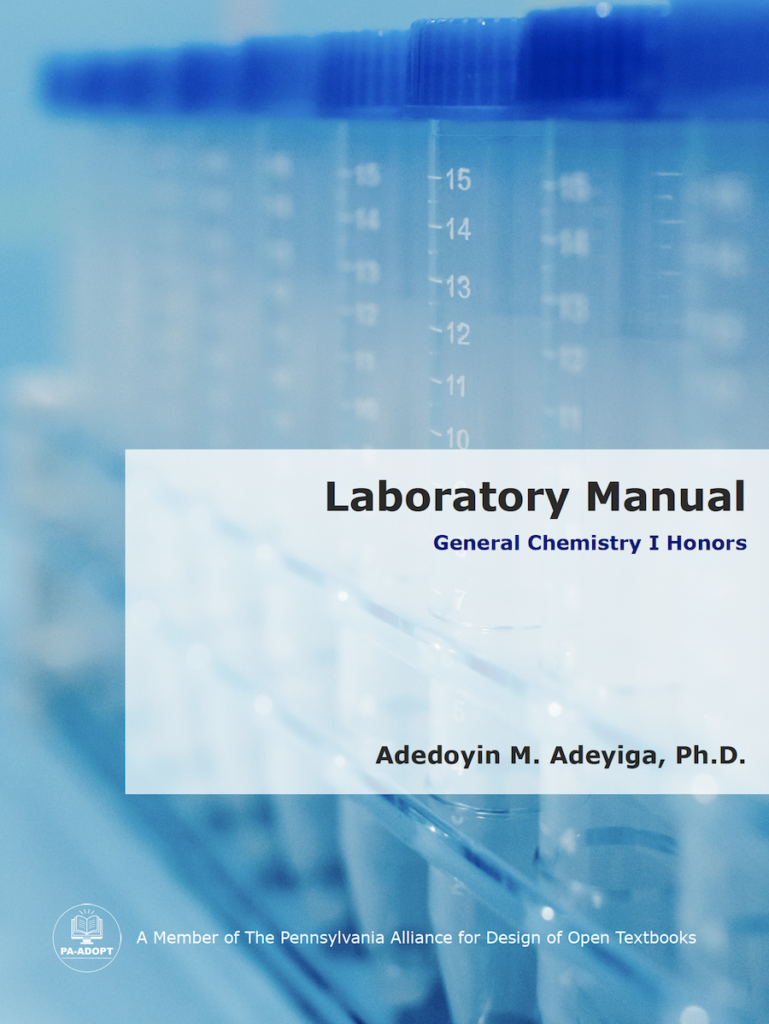
Laboratory Manual: General Chemistry I Honors
Not rated yetRate this bookAdedoyin M. Adeyiga’s honors chemistry laboratory manual pairs quantitative preparation with five investigations of familiar materials. Its opening develops unit-based reasoning and measurement before students encounter experimental evidence and post-laboratory interpretation.
Free reading is available at the official source. Opens in a new tab.
 Free
About this book
About this book
Published through PA-ADOPT as a 2023 first edition, this manual is designed for a General Chemistry I Honors laboratory. The publisher identifies the linked file as updated in November 2025. An extended calculations section precedes experiments concerning antacids, fat extraction, bone constituents, acetaminophen synthesis, and separation of analgesic components. Preparation, recorded observations, and analysis are built into the source activities. This page concentrates on the opening calculations material and the introductory explanation of the first experiment; it does not reproduce experimental procedures or provide answers to the manual’s questions.
Sources and reading coverage
Title and rights pages, contents, and selected passages on PDF sheets 6–12 and 24–25 were reviewed. The study guide covers the calculation opening and the first experiment’s introductory rationale; it is not a whole-manual or procedure review.
See the official publication record for edition details. The external PDF provides the available source text.
The consulted PDF contains 51 sheets, including preliminary material; this count can differ from printed pagination.
Book summary
Guide to the reviewed opening
The calculations opening treats a number and its unit as a single meaningful quantity. Its unit-basis approach begins by making the known information and the unknown quantity explicit. A relationship between units then connects the two. This approach makes cancellation a check on reasoning rather than a decorative step after arithmetic. Everyday conversion examples prepare the reader to apply the same logic in chemistry.
The measurement discussion distinguishes the agreement of repeated observations from closeness to an accepted reference value. That distinction matters because a plausible-looking numerical answer does not establish that an experiment was well measured. Scientific notation and significant figures are introduced within this broader concern for reporting evidence.
The first experiment’s opening turns advertising claims about antacids into a question about acid-neutralizing capacity. The reviewed introduction establishes a measurable comparison, rather than treating price or brand familiarity as proof of performance. The later experimental procedure and results have not been evaluated here.
How to study this book
Before each assigned experiment, write down the scientific question, the quantities that will be measured, and the units needed for the final comparison. Rework a unit conversion without copying the source solution, then explain why the conversion factor has the orientation you chose.
After reading the measurement section, keep separate notes for uncertainty, precision, and accuracy. When reviewing your own laboratory report, distinguish raw observations from calculated values and from the conclusion those values support. For the antacid reading, focus on what a comparison of neutralizing capacity can establish. Carry out practical work only within the course’s supervised laboratory arrangements and the original safety instructions.
Questions for reflection
- Why are units part of the reasoning rather than just labels?
- Can repeated measurements agree closely and still be inaccurate?
- What evidence would support a fair comparison between two antacids?
The study suggestions and questions are independent Academic Master editorial material.
About access & copyright
This page provides book information and study material. Full-text access is provided by the original publisher or authorised source; a listing does not grant permission to republish the book.
Read our Library Access & Copyright policyUnit reasoning
Explain how conversion factors connect known and unknown quantities.
Measurement quality
Distinguish precision from accuracy.
Evidence
Separate a measured comparison from an advertising claim.
Reporting
Keep observations, calculations, and conclusions distinct.
Reader ratings & reviews
Share your thoughts
Your review helps other students choose the right resources.
KEEP LEARNING
Your next great read
Biology
Geology Online Lab Activities: An Open Educational Resource for Community College Students and Instructors
Geology Online Lab Activities: An Open Educational Resource for Community College Students and Instructors
View Geology Online Lab Activities: An Open Educational Resource for Community College Students and Instructors — book Natural Sciences
Ecology for All!
View Ecology for All! — book Chemistry
Chemical Bonding and Organic Chemistry
View Chemical Bonding and Organic Chemistry — book Applied
COMPUTATIONAL PHYSICS: A Practical Introduction to Computational Physics and Scientific Computing (using C++)
View COMPUTATIONAL PHYSICS: A Practical Introduction to Computational Physics and Scientific Computing (using C++) — book Natural Sciences
Conservation techniques
View Conservation techniques — book Earth Sciences
Introduction to Earth Science
View Introduction to Earth Science — book Biology
Virginia Cooperative Extension Gardener Handbook
View Virginia Cooperative Extension Gardener Handbook — book Biology
Microbiology for Earth Scientists
View Microbiology for Earth Scientists — book Chemistry



