
 Biology
Textbook
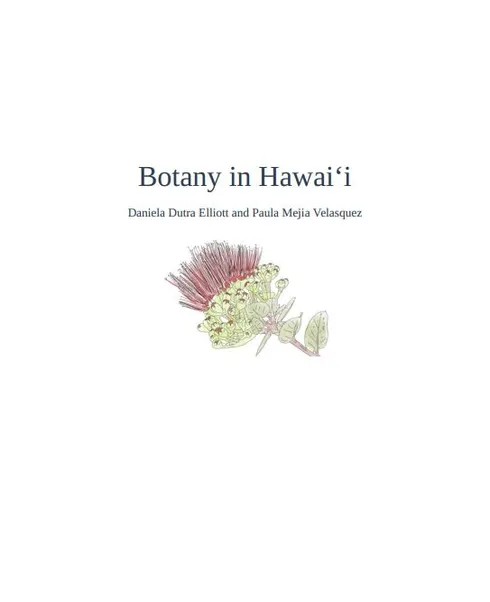
Botany in Hawaiʻi
Not rated yetRate this bookBotany in Hawaiʻi introduces plant structure, function, reproduction, and diversity through examples connected with the Hawaiian Islands. Daniela Dutra Elliott and Paula Mejia Velasquez move from cells and organs to…
Read on the publisher’s website. Opens in a new tab.
 Free
About this book
Botany in Hawaiʻi introduces plant structure, function, reproduction, and diversity through examples connected with the Hawaiian Islands. Daniela Dutra Elliott and Paula Mejia Velasquez move from cells and organs to evolutionary groups and the history of plants in Hawaiʻi. The ten chapters combine general botanical concepts with locally meaningful examples and cultural relationships. This guide follows the complete online edition, since the listed short PDF contains only introductory or contents material. Readers should use the diagrams and nearby plants alongside the explanations, paying attention to evidence that distinguishes an organ or plant group from another rather than relying only on outward resemblance.
The detailed guide below explains the book’s chapter, unit, or activity sequence. Use it alongside the study instructions and the complete official text.
Book summary
Chapter-by-chapter summaries
Chapter 1: Introduction to plants
The opening chapter establishes plants as central to daily life through food, materials, shelter, ecological relationships, and cultural practices. Botany is introduced as a science based on observations, questions, hypotheses, and evidence. The chapter then moves to cells and tissues, connecting microscopic structures with the functions of the whole organism. Cell walls, chloroplasts, and other features need to be understood as parts of a living system rather than a list of identifying labels. Tissues organize cells into functional relationships that later chapters revisit in roots, stems, and leaves. The Hawaiian examples make the broader relevance visible: a plant can be studied biologically while also understood through its use and meaning in a community. The key habit is to distinguish an observation from the explanation proposed for it and to connect a visible plant feature with an appropriate level of organization.
Chapter 2: Roots
Roots anchor plants, take up water and dissolved nutrients, and in some species perform additional storage or support functions. The chapter compares root systems, follows development from the radicle, and identifies regions involved in growth and differentiation. Internal anatomy explains how movement from soil toward the vascular tissues is regulated. Root hairs increase contact with the surrounding environment, while tissue organization affects the route water and solutes take. Modified roots demonstrate that one organ can support several functions. A thick underground plant part should not automatically be called a root; comparison with the stem chapter provides evidence for distinguishing them. The chapter therefore combines form, growth, and transport. Readers should follow an absorbed substance through the tissues and relate differences in root structure to the conditions or roles discussed in the examples.
Chapter 3: Stems
Stems support and position organs and connect roots with leaves through transport tissues. Nodes, internodes, and buds help identify their organization, including stems that do not resemble an upright trunk. Primary growth extends the plant, while secondary growth increases the diameter in plants with the relevant meristems. The chapter connects wood and other tissues with the activity that produces them rather than treating a trunk as an inert support. Modified stems include forms involved in storage or vegetative spread. Their identity is established through structural features such as nodes and buds, not merely their position above or below ground. These distinctions are useful when examining familiar food plants. The chapter’s central contribution is to show how development produces a structure that can perform support, transport, storage, and reproduction-related roles in different combinations.
Chapter 4: Leaves
Leaf structure connects light capture with gas exchange, transport, and water balance. The chapter introduces external features and internal regions, including epidermis, mesophyll, and veins. Photosynthesis transforms light energy into chemical energy, while the arrangement of tissues helps bring the required materials together. Stomatal behavior creates a relationship between access to carbon dioxide and the loss of water. The chapter also examines modified leaves, showing that a leaf need not look or function like a broad green blade. Bracts and other examples encourage readers to distinguish organ identity from its most familiar role. A useful review compares the external shape with the internal tissues and asks how they support the plant in a particular setting. This connects recognition with explanation rather than learning leaf terms only as a naming exercise.
Chapter 5: Flowers, fruits, and seeds
The reproduction chapter distinguishes the stages that lead from a flower to seeds and fruit. Pollination transfers pollen to an appropriate receptive site; fertilization is a later event involving the union of gametes. Confusing these stages makes the whole process harder to understand. Flower structures participate in reproduction and can also mediate relationships with pollinators. After fertilization, ovules develop into seeds, while the ovary contributes to fruit development, sometimes together with additional floral tissues. Seeds contain an embryo and structures that support survival and establishment. The examples also show why botanical fruit categories differ from everyday culinary labels. Readers should follow the origin of each mature structure rather than identify it only from taste or use. The chapter links reproductive anatomy with dispersal and the beginning of another generation.
Chapter 6: Plant evolution and nonvascular plants
The evolutionary discussion introduces plants within the wider organization of life and develops alternation of generations. Haploid and diploid phases have different roles, and spores should not be confused with seeds or gametes. Nonvascular plants provide a setting for examining these relationships without assuming that every plant follows the familiar life cycle of a flowering tree. Their size, water relations, and reproductive conditions are connected with their structures. The chapter also makes clear that living groups are not simply a ladder from inferior to superior organisms. They represent lineages with their own histories and adaptations. Readers should trace the life cycle by identifying which stage produces spores, which produces gametes, and where fertilization occurs. That method supports comparison with every later plant group.
Chapter 7: Ferns and lycophytes
Ferns and lycophytes possess vascular tissues but reproduce through spores rather than seeds. The chapter compares these lineages and relates their structures to transport, growth, and reproduction. A dominant sporophyte is a major contrast with the life cycles emphasized for nonvascular plants. Gametophytes and the conditions required for fertilization remain important even when they are less conspicuous than the leafy plant. Readers should distinguish shared features from evidence that separates the groups. A plant’s common name or general appearance may be misleading, so observing leaves, stems, and reproductive structures provides a more reliable basis for identification. The chapter continues the book’s comparative method: trace the life cycle and the function of the vascular system, then explain how those features differ from the previous and following groups.
Chapter 8: Gymnosperms
Gymnosperms introduce seeds without the flowers and fruits characteristic of angiosperms. The chapter compares conifers, cycads, ginkgo, and gnetophytes, illustrating diversity that a general image of a pine tree would miss. Pollen and seeds change the relationships among reproduction, dispersal, and terrestrial conditions. The gametophytes are reduced and closely associated with the sporophyte. Familiar ornamental plants provide opportunities to distinguish resemblance from relationship: a cycad may look palm-like while belonging to a different major group. Likewise, a fleshy covering around a seed is not automatically a botanical fruit. Readers should identify what reproductive structure is actually present and how it develops. The chapter’s value lies in combining those diagnostic distinctions with a broader understanding of why seeds were a consequential evolutionary innovation.
Chapter 9: Angiosperms
Flowering plants combine flowers, enclosed ovules, seeds, and fruits in a diverse reproductive system. The chapter places their life cycle and structures in comparison with the earlier groups. Pollination and fertilization remain distinct processes, and the development of the embryo and nutritive tissues should be tracked separately. Diversity within flowering plants also makes it important to use several characters when comparing groups rather than rely on one familiar trait. The chapter connects structures already studied in the organs section with their significance for classification and reproduction. Readers can use a complete example to follow the sequence from flower to fruit, seed, and young plant. This brings the book’s developmental and evolutionary accounts together: an organ is understood both through what it does and through its relationship with corresponding structures in other plants.
Chapter 10: Plants in Hawaiʻi
The final chapter connects the islands’ flora with dispersal, human history, cultivation, and later introductions. Native plants, Polynesian-introduced plants, and more recent introductions have different historical relationships with Hawaiʻi. Endemic and indigenous also describe different patterns of geographic occurrence. The chapter’s examples show how important food and cultural plants can be introduced without being recent arrivals, and why introduced should not be used as an automatic synonym for invasive. Later agricultural and ornamental introductions create further ecological and cultural relationships. Readers should distinguish historical origin, present distribution, human use, and ecological behavior as separate questions. The chapter concludes the book by placing botanical knowledge within an inhabited landscape, where understanding plants involves both biological evidence and the histories of the people who have moved, cultivated, and valued them.
Supplementary study focus: Identifying organs through evidence
One useful synthesis is to compare structures that look alike but develop differently. An underground storage organ may be a root or a stem; a colorful structure near a flower may be a petal or a bract; a fleshy reproductive structure need not always be a fruit. The source chapters provide the anatomical and developmental evidence for resolving such questions. This is a study exercise rather than an additional original chapter. Record the observed features, propose the organ identity, and identify which evidence would distinguish an alternative. The same reasoning connects field observation with the internal anatomy and life cycles explained throughout the book.
Study instructions
- Begin with plant terminology and connect each term to a labeled drawing or observed structure. Keep observations separate from guesses about function.
- Work through roots, stems, leaves, flowers, fruits, and seeds by comparing form and role. Trace how the organs contribute to the functioning of a whole plant.
- Create a comparison chart for nonvascular plants, ferns and lycophytes, gymnosperms, and angiosperms. Include the traits used to distinguish them.
- Use photographs and examples to practice identification of structures before attempting broader classification. Explain what evidence supports a label and what is not visible.
- In the Hawaii-focused material, distinguish native and introduced plants using the book’s context. Avoid assuming that a plant’s present abundance establishes its historical origin.
Practice and review task
Build a visual plant portfolio with labeled organs, group comparisons, and a short explanation of one Hawaiian example.
Questions for reflection
How does a structural trait support a function? Which feature provides the strongest evidence for placement in a plant group?
Sources and coverage
This guide follows the complete online edition, with ten original chapters and one clearly labeled supplementary study focus. These original summaries draw on review of the source text, including chapter or section introductions and selected explanations, examples, exercises, and review material. They are condensed study guides, not a page-by-page account or a replacement for the complete resource. Supplementary study discussions are identified separately.
About access & copyright
This page provides book information and study material. Full-text access is provided by the original publisher or authorised source; a listing does not grant permission to republish the book.
Read our Library Access & Copyright policyExplore the contents
Check the chapters covered in this edition.
Visit the official source
See reading, preview or purchase options.
Save for later
Keep this textbook in your saved collection.
Reader ratings & reviews
Share your thoughts
Your review helps other students choose the right resources.
KEEP LEARNING
Your next great read
Biology Biology
PGCC Microbiology
View PGCC Microbiology — book Biology
BIOL 130: Human Biology
View BIOL 130: Human Biology — bookBIOL 440: General Microbiology
BIOL 440: General Microbiology
View BIOL 440: General Microbiology — bookEnvironmental Science
Environmental Science
View Environmental Science — bookIntroduction to Conservation Biology
Introduction to Conservation Biology
View Introduction to Conservation Biology — bookCell Biology for Allied Health
Cell Biology for Allied Health
View Cell Biology for Allied Health — book Biology
BIOL 440: General Microbiology
View BIOL 440: General Microbiology — book Biology
Microbiology with NEC
View Microbiology with NEC — book Biology



