
Botany in Hawaiʻi
ChemistryTextbook
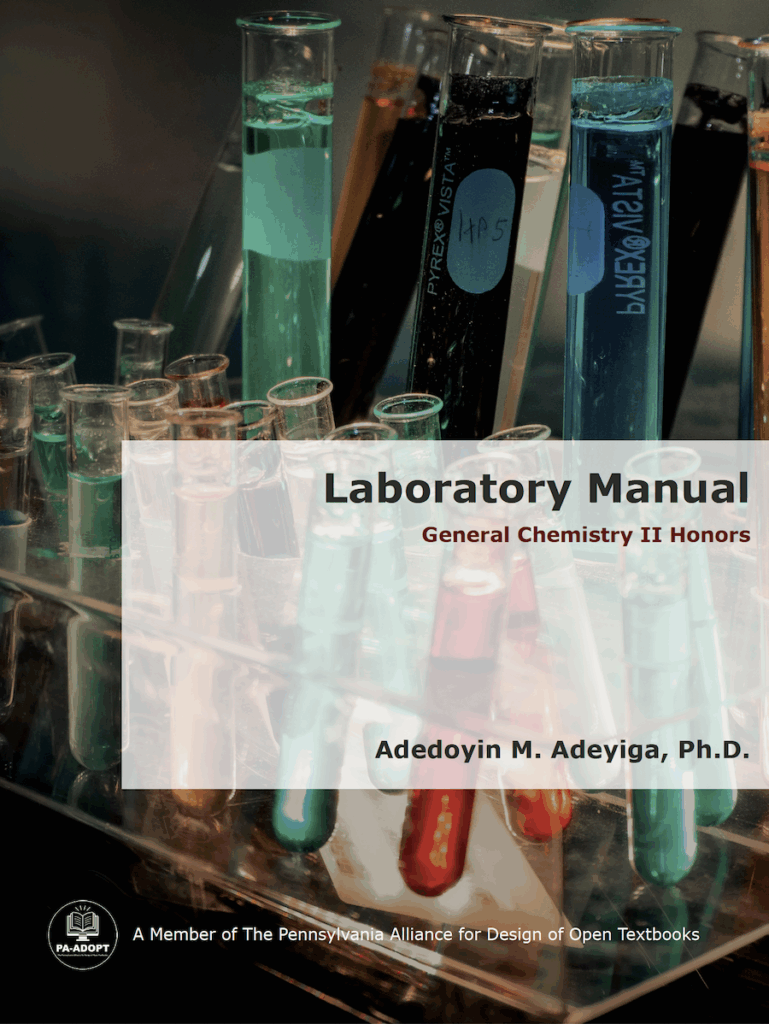
Laboratory Manual: General Chemistry II Honors
Not rated yetRate this bookAn honours general chemistry laboratory manual whose preface emphasises quantitative reasoning, units, and a deliberate approach to solving scientific problems.
Free reading is available at the official source. Opens in a new tab.
 Free
About this book
About this book
An honours general chemistry laboratory manual whose preface emphasises quantitative reasoning, units, and a deliberate approach to solving scientific problems.
This page introduces the source edition and offers a focused reading route. Use the linked original resource for the complete text, references, activities, and the author’s full explanation. The overview below is limited to the sections identified in the coverage note.
Contents and further reading
Consult the official book or repository page for the resource’s contents and publication information. Open the source PDF to read the complete available edition.
Sources and coverage
This original overview is based on the preface on quantitative problem-solving (PDF sheets 6–7), with publication information and contents checked. It is not a whole-book review. The verified source PDF contains 48 PDF sheets, including preliminary or repository pages; this may differ from its printed pagination. The source retains its own authorship, rights notices, and any separately credited third-party material.
Book summary
Study overview
The reviewed preface encourages students to understand the structure of a problem before calculating. It distinguishes meaningful quantitative reasoning from a sequence of memorised operations. A number becomes scientifically useful when its unit and relationship to the question are clear. The author therefore asks readers to identify what is known, determine what is being sought, and choose a basis for calculation. Unit relationships help organise the work and provide a way to check whether the result is expressed appropriately. The contents point onward to measurement and selected laboratory investigations, including spectroscopy and chemical analysis. Those experiments and their procedures were not evaluated for this overview. The page offers study orientation rather than instructions for conducting an experiment independently.
How to study this book
For a calculation assigned in your course, write the known quantities and desired result before substituting numbers. Carry units through each stage and explain why each conversion is appropriate. After calculating, check the unit, scale, and relevance of the answer. Keep a record of assumptions and any measurement limitations discussed by your instructor. For practical sessions, read the complete approved protocol and follow the laboratory’s supervision and safety requirements. Use this overview to prepare questions about reasoning; use the actual course manual for authorised experimental instructions.
These study suggestions and the questions below are independent Academic Master editorial guidance.
Questions for reflection
- What unit should the answer have before you calculate?
- Which relationship connects the information given to the unknown?
- What would make a numerical answer implausible even if the arithmetic is correct?
About access & copyright
This page provides book information and study material. Full-text access is provided by the original publisher or authorised source; a listing does not grant permission to republish the book.
Read our Library Access & Copyright policyProblem framing
Identify known quantities and the target result.
Units
Carry and check units throughout a calculation.
Reasoning
Explain the relationship behind each operation.
Laboratory context
Use the approved protocol under course supervision.
Reader ratings & reviews
Share your thoughts
Your review helps other students choose the right resources.
KEEP LEARNING
Your next great read
Biology
Geology Online Lab Activities: An Open Educational Resource for Community College Students and Instructors
Geology Online Lab Activities: An Open Educational Resource for Community College Students and Instructors
View Geology Online Lab Activities: An Open Educational Resource for Community College Students and Instructors — book Natural Sciences
Ecology for All!
View Ecology for All! — book Chemistry
Chemical Bonding and Organic Chemistry
View Chemical Bonding and Organic Chemistry — book Applied
COMPUTATIONAL PHYSICS: A Practical Introduction to Computational Physics and Scientific Computing (using C++)
View COMPUTATIONAL PHYSICS: A Practical Introduction to Computational Physics and Scientific Computing (using C++) — book Natural Sciences
Conservation techniques
View Conservation techniques — book Earth Sciences
Introduction to Earth Science
View Introduction to Earth Science — book Biology
Virginia Cooperative Extension Gardener Handbook
View Virginia Cooperative Extension Gardener Handbook — book Chemistry
Laboratory Manual: General Chemistry I Honors
View Laboratory Manual: General Chemistry I Honors — book Biology



