
Introduction to Drafting and AutoCAD 3D
Computer ScienceTextbook
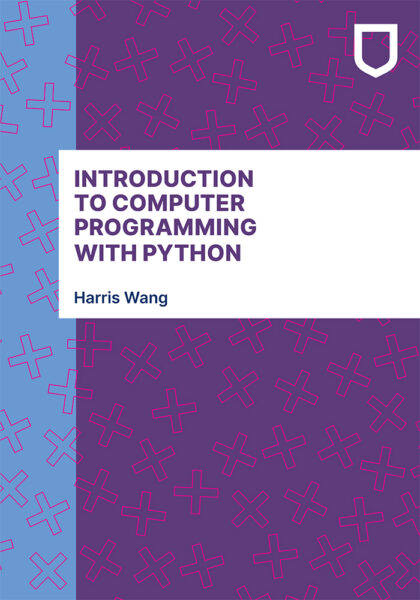
Introduction to Computer Programming with Python
Not rated yetRate this bookHarris Wang’s introductory Python textbook places programming within the broader development of computing and provides a structured starting point for learning to write programs.
Read on the publisher’s website. Opens in a new tab.
 Free
About this book
About this book
Harris Wang’s introductory Python textbook places programming within the broader development of computing and provides a structured starting point for learning to write programs.
This page introduces the source edition and offers a focused reading route. Use the linked original resource for the complete text, references, activities, and the author’s full explanation. The overview below is limited to the sections identified in the coverage note.
Contents and further reading
Consult the official book or repository page for the resource’s contents and publication information. Open the source PDF to read the complete available edition.
Sources and coverage
This original overview is based on publication information and selected opening historical discussion (PDF sheets 5 and 17–18), with contents checked. It is not a whole-book review. The verified source PDF contains 501 PDF sheets, including preliminary or repository pages; this may differ from its printed pagination. The source retains its own authorship, rights notices, and any separately credited third-party material.
Book summary
Study overview
The selected opening gives historical context for computer programming by tracing a movement from calculating devices to programmable and electronic machines. Its examples connect developments in machinery with ideas about logic, computation, and stored instructions. This helps frame programming as an activity grounded in models of information processing, rather than merely remembering language syntax. The reviewed pages discuss several contributors and machines as part of a cumulative development. Their educational role is to make the modern computer less of a black box before readers progress to language study. The wider contents provide the route into Python, but this overview is confined to the historical opening that was read. It should not be taken as a review of every coding example or a statement about the latest Python release.
How to study this book
Write a brief explanation of how a programmable machine differs from a fixed calculating device. Then establish a small practice routine for the programming readings assigned in your course. Type examples yourself, predict what they will do, and compare the observed result with your prediction. Change one element at a time so that an unexpected result is easier to investigate. Record the Python version and execution environment used for exercises. Keep explanations in your own words alongside working code, and use your instructor’s requirements when selecting tools or submitting assignments.
These study suggestions and the questions below are independent Academic Master editorial guidance.
Questions for reflection
- Why does programmability matter to the history of computing?
- What prediction can you make before running a small example?
- Which details would another learner need to reproduce your result?
About access & copyright
This page provides book information and study material. Full-text access is provided by the original publisher or authorised source; a listing does not grant permission to republish the book.
Read our Library Access & Copyright policyComputing context
Programming belongs to a longer development of tools and ideas.
Active practice
Predict, execute, and explain small examples.
Reproducibility
Record the environment used for exercises.
Conceptual learning
Connect code with an account of what it does.
Reader ratings & reviews
Share your thoughts
Your review helps other students choose the right resources.
KEEP LEARNING
Your next great read
Civil Engineering
Programming for Computations – Python: A Gentle Introduction to Numerical Simulations with Python 3.6
Programming for Computations - Python: A Gentle Introduction to Numerical Simulations with Python 3.6
View Programming for Computations - Python: A Gentle Introduction to Numerical Simulations with Python 3.6 — bookCISC 187: Data Structures in C++
CISC 187: Data Structures in C++
View CISC 187: Data Structures in C++ — bookAccounting Analytics: An Integrated Approach
Accounting Analytics: An Integrated Approach
View Accounting Analytics: An Integrated Approach — bookGame Based and Adaptive Learning Strategies
Game Based and Adaptive Learning Strategies
View Game Based and Adaptive Learning Strategies — book Computer Science
The Shallow and the Deep: A biased introduction to neural networks and old school machine learning
View The Shallow and the Deep: A biased introduction to neural networks and old school machine learning — bookComputer Systems Security: Planning for Success
Computer Systems Security: Planning for Success
View Computer Systems Security: Planning for Success — book Computer Science
Pro Git: Everything You Need to Know About Git (English)
View Pro Git: Everything You Need to Know About Git (English) — book Computer Science
Building User Interfaces for Modern Web Applications: React Programming
View Building User Interfaces for Modern Web Applications: React Programming — book Computer Science



