
Introduction to Drafting and AutoCAD 3D
Computer ScienceTextbook
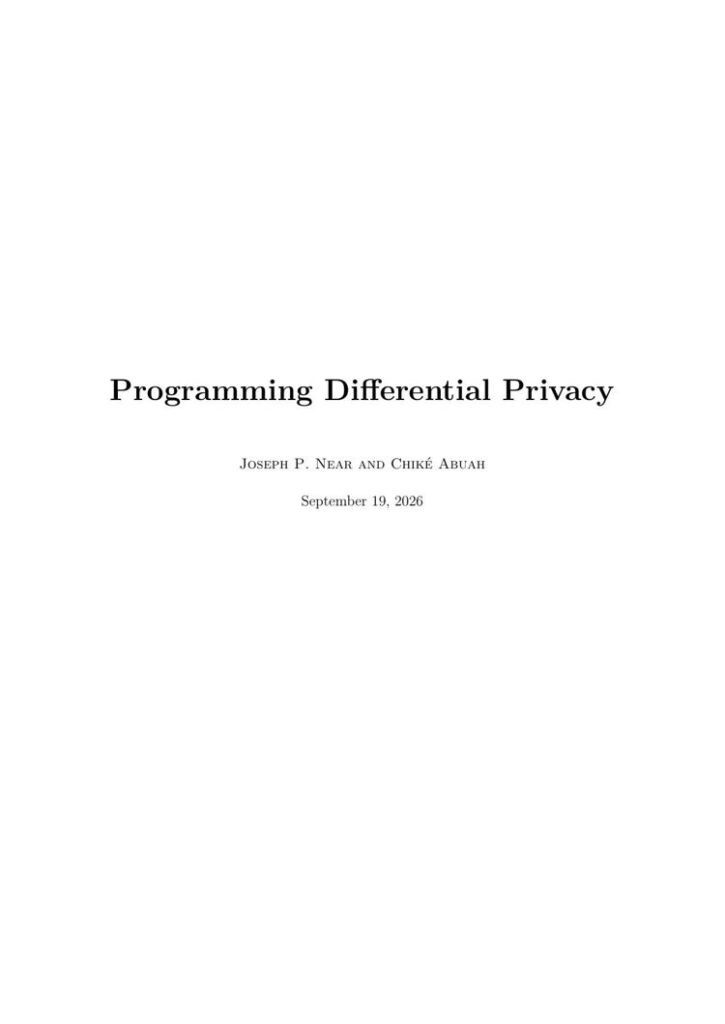
Programming Differential Privacy
Not rated yetRate this bookJoseph P. Near and Chiké Abuah connect differential-privacy concepts with executable programming examples. Their book introduces the challenge of learning from sensitive data while controlling what a release can reveal about individuals.
Read on the publisher’s website. Opens in a new tab.
 Free
About this book
Programming Differential Privacy is an example-driven resource by Joseph P. Near and Chiké Abuah. The reviewed PDF is dated 19 September 2026 and contains 122 pages. Its licence credits the authors in 2025; the PDF date is recorded separately as edition context.
The verified contents move from privacy challenges and limitations of earlier approaches to mechanisms, composition, sensitivity, variants, design, machine learning, local privacy, synthetic data, and implementation limitations. The book combines formal ideas with Python examples rather than treating definitions and implementation as unrelated subjects.
The opening assumes working familiarity with Python, NumPy, and pandas. It also points readers toward background in discrete mathematics and probability. The online format and the print version are generated from the same manuscript, with the web edition providing access to interactive notebook material.
The book text is CC BY-NC-SA 4.0, while its code examples have a separate MIT licence. The guide below covers front matter and the introductory chapter; it does not claim to explain or validate all later algorithms.
Book summary
Study overview of the reviewed opening
The reviewed introduction defines the subject through a tension: analysts want to learn useful trends from sensitive data, while information about particular people should remain protected. This makes an intentional release of information central to the problem. The question is not simply whether access is allowed, but what can be learned from the information released.
The authors distinguish that concern from security techniques that control access or prevent disclosure. In the introduction’s framing, privacy methods aim to make some analysis possible while limiting individual information. That distinction helps specify the purpose of the later techniques without implying that privacy and security are unrelated in a complete system.
The book’s design connects explanation with executable examples. Chapters are generated from self-contained Jupyter notebooks, and the web format exposes material that can be run or inspected. The opening identifies the programming and mathematical background expected of readers, so preparation is part of the learning task.
Differential privacy is presented as the authors’ principal focus, with earlier techniques used to motivate the problem. The introduction announces limitations of de-identification and related approaches, but the detailed attacks and mathematical mechanisms belong to later chapters. This overview does not reproduce them or turn introductory statements into a guarantee about any particular implementation.
Read as orientation, the chapter gives students a set of distinctions to carry into subsequent study: the analysis desired, the individuals affected, the release being considered, and the assumptions behind a method. The formal definitions, parameters, and implementation limits still require close reading of the relevant chapters.
Independent study suggestions
Academic Master editorial guidance:
Before studying an example, write down the learning goal and the assumptions you think it makes. After reading, distinguish the behaviour you observed from a guarantee established by a definition or argument. Keep experiments separate from claims of validation. This independent study approach is not a deployment checklist or a replacement for a formal privacy analysis.
Questions for discussion
These are Academic Master’s original discussion prompts.
- How does the introduction distinguish learning from data from controlling access to data?
- Why is the intended information release important to defining a privacy problem?
- What would distinguish observing a programme’s output from establishing a formal guarantee?
Book contents and further reading
Consult the complete official contents. The contents are linked rather than reproduced here.
Sources and coverage
Reviewed: title/date, contents, front matter (PDF pages 6–8), Chapter 2 in full (pages 9–10, printed pages 4–5), and the licence section (page 118). Chapters 3 onward, formal mechanisms, attack demonstrations, and deployment exercises have not been summarised.
Sources: official source and official PDF.
About access & copyright
This page provides book information and study material. Full-text access is provided by the original publisher or authorised source; a listing does not grant permission to republish the book.
Read our Library Access & Copyright policyPrivacy purpose
Identify the tension between useful analysis and individual information.
Distinct goals
Explain the introduction’s distinction between privacy and access security.
Preparation
Recognise the programming and mathematics background identified by the authors.
Evidence and guarantees
Separate an observed output from a formally established claim.
Reader ratings & reviews
Share your thoughts
Your review helps other students choose the right resources.
KEEP LEARNING
Your next great read
Civil Engineering
Programming for Computations – Python: A Gentle Introduction to Numerical Simulations with Python 3.6
Programming for Computations - Python: A Gentle Introduction to Numerical Simulations with Python 3.6
View Programming for Computations - Python: A Gentle Introduction to Numerical Simulations with Python 3.6 — bookCISC 187: Data Structures in C++
CISC 187: Data Structures in C++
View CISC 187: Data Structures in C++ — bookAccounting Analytics: An Integrated Approach
Accounting Analytics: An Integrated Approach
View Accounting Analytics: An Integrated Approach — bookGame Based and Adaptive Learning Strategies
Game Based and Adaptive Learning Strategies
View Game Based and Adaptive Learning Strategies — book Computer Science
The Shallow and the Deep: A biased introduction to neural networks and old school machine learning
View The Shallow and the Deep: A biased introduction to neural networks and old school machine learning — bookComputer Systems Security: Planning for Success
Computer Systems Security: Planning for Success
View Computer Systems Security: Planning for Success — book Computer Science
Pro Git: Everything You Need to Know About Git (English)
View Pro Git: Everything You Need to Know About Git (English) — book Computer Science
Building User Interfaces for Modern Web Applications: React Programming
View Building User Interfaces for Modern Web Applications: React Programming — book Computer Science



