
Elementary Calculus
AppliedTextbook
Introduction to Game Theory: a Discovery Approach
Not rated yetRate this bookIntroduction to Game Theory: a Discovery Approach develops quantitative reasoning through games and strategic choices. Jennifer Firkins Nordstrom uses inquiry-based activities to introduce mathematical models of social and economic situations.
 Free
About this book
The preface identifies a college quantitative reasoning course as the main context, with an introductory social-science game theory course as another possible use. Students are asked to make conjectures and attempt problems before all formal tools have been supplied. This discovery approach creates opportunities to compare initial intuition with a more developed model. Algebra and probability appear as needed, while popular-culture prompts connect the mathematical discussion with other interests. The hosted PDF is dated January 12, 2026; its contents distinguish zero-sum, repeated and non-zero-sum games.
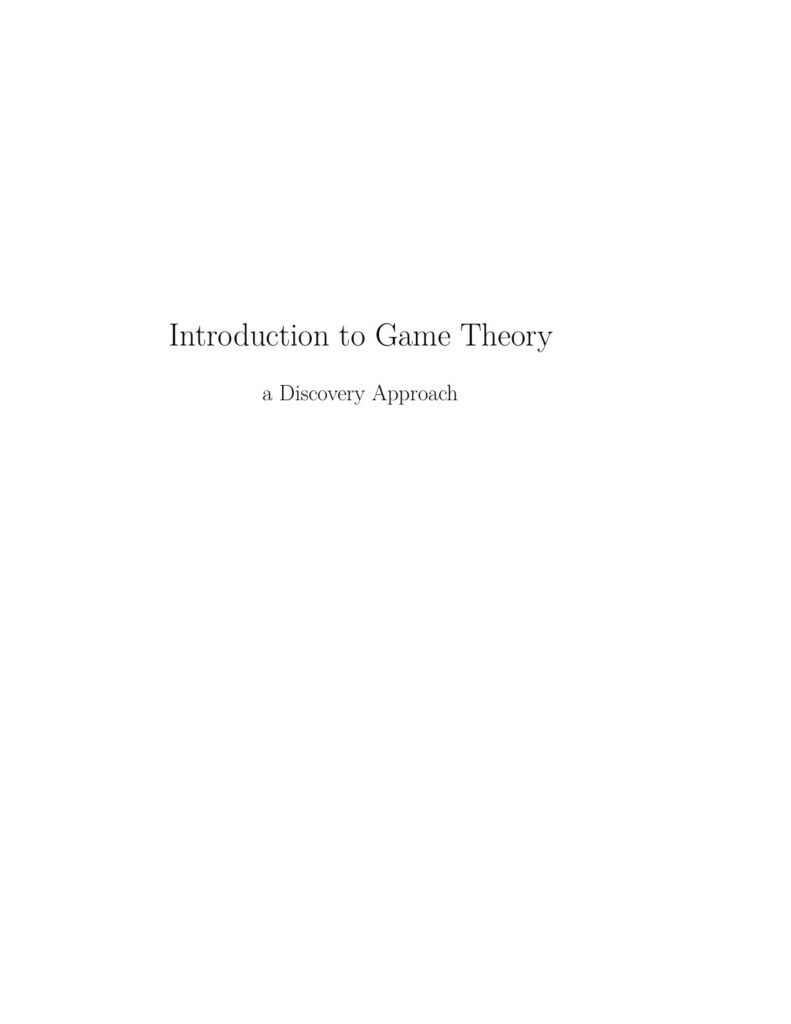
The attached edition contains 121 PDF pages, including front matter. Cover: source edition title page rendered from the PDF. The textbook and its original notices are retained; Academic Master’s study material is separate from the source text.
Book summary
Study overview of the reviewed opening
Nordstrom’s preface proposes game theory as a cohesive topic for quantitative reasoning. It can connect students with different academic interests while showing how mathematics frames choices in social, political and economic situations. The course goals include modelling, quantitative intuition and the application of algebra and probability.
The teaching format begins with activity and conjecture. A student may try to solve a problem before receiving the framework needed for a more systematic solution. Comparing those initial ideas with a later mathematical account helps reveal both the value and the limits of intuition.
The verified chapters move from players and strategies into two-person zero-sum games, repeated games and non-zero-sum settings. Popular-culture connections provide opportunities for written reflection alongside calculations. The preface assumes only modest algebraic preparation and allows further background to be introduced when needed. This guide reviews the teaching rationale and structure; it does not supply strategies for every game or reproduce the activity solutions.
Book contents
- What is Game Theory?
- Two-Person Zero-Sum Games
- Repeated Two-Person Zero-sum Games
- Non-Zero-Sum Games
- Back Matter
Questions for study
The following prompts are Academic Master’s editorial material.
- What can a first conjecture reveal about your assumptions?
- How does a mathematical model sharpen an intuitive account of a choice?
- Why might one topic connect students from different disciplines?
Sources and coverage
Preface read in full (PDF pages 5–6); dated title page and complete contents checked.
About access & copyright
Check this edition’s source and licence before reusing its files or content. A library listing does not grant additional rights.
Read our Library Access & Copyright policyDiscovery learning
Relate conjecture to later formal analysis.
Quantitative modelling
Identify the role of algebra and probability.
Game structure
Recognise the verified route through different game settings.
Reflective comparison
Compare intuition with a mathematical result.
Reader ratings & reviews
Share your thoughts
Your review helps other students choose the right resources.
KEEP LEARNING
Your next great read
Calculus
Measure, Integration & Real Analysis
Measure, Integration & Real Analysis
View Measure, Integration & Real Analysis — bookOptimal, Integral, Likely Optimization, Integral Calculus, and Probability for Students of Commerce and the Social Sciences
Optimal, Integral, Likely Optimization, Integral Calculus, and Probability for Students of Commerce and the Social Sciences
View Optimal, Integral, Likely Optimization, Integral Calculus, and Probability for Students of Commerce and the Social Sciences — bookModeling, Functions, and Graphs
Modeling, Functions, and Graphs
View Modeling, Functions, and Graphs — bookTrigonometry
Trigonometry
View Trigonometry — bookIntermediate Algebra
Intermediate Algebra
View Intermediate Algebra — bookProgramming for Computations – Python: A Gentle Introduction to Numerical Simulations with Python 3.6
Programming for Computations - Python: A Gentle Introduction to Numerical Simulations with Python 3.6
View Programming for Computations - Python: A Gentle Introduction to Numerical Simulations with Python 3.6 — book Mathematics
MGF 1131: Mathematics in Context
View MGF 1131: Mathematics in Context — book Applied
COMPUTATIONAL PHYSICS: A Practical Introduction to Computational Physics and Scientific Computing (using C++)
View COMPUTATIONAL PHYSICS: A Practical Introduction to Computational Physics and Scientific Computing (using C++) — book Algebra



