
Calculus-Based Physics II
CalculusTextbook
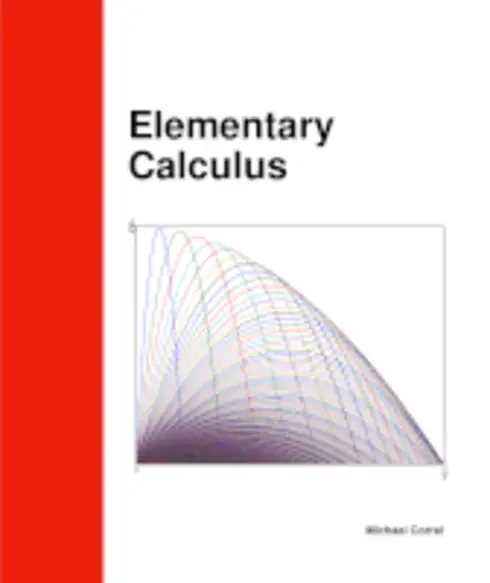
Elementary Calculus
Not rated yetRate this bookMichael Corral’s Elementary Calculus develops single-variable calculus through physical motivation, geometric interpretation, worked examples, and progressively demanding exercises. The December 2020 text covers the material of a two-semester calculus sequence in nine chapters. It introduces derivatives early, uses both limits and infinitesimal language, and connects techniques with motion, curves, accumulation, and approximation. This guide covers every chapter, the selected-answer appendix, and three original study checkpoints. Algebra, geometry, and trigonometry are the assumed foundations.
Free reading is available at the official source. Opens in a new tab.
 Free
About this book
Michael Corral’s Elementary Calculus develops single-variable calculus through physical motivation, geometric interpretation, worked examples, and progressively demanding exercises. The December 2020 text covers the material of a two-semester calculus sequence in nine chapters. It introduces derivatives early, uses both limits and infinitesimal language, and connects techniques with motion, curves, accumulation, and approximation. This guide covers every chapter, the selected-answer appendix, and three original study checkpoints. Algebra, geometry, and trigonometry are the assumed foundations.
Book summary
Michael Corral’s Elementary Calculus develops single-variable calculus through physical motivation, geometric interpretation, worked examples, and progressively demanding exercises. The December 2020 text covers the material of a two-semester calculus sequence in nine chapters. It introduces derivatives early, uses both limits and infinitesimal language, and connects techniques with motion, curves, accumulation, and approximation. This guide covers every chapter, the selected-answer appendix, and three original study checkpoints. Algebra, geometry, and trigonometry are the assumed foundations.
Chapter-by-chapter summaries
Chapter 1 — The Derivative
The derivative emerges from the problem of finding an instantaneous rate when an average rate is not enough. Corral’s motion example connects position, velocity, and the slope of a curved graph. The chapter then develops limit and infinitesimal approaches, rules for sums, products, and quotients, the chain rule, and higher derivatives. Keep the meaning of a derivative visible while learning procedures: it describes local change with respect to a specified variable. In the difference quotient, simplify with a nonzero increment before considering its limiting behavior; substituting zero into an unresolved ratio is not the derivation. Compare a product with a composition and explain why they require different rules. After differentiating, check the result’s units, its sign in a simple region, and whether the graph behaves as the derivative predicts.
Chapter 2 — Derivatives of Common Functions
This chapter extends the derivative toolkit to inverse functions, trigonometric functions and their inverses, exponentials, and logarithms. Relationships among functions provide reasons for the formulas rather than leaving a disconnected table to memorize. Domains and branch choices matter, especially for inverse trigonometric functions and logarithms. Distinguish an inverse function from a reciprocal, and track the inner derivative when a familiar function is composed with another expression. Practice comparing an exponential with fixed base and variable exponent to a power with fixed exponent. For logarithmic differentiation, state the domain or sign assumptions that make the steps meaningful. A useful exercise is to derive one formula from a previously understood relationship, then use it in a composite example without losing the chain-rule factor.
Chapter 3 — Topics in Differential Calculus
Tangent lines, formal limits, continuity, implicit differentiation, related rates, and differentials deepen the meaning and use of derivatives. The formal limit discussion makes precise what it means for output values to approach a target as inputs approach a point. Continuity and differentiability must be distinguished: continuity alone does not guarantee a derivative. Implicit differentiation treats one variable as dependent on another even when an equation is not solved explicitly. Related-rate problems require a relationship that holds through time, not just a diagram at one instant. Label variables and units, differentiate the relationship first, and only then substitute the instant’s measurements. Differentials connect small input changes with linear estimates; explain why such an estimate is local and why its accuracy can deteriorate over a larger interval.
Chapter 4 — Applications of Derivatives
Optimization, curve sketching, numerical root finding, and the mean value theorem show how derivative information supports conclusions about a function. For optimization, translate the situation into an objective with a justified domain, then examine critical points and relevant boundaries. A zero derivative identifies a candidate, not an automatic maximum or minimum. Curve sketching integrates increasing and decreasing behavior, curvature, intercepts, and other constraints. Numerical methods require an initial choice and a check on whether the iteration behaves reliably. The mean value theorem depends on continuity on the closed interval and differentiability in its interior; record those hypotheses before applying the conclusion. Across these applications, distinguish finding a plausible numerical answer from establishing that it answers the original question under the stated assumptions.
Chapter 5 — The Integral
The integral is developed through antiderivatives, definite accumulation, the fundamental theorem of calculus, substitution, and improper integrals. An indefinite integral describes a family of antiderivatives, while a definite integral returns a net accumulation over an interval. They are connected but should not be confused. The fundamental theorem explains why differentiation and integration are linked, making many accumulation calculations possible through endpoint values of an antiderivative. Substitution reverses a chain-rule structure and must transform the differential and, when used directly in a definite integral, the limits consistently. Improper integrals require limits because an interval or integrand has a problematic feature. Compute the relevant one-sided or infinite limits and check convergence before treating an expression as an ordinary finite answer.
Chapter 6 — Methods of Integration
Integration by parts, trigonometric identities, trigonometric substitutions, partial fractions, miscellaneous methods, and numerical quadrature form a collection of strategies rather than one universal recipe. Begin by identifying structure: a product may suggest parts, a rational function may suggest algebra and partial fractions, and a radical may suggest a suitable change of variable. A method is useful when it simplifies the remaining problem, not merely because it can be applied. Differentiate a proposed antiderivative to check it. Numerical methods approximate definite accumulation when symbolic evaluation is inconvenient or unavailable, but their accuracy depends on the function and method. Compare results as the subdivision changes, and distinguish evidence of stabilization from a justified error bound. The chapter develops judgment about choosing and checking a technique as well as carrying it out.
Chapter 7 — Analytic Geometry and Plane Curves
Ellipses, parabolas, hyperbolas, translations, rotations, hyperbolic functions, parametric equations, and polar coordinates broaden the kinds of curves calculus can describe. A curve need not be presented as a single graph y = f(x) to have a meaningful tangent or geometric property. Compare an implicit equation, a parametrization, and a polar description of the same shape, noting what each representation makes easy to see. Track the parameter’s direction and possible repeated traversal. In coordinate transformations, distinguish a change of description from a change in the geometric object. The conic and hyperbolic-function material also prepares useful techniques for later applications. Sketch before calculating so algebraic results can be checked against the expected geometry and domain.
Chapter 8 — Applications of Integrals
Definite integration calculates areas between curves, average values, arc length, curvature-related quantities, surfaces and solids of revolution, and selected physical or statistical quantities. Each application begins by identifying a small contribution and how those contributions combine. Draw the region or object and choose an appropriate variable before writing the integral. For area between graphs, determine which is above the other and split the interval when necessary. For a solid of revolution, explain the cross-section or shell represented by the integrand. Check dimensions: an area, volume, length, and average value should not have identical units. The chapter’s broader lesson is that integration models a specific quantity; a correctly evaluated integral still gives the wrong answer if the model or bounds describe a different problem.
Chapter 9 — Infinite Sequences and Series
Sequences concern ordered terms, while series concern the behavior of their partial sums. The chapter develops convergence tests, alternating series, power series, and Taylor expansions. A term tending to zero is necessary for convergence of a series, but it is not sufficient. Select a test by the structure of the terms and state its conditions, rather than trying formulas without an argument. For a power series, determine the convergence interval and check endpoints separately when needed. Taylor polynomials create local approximations from derivatives, but a function’s smoothness alone does not justify assuming that its Taylor series equals it everywhere. Keep the domain of representation and the approximation question explicit. The chapter links infinite processes with the practical use of simpler expressions to approximate more complicated functions.
Appendix A, Reference Material, and Exercise Levels
The selected answers and hints support checking after an independent attempt. Corral groups exercises as A, B, and C, broadly progressing from routine computation toward more involved or insightful work, while noting that the division is not absolute. Build practice sets that include more than one level so success with routine procedures does not conceal gaps in interpretation. The Greek alphabet and notation reference help with reading, and the index connects concepts across chapters. For numerical programming exercises, translate the stated algorithm into a language you understand and test it on a simple case with a known result. Use the included license and history when comparing or adapting editions.
Original Study Checkpoint — Composition and Local Behavior
Consider f(x) = (x² + 1)³. The outer operation is cubing and the inner function is x² + 1, so the chain rule gives f′(x) = 6x(x² + 1)². Since the squared factor is positive for real x, the sign of the derivative follows the sign of x: the function decreases to x = 0 and increases afterward. This gives more information than a formula alone. The checkpoint joins technique with Chapter 4’s interpretation and illustrates why the vanishing derivative must be analyzed in its neighborhood before classifying a point.
Original Study Checkpoint — Net Change and Total Change
Suppose an object’s velocity is v(t) = 2t − 2 metres per second, with time measured in seconds from 0 to 2. The definite integral of velocity is zero over that interval, so the final position equals the initial position. The object has nevertheless moved: its velocity is negative before t = 1 and positive afterward. Integrating the speed, the absolute value of velocity, gives a total distance of 2 metres. This example connects derivatives, signed accumulation, and applications, showing why net displacement and distance are different questions.
Original Study Checkpoint — A Series and Its Domain
The geometric series 1 + x + x² + … equals 1/(1 − x) when |x| < 1. At x = 1, the partial sums increase without bound; at x = −1, they alternate rather than approaching a single value. The compact expression 1/(1 − x) is defined at many other values, but that does not make the original series convergent there. This checkpoint separates an algebraic expression’s domain from a series representation’s convergence domain. Use the same discipline when applying a power series to integration, differentiation, or approximation.
Study instructions
- Review algebraic manipulation, functions, trigonometry, and units before beginning; revisit a prerequisite when it blocks the calculus idea.
- For each new method, write its purpose and assumptions, solve an example independently, and check the result geometrically or by differentiation.
- Practice across A, B, and C exercises, using selected answers only after recording a complete attempt.
- Before an application, draw a diagram, define variables and bounds, and identify what quantity the calculation should return.
- For numerical and series approximations, state the convergence conditions and explain how accuracy is being assessed rather than reporting extra digits without support.
Questions for reflection
- How does an instantaneous rate differ from an average over an interval?
- Why is a critical point only a candidate in an optimization problem?
- When does a definite integral measure net change rather than total magnitude?
- What must be checked before a power series is used to represent a function?
Sources and coverage
This original reading guide follows the linked source edition’s chapter, module, unit, or lesson structure. Consult the source for full arguments, cases, worked examples, exercises, illustrations, and references. Coverage follows the December 2020 source PDF. The three labeled study checkpoints are original examples added to this reading guide. Read the source edition.
About access & copyright
This page provides book information and study material. Full-text access is provided by the original publisher or authorised source; a listing does not grant permission to republish the book.
Read our Library Access & Copyright policyExplore the contents
Check the chapters covered in this edition.
Visit the official source
See reading, preview or purchase options.
Save for later
Keep this textbook in your saved collection.
Reader ratings & reviews
Share your thoughts
Your review helps other students choose the right resources.
KEEP LEARNING
Your next great read
Calculus
Calculus-Based Physics I
Calculus-Based Physics I
View Calculus-Based Physics I — book Mathematics
 for Public and Occupational Health Professionals
View Mathematics for Public and Occupational Health Professionals — book Algebra
Fanshawe Pre-Health Sciences Mathematics 2
View Fanshawe Pre-Health Sciences Mathematics 2 — book Algebra
Fanshawe Pre-Health Sciences Mathematics 1
View Fanshawe Pre-Health Sciences Mathematics 1 — book Mathematics
Math 3080 Preparation
View Math 3080 Preparation — book Algebra
Linear Algebra with Applications
View Linear Algebra with Applications — book Business and Economics
Mathematics of Finance
View Mathematics of Finance — book Algebra
The Essence of Mathematics Through Elementary Problems
View The Essence of Mathematics Through Elementary Problems — book complex numbers



