
Abstract
Batteries convert chemical energy into electrical energy through oxidation and reduction reactions. These notes explain the relationship between cell potential and free-energy change, distinguish primary and secondary cells, and describe five familiar battery systems. Their construction, discharge reactions, and rechargeability show how electrode materials and electrolytes determine the practical uses of a battery.
Introduction and Definition
A battery is an electrochemical power source containing one or more cells. Each cell has two electrodes and an electrolyte. During discharge, oxidation at the anode releases electrons, which flow through the external circuit to the cathode, where reduction occurs. Movement of ions through the electrolyte completes the circuit. Connecting cells in series increases the total voltage.
The connection between thermodynamics and cell potential is expressed by:
\[\Delta G=-nFE\]
Here, \(\Delta G\) is the Gibbs free-energy change for the cell reaction, \(n\) is the number of moles of electrons transferred, \(F\) is the Faraday constant, and \(E\) is the cell potential. A spontaneous discharge reaction has a negative free-energy change and can deliver electrical work. The maximum electrical work delivered by a reversible cell is \(-\Delta G=nFE\).
Battery Functions and Types
A useful battery supplies a suitable voltage for its load, retains charge during storage, and provides sufficient operating life. Its voltage and available capacity change as the reactants are consumed. Whether it can be used again depends on the reversibility of its electrode reactions.
Primary Cells
Primary cells are designed for a single discharge cycle. Their electrode reactions are not practically reversed by ordinary charging. Once their useful capacity is exhausted, they must be replaced. Zinc-carbon dry cells, alkaline cells, silver-oxide cells, and primary lithium cells are examples; the latter two are separate systems rather than varieties of the Leclanché cell.
Secondary Cells
Secondary cells, also called storage cells, have electrode reactions that can be reversed by an external source of electrical energy. They operate as galvanic cells during discharge and as electrolytic cells during charging. Lead-acid and nickel-cadmium batteries are examples.
Flow Batteries and Fuel Cells
Both systems can use externally supplied reactants, but they are different technologies. A flow battery circulates electrolyte containing electroactive material between tanks and a cell. A fuel cell receives fuel and an oxidant continuously and generates electricity while those supplies remain available.
Important Primary Batteries
Dry Cell or Leclanché Cell
The zinc container is the anode. Inside it, an electrolyte paste contains ammonium chloride and zinc chloride. Manganese dioxide is the active cathode material, and a carbon rod acts as a current collector. The surrounding insulation protects the cell and separates its conducting parts.
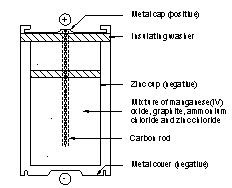
During discharge, zinc is oxidized and manganese dioxide is reduced. A simplified, balanced representation of the reactions is:
Anode
\[\mathrm{Zn\rightarrow Zn^{2+}+2e^-}\]
Cathode
\[\mathrm{2MnO_2+2NH_4^++2e^-\rightarrow 2MnOOH+2NH_3}\]
Overall reaction
\[\mathrm{Zn+2MnO_2+2NH_4^+\rightarrow Zn^{2+}+2MnOOH+2NH_3}\]
Manganese is reduced from oxidation state +4 to +3. Ammonia formed during discharge can combine with zinc chloride:
\[\mathrm{ZnCl_2+2NH_3\rightarrow [Zn(NH_3)_2]Cl_2}\]
The nominal voltage is about 1.5 V. Dry cells have been used in radios, calculators, and torches. Consumption and corrosion of the zinc container limit their life and can eventually cause leakage.
Mercury Cell
A mercury cell uses zinc as the anode and mercury(II) oxide as the cathode material, with an alkaline electrolyte such as potassium hydroxide. These cells historically supplied watches and hearing aids. The electrode reactions are:
Anode
\[\mathrm{Zn+2OH^-\rightarrow ZnO+H_2O+2e^-}\]
Cathode
\[\mathrm{HgO+H_2O+2e^-\rightarrow Hg+2OH^-}\]
Overall reaction
\[\mathrm{Zn+HgO\rightarrow ZnO+Hg}\]
The cell provides a relatively steady voltage during much of its useful discharge. Mercury is a toxic material, so this historical example should not be treated as a preferred modern battery choice.
Alkaline Battery
Like the zinc-carbon dry cell, an alkaline battery uses zinc and manganese dioxide. Its electrolyte is potassium hydroxide rather than the ammonium-chloride paste of a Leclanché cell. Graphite assists electrical conduction but is not the active cathode reactant. The simplified reaction scheme used here is:
Anode
\[\mathrm{Zn+2OH^-\rightarrow Zn(OH)_2+2e^-}\]
Cathode
\[\mathrm{2MnO_2+H_2O+2e^-\rightarrow Mn_2O_3+2OH^-}\]
Overall reaction
\[\mathrm{Zn+2MnO_2+H_2O\rightarrow Zn(OH)_2+Mn_2O_3}\]
Alkaline cells generally offer longer useful life than comparable zinc-carbon cells under many common loads. Zinc is still consumed during discharge; the advantage does not mean that corrosion is absent or that voltage remains perfectly constant.
Important Secondary Batteries
Lead-Acid Storage Battery
A lead-acid cell contains a lead negative electrode, a lead-dioxide positive electrode, and sulfuric-acid electrolyte. Groups of plates provide a large reaction area, while separators keep the positive and negative plates apart. Each cell supplies approximately 2 V; three or six cells connected in series produce nominal 6 V or 12 V batteries.
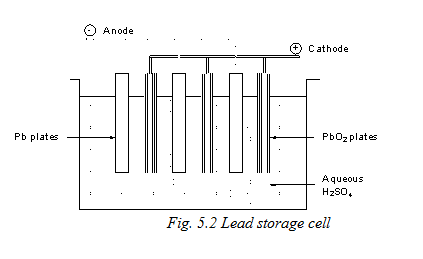
A simplified cell notation is:
\[\mathrm{Pb\,|\,PbSO_4\,|\,H_2SO_4(aq)\,|\,PbSO_4\,|\,PbO_2\,|\,Pb}\]
At the anode, lead is oxidized. The oxidation step and its combination with sulfate can be represented separately:
\[\mathrm{Pb\rightarrow Pb^{2+}+2e^-}\]
\[\mathrm{Pb+SO_4^{2-}\rightarrow PbSO_4+2e^-}\]
At the cathode, lead in lead dioxide is reduced from +4 to +2. The intermediate reduction and complete sulfate-forming half-reaction are:
\[\mathrm{PbO_2+4H^++2e^-\rightarrow Pb^{2+}+2H_2O}\]
\[\mathrm{PbO_2+4H^++SO_4^{2-}+2e^-\rightarrow PbSO_4+2H_2O}\]
Overall discharge reaction
\[\mathrm{Pb+PbO_2+2H_2SO_4\rightarrow 2PbSO_4+2H_2O}\]
Lead sulfate forms on both electrodes, and sulfuric acid is consumed during discharge.
Recharging a Lead-Acid Battery
An external power source drives the reaction in the reverse direction. Lead is restored at the negative electrode, lead dioxide is restored at the positive electrode, and the electrolyte regains sulfuric acid:
\[\mathrm{2PbSO_4+2H_2O\rightarrow Pb+PbO_2+2H_2SO_4}\]
Lead-acid batteries are used in cars, buses, and lorries, as well as backup-power installations in telephone exchanges, hospitals, and power stations. Storage also has a broader role in the operation of grid-connected solar PV systems.
Nickel-Cadmium Cell
A nickel-cadmium cell is rechargeable. It uses cadmium at the negative electrode, a nickel-based positive electrode, and potassium-hydroxide electrolyte. Cadmium is converted to insoluble cadmium hydroxide during discharge. A cell has a nominal voltage of approximately 1.2 V.
The following equations use simplified NiO2 notation. Practical nickel-electrode chemistry is more commonly described in terms of nickel oxyhydroxide; this simplified scheme illustrates the reversible reaction rather than a complete account of the electrode phases.
Anode during discharge
\[\mathrm{Cd+2OH^-\rightarrow Cd(OH)_2+2e^-}\]
Cathode during discharge
\[\mathrm{NiO_2+2H_2O+2e^-\rightarrow Ni(OH)_2+2OH^-}\]
Overall discharge reaction
\[\mathrm{Cd+NiO_2+2H_2O\rightarrow Cd(OH)_2+Ni(OH)_2}\]
The idealized overall discharge reaction does not produce gas. Charging reverses these electrode reactions.
Recharging a Nickel-Cadmium Battery
Charging supplies electrical energy to reverse the discharge reactions. Cadmium is regenerated, and the nickel electrode is returned to its charged state:
\[\mathrm{Cd(OH)_2+2e^-\rightarrow Cd+2OH^-}\]
\[\mathrm{Ni(OH)_2+2OH^-\rightarrow NiO_2+2H_2O+2e^-}\]
\[\mathrm{Cd(OH)_2+Ni(OH)_2\rightarrow Cd+NiO_2+2H_2O}\]
Nickel-cadmium batteries can offer compact construction and a long cycle life. They require a suitable enclosure and charging conditions. Their size and weight depend on capacity and design, and cadmium-containing batteries require appropriate end-of-life handling.
Conclusion
The distinction between primary and secondary batteries follows from the practical reversibility of their reactions. Zinc-carbon, mercury, and alkaline cells illustrate primary systems, while lead-acid and nickel-cadmium cells illustrate rechargeable systems. Understanding electron transfer, electrolyte participation, and the changes at each electrode explains both the electrical output and the limits of each battery type.
Further Reading
Flowers, P., Theopold, K., Langley, R., and Robinson, W. R. (2019). Chemistry 2e, Section 17.5, “Batteries and Fuel Cells.” OpenStax. Read the electrochemistry chapter.
Cite This Work
To export a reference to this article please select a referencing stye below:

Academic Master Education Team is a group of academic editors and subject specialists responsible for producing structured, research-backed essays across multiple disciplines. Each article is developed following Academic Master’s Editorial Policy and supported by credible academic references. The team ensures clarity, citation accuracy, and adherence to ethical academic writing standards
Content reviewed under Academic Master Editorial Policy.





