
Abstract
Introduction: Conventional methods of teaching and learning anatomy included cadaveric dissection and the use of textbooks at the dissection table. With the rapid revolution in technology there evolved innovative ways to teach and learn Anatomy. Among the numerous technologies utilized in Anatomy education, virtual reality is one specific innovation has received a lot of interest and attraction. Although there has been a surge in interest in the use of these technologies, the literature is sparse in evaluating the effectiveness of such tools in the teaching and learning process of Anatomy. This study would help human Anatomy educators to identify a low-cost and easy-to-manage alternative. The aim: The study aims to explore how well virtual reality technology works in learning Anatomy among nursing students. Materials and methods: An exploratory quantitative cross-sectional design with a purposeful sampling technique was utilized. The sample size included (n =68) nursing students. These students enrolled for the Anatomy and Physiology 1 course during the Fall (First) semester and Anatomy and Physiology 2 during the Spring (Second) semester during the first year of the nursing degree program. These courses are spread over 15 weeks each and include an anatomy laboratory of two hours per week. They had undergone a weekly training of one anatomy lab session of 2 contact hours for fifteen weeks. The platform used for instruction was the 3D Organon VR Anatomy app which has 15 body systems, and the students could access the VR learning experience through their headsets. Data was collected by distributing a 11 item questionnaire and data was analyzed using SPSS. Findings: Among the respondents 54 participants (79.4%) reported that 3D VR technology was helpful to a great deal for learning anatomy. 62 participants (91.1%) described that 3D VR technology as very effective to extremely effective in helping to learn the names and locations of anatomical structures. Using the 3D VR technology supported 32 students (47.1%) to achieve better grades in the Anatomy and Physiology courses. 51 participants (75%) reported the overall learning experience using 3D VR as excellent. The two (2) major benefits of learning anatomy through Virtual Reality were identified by 50 participants (73.5%) as 1) Get students excited and engaged about learning and 2) Makes difficult concepts easier to learn 48(70.6%). Conclusion: From the survey findings it is evident that the nursing students find virtual reality as an effective tool for learning Anatomy.
Introduction
The novel Snow crash published in 1992 introduced the idea of the metaverse. Four types of metaverse have been developed 1. Augmented reality, 2. Lifelogging, 3. Mirror world and 4. Virtual reality. Virtual reality is defined as a digital data-driven world. Its features depend on the user's egotistical avatar engagement actions. Virtual reality apps are primarily used by online gaming platforms such as Second Life, Minecraft, Roblox, and Zepeto1 (Kye). Virtual reality has become part of the sets of educational tools because of its ability to promote constructive learning. The constructivist learning theory pioneered by Jean Piaget and John Dewey suggests that knowledge is developed through a person’s interaction with the environment. The sensory stimuli that are received combined with current knowledge, and new information create novice experiences that are helpful in participative learning activities. It allows the learner to analyze and visually perceive the three-dimensional models, navigate the environment, and picture theoretical concepts. Having all these qualities virtual reality when wisely used as an educational tool will bring about optimistic outcomes in education2 (chen).
Virtual reality is created due to the interaction of the three I’s. I.e., I3 = Interaction, Immersion, and Imagination. There are numerous positive impacts of VR in education, namely 1. Practical learning than traditional learning from books 2. Easy understanding of complex concepts 3. Undivided attention during the learning process 4. Taps into the creativity of students 5. Improvement in teachers’ skill levels 6. Ease to revisit learned materials 7. Learning clarity and autonomy 8. Overcomes the communication barrier 9. Opportunity for learners to collaborate. A few drawbacks of VR-based education include 1. Cost of the VR equipment 2. Hard to choose the correct device for the specific learning situation 3. Teacher’s training is a challenge 4. Associated sicknesses following regular VR usage. 3 (M. Raja).
The application of virtual reality is multifold and the health sector is utilized it for education and as complementary treatment modalities. Some studies show a positive impact of VR in Psychiatric disorders. 4(Błażej Cieślik). Virtual and augmented reality are utilized in the planning and in the training of surgical procedures. The application of virtual reality has also been explored in Physical education with positive results 5(YU DING1,2, YUHANG LI 3 , AND LEI CHENG4). A systematic review has shown promising results in utilizing VR technology in the the Rehabilitation of patients with osteoarthritic pain, range of motion issues, and improving proprioception function.6 Joanna Byra 1,2,* and Krzysztof Czernicki. However, no significant improvement was seen in patients who used AR and VR in hand rehabilitation7 Margarida F. Pereira a,* , Cosima Prahm b , Jonas Kolbenschlag b , Eva Oliveira c , Nuno F. Rodrigues. Application of the three types of reality such as virtual, augmented, and mixed in urology training has been proven to be effective and trainees improved their skills in suturing, it also overcomes the ethical issues of otherwise practicing on animals.8. B. M. Zeeshan Hameed1,2,3, Shraddha Somani 4 , Etienne Xavier Keller 5 , R. Balamanigandan6 , Satyasundara Mahapatra7 , Amelia Pietropaolo2,8, ¸Senol Tonyali 9 , Patrick Juliebø-Jones 10,11, Nithesh Naik 3,12 *, Dilip Mishra13, Sarvesh Kumar 14 , Piotr Chlosta15 and Bhaskar K. Somani 2. Virtual reality has been established to provide effective results in gait training for patients with Parkinson’s syndrome 9. Cheng LeiID1 , Kejimu Sunzi1 , Fengling Dai2,3, Xiaoqin Liu1 , Yanfen Wang1 , Baolu Zhang2 , Lin He1 , Mei Ju2 .*Maxillofacial surgical training and procedural planning has positively influenced patient care Ashraf 10 Ayoub* and Yeshwanth Pulijala
Apart from clinical applications, VR has been also applied effectively in medical education and higher education sectors which include teaching empathy, 11 Elizabeth Dyer, MLIS, AHIP; Barbara J. Swartzlander, MSEd, MLS; Marilyn R. Gugliucci, MA, PhD,. Charles Darwin's evolutionary theory is where the phrase "survival of the fittest" arose. During the pandemic the forced change in higher education was also felt in how students learned anatomy. The traditional methods of learning anatomy by dissection of cadavers were changed to a “cadaverless” anatomy education globally. During this period the anatomy fraternity adopted the virtual platform for teaching and learning anatomy and explored ground-breaking technology, instructional approaches, and assessment methods.12 Anjali Singal. The need for anatomy to be taught with three-dimensional instructional tools is mandated due to the innate nature of the science itself which studies three-dimensional structures. Virtual reality offers an excellent solution for anatomy teaching and learning by providing a) Immersive learning and collaborative learning b) Providing a positive effect on students’ capacity to understand special and structural anatomy c) simulating a real realistic learning setting and promoting student enthusiasm to learn deploying a situational learning strategy. d)another benefit in favor of VR anatomy education is the passive teacher-centered approach of a more interactive student-centered approach. 13 How Can we Use Simulation K. Aasekjær, B. Gjesdal, I. Rosenberg, and L. P. Bovim The present-day classroom is filled with generation Z and the majority of instructors belong to generation X and generation Y, Virtual reality if optimally utilized helps bridge the gap in teaching and the learning process between some of the complex realities and challenges faced when teaching Generation Z. 14 Elizelle Juaneé Cilliers. This survey of bachelor nursing students would like to bring out the individual views and experiences of learning Anatomy through Virtual Reality Technology so as to modify the curriculum accommodating VR as a teaching and learning strategy.
Materials and Methods
An exploratory quantitative cross-sectional design with a purposeful sampling technique was utilized. The study sample included first year Bachelor of Science in Nursing students, registered in the academic year 21-22 Fall semester (Cohort 1a). These students enrolled for the APH1123 Anatomy and Physiology for nursing 1 course during the Fall (First) semester and APH1163 Anatomy and Physiology for nursing 2 during the Spring (Second) semester. The Cohort 1b students enrolled in the Bachelor of Science in Nursing program during the spring semester of the same academic year and took the APH1123 Anatomy and Physiology for nursing 1 course. The course APH1123 Anatomy and Physiology for nursing 1 course covered the topics such as the Skeletal system, Muscular System, Nervous system, and Endocrine system. The course APH1163 Anatomy and Physiology for nursing 2 covered themes like Immune system, Digestive system, Cardiovascular, Respiratory system, Urinary system the composition and function of Blood. Both the courses offered were 3 credit-hour with 2 contact hours for theory and 2 contact hours for the lab. Both the courses were spread over 15 weeks and the students during each lab session utilized the 3D Organon VR Anatomy platform individually and in groups to explore and learn the CLOs planned for that week. One section of the lab session included 17 students and 3 students each utilized the 3 VR anatomy application devices. Each 3D Organon VR anatomy application had operating devices such as the PC-Powered VR Premium licenses and one VR head set. in the 2 courses, the students had 60 hours of VR learning exposure. The platform used for instruction was the 3D Organon VR Anatomy app which has 15 body systems, and the students could access the VR learning experience through their headsets. The virtual reality environment has an interface that allows the user to choose the body system needed to be studied and labeled and also to listen to the labels which helps non-native Latin and English speakers to learn accurate pronunciation. Students could also isolate the structures from each other as they would dissect a cadaver and also identify the landmarks and relation and orientation of adjacent organs. An 11-item questionnaire was sent as a google form for the students through their university email, the students were asked to respond regarding their experiences with the exposure to learning anatomy through the VR 3D Organon anatomy application. Informed consent was sought from the participants before data was collected.
Results
A total of 74 students responded (72%), and the age category of the students was between 18 to 22 years (95.5%). 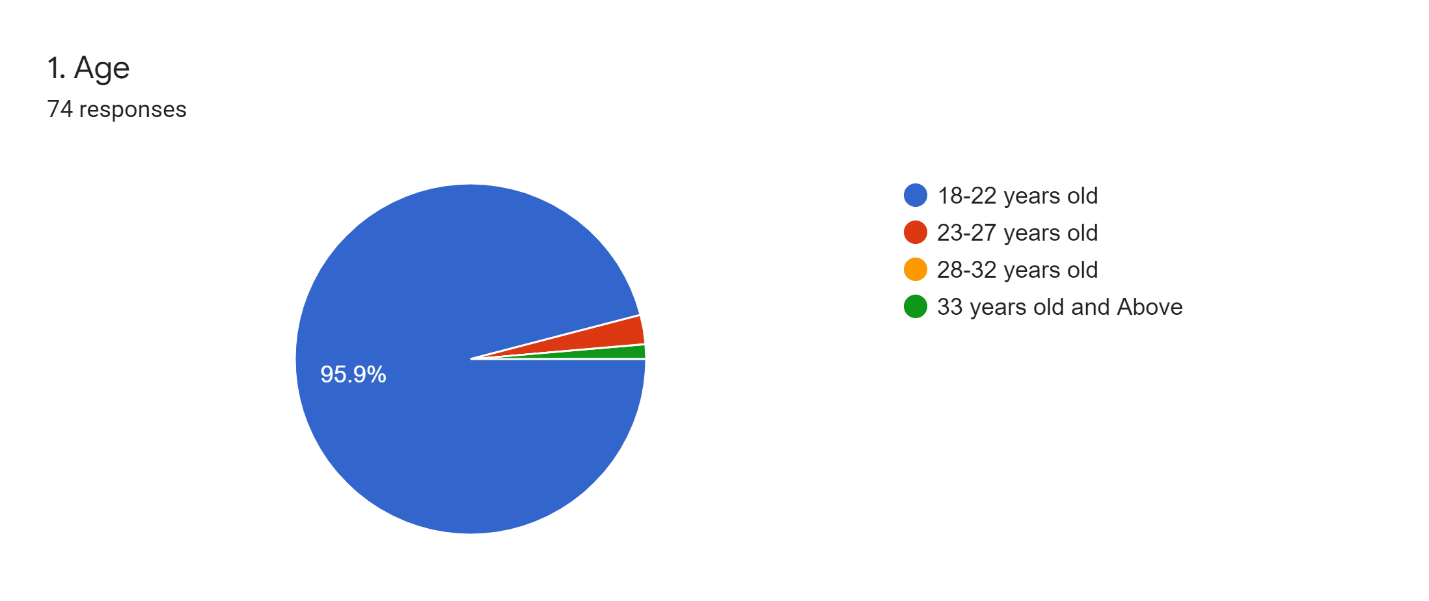
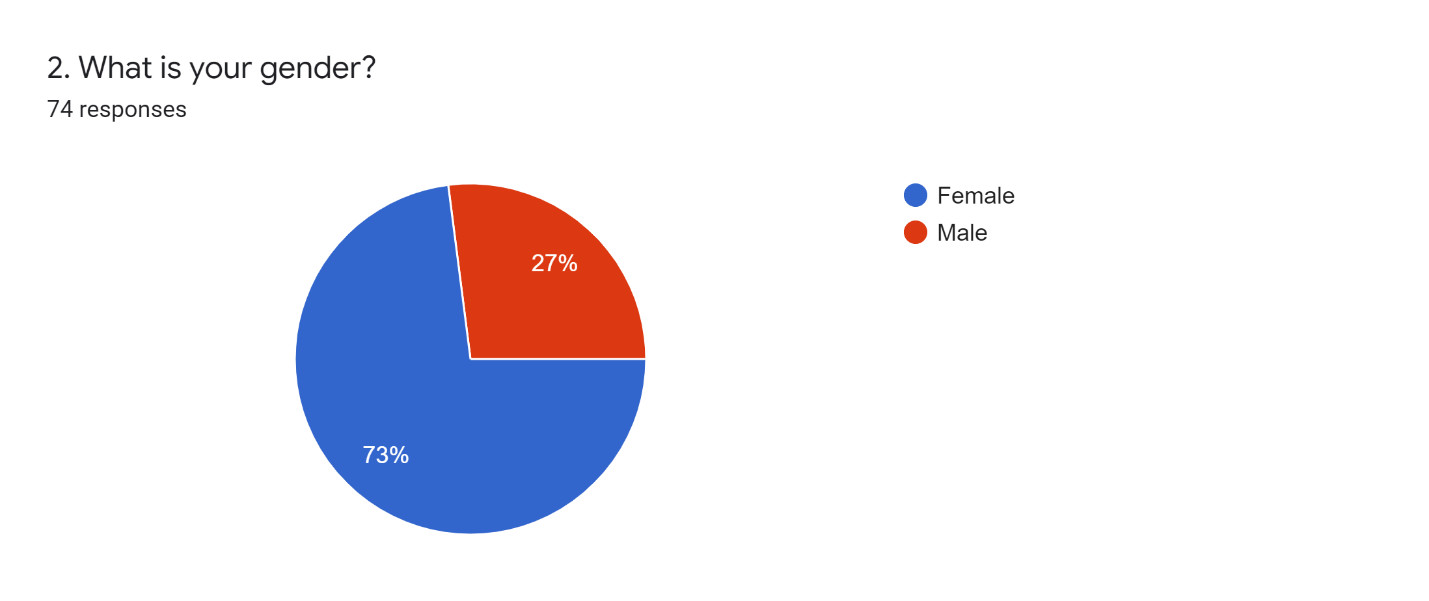
The majority of the respondents (73%) were females and (27%) were male.
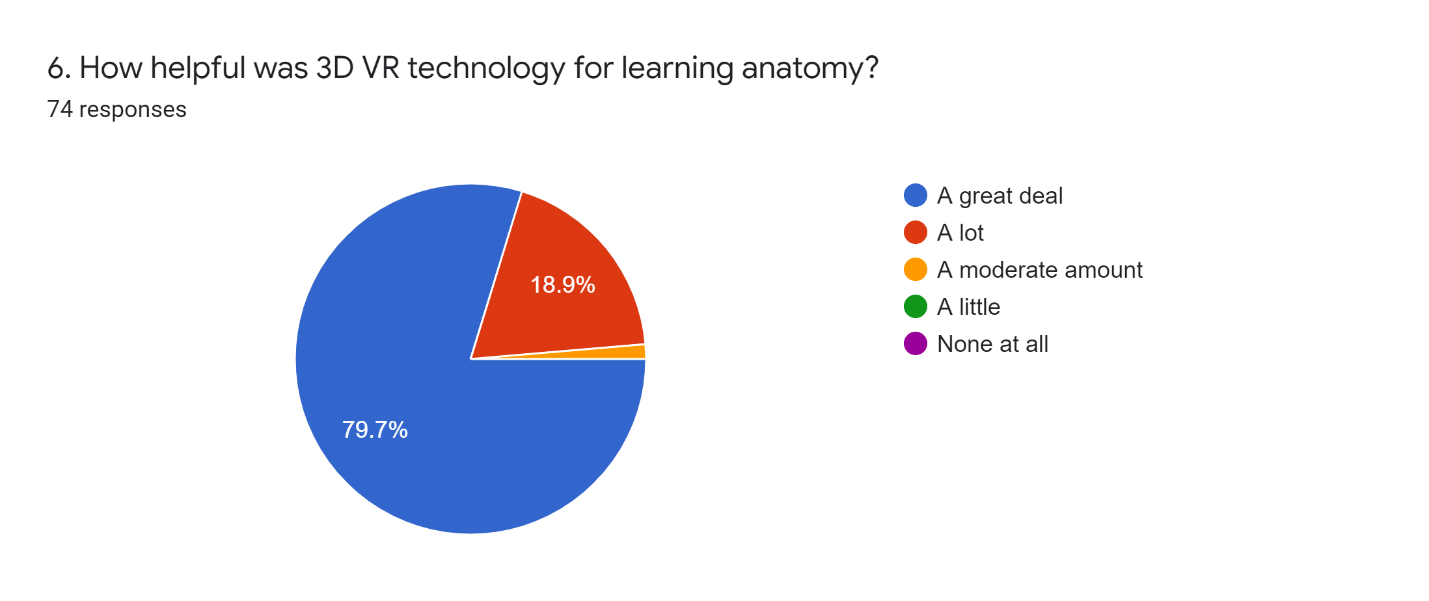
The percentage of cohort 1a respondents were (71.6%) and cohort 1b was 28. The students belonged to 11 different nationalities. Specific questions regarding the healthfulness of 3D Organon in learning anatomy were included in the survey, (79.7%) of students reported that VR anatomy has helped them a great deal in learning anatomy.
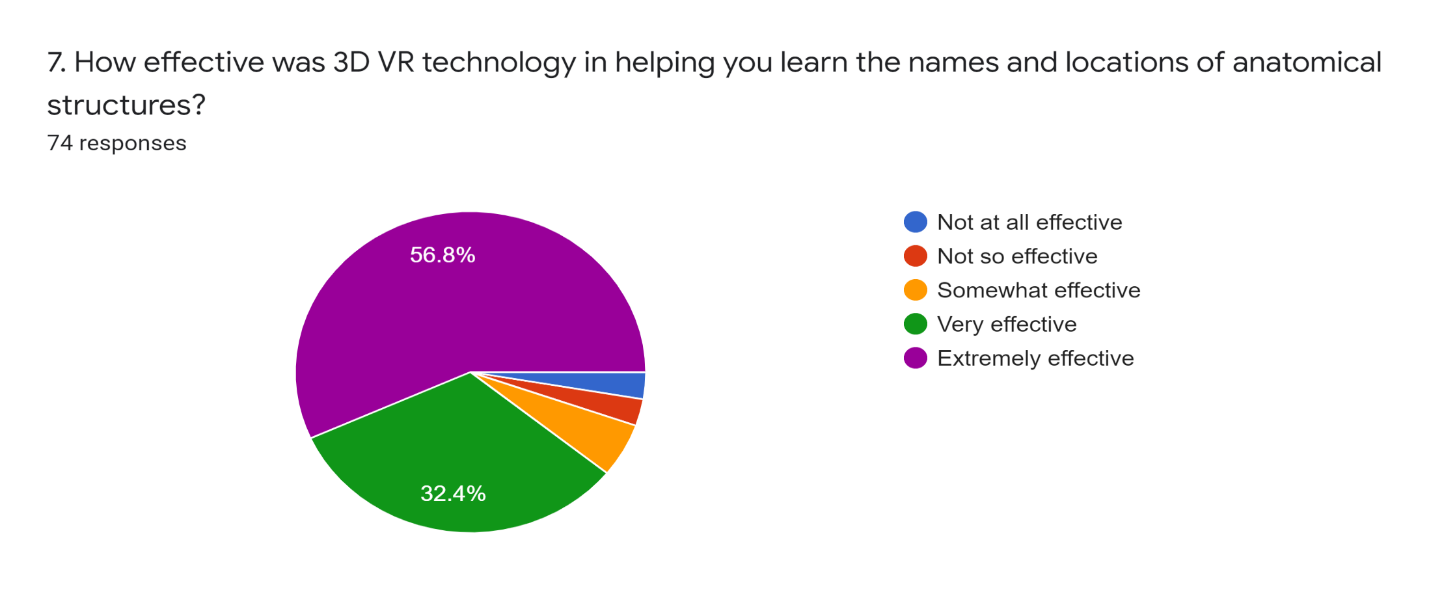
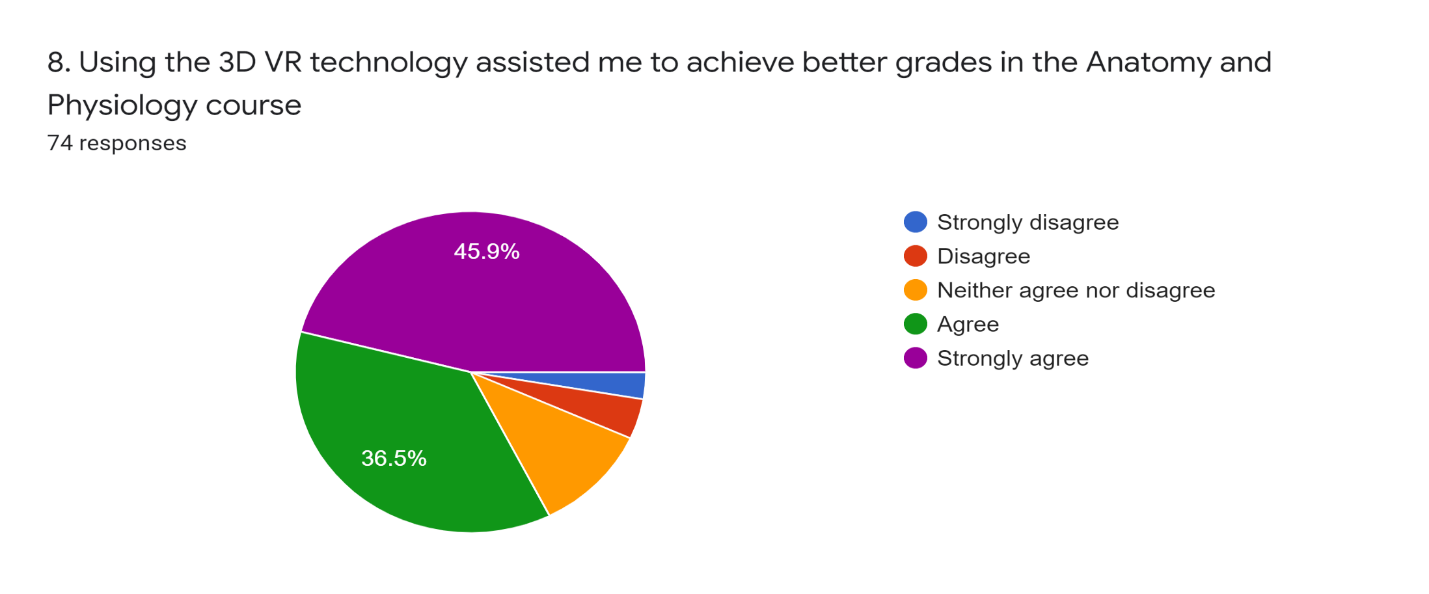
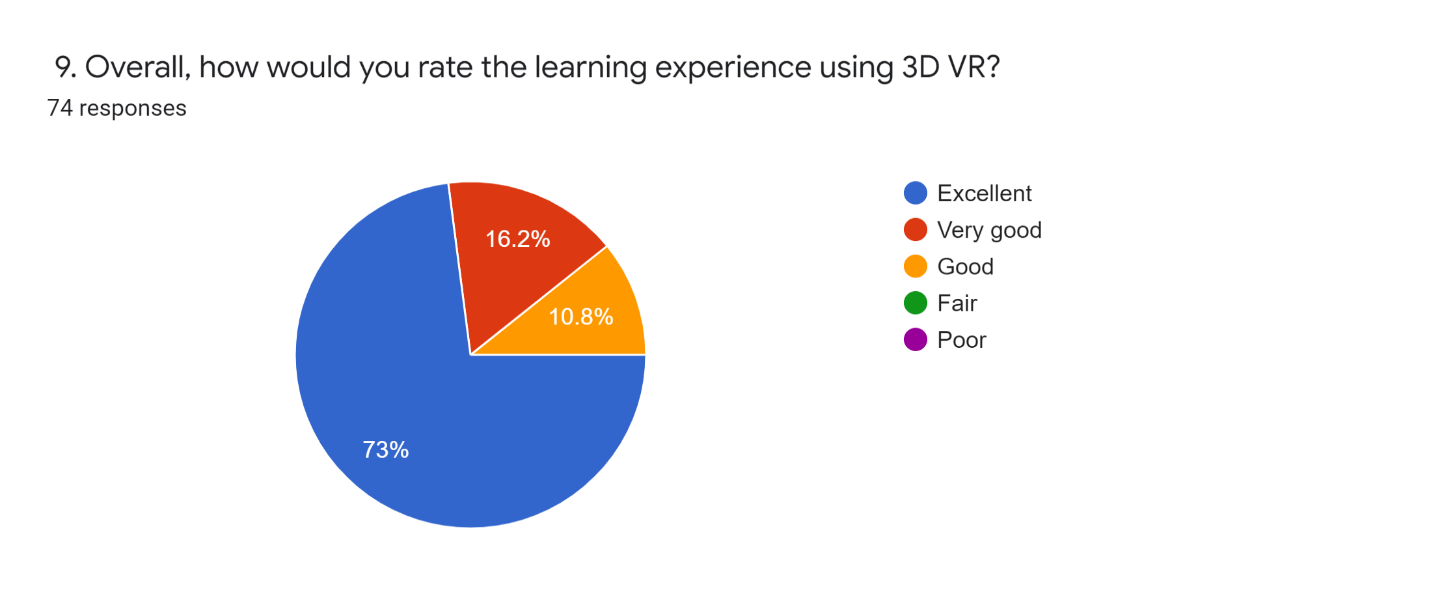
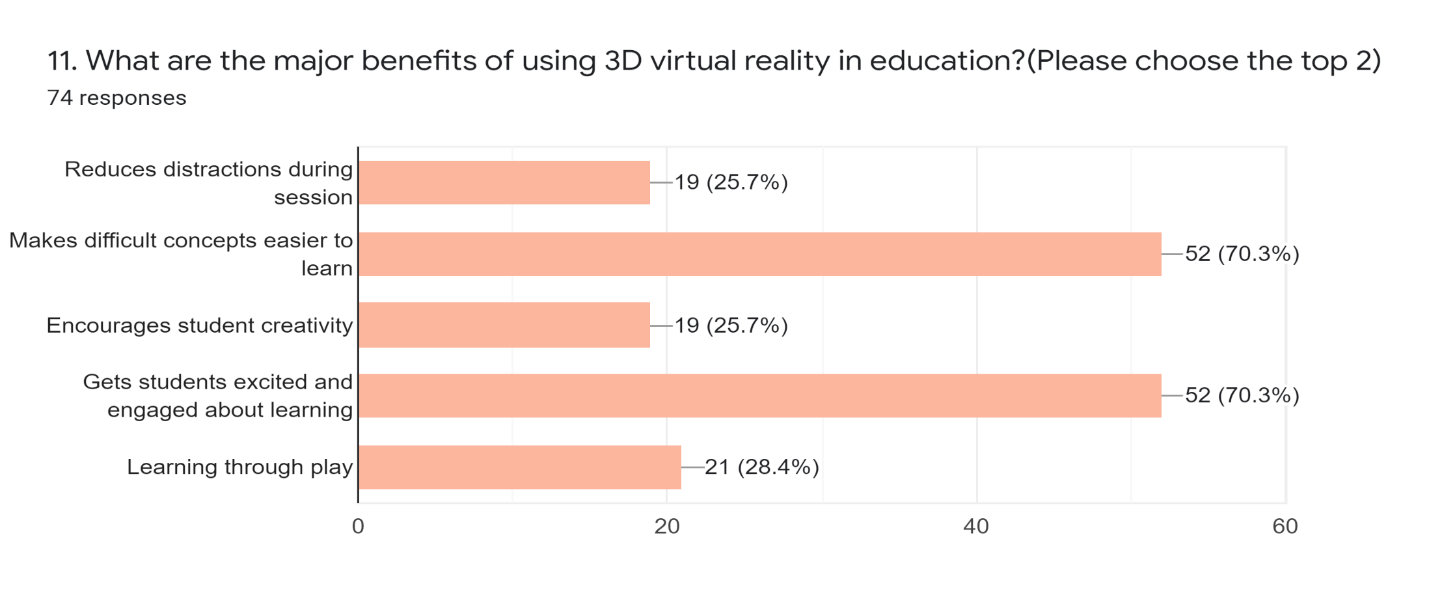
(56.8%) of students expressed that the 3D VR anatomy is an extremely effective tool to learn the name and location of anatomical structure at the same time (32.4%) replied that it is very effective. (45.9%) of the students strongly agreed that the VR technology assisted them to achieve better grades in the course with (36.5%) who agreed. (73%) of students commented that the VR anatomy learning experience was excellent. The students were asked to choose the two greatest advantages of VR reality in education to which they responded equally 1. Makes difficult concepts easier to learn and 2. Gets students excited and engaged to learn (70.3%) each.
Discussion
Digital technology and its applications are revolutionizing the entire world, and its application is increasing, (VR) technology has been an effective tool when compared with other traditional anatomy teaching and learning approaches in 3D skull models. 15Shi Chen1. Nursing students advocate the usage of VR as a complementary tool in the anatomy teaching and learning process.16 Mohamad M. SaabJosephine HegartyDavid MurphyMargaret Landers. When making use of a 3D virtual reality tool for CT- anatomy teaching and training program all participants reported that they possessed the capacity to comprehend and retain and to work with it very efficiently and were enthusiastic about its potential in medical education. 17. Cite this article Yu, L., Ouwerling, J., Svetachov, P. et al. VeLight: A 3D virtual reality tool for CT-based anatomy teaching and training. J Vis 25, 293–306 (2022). https://doi.org/10.1007/s12650-021-00790-y. A meta-analysis of randomized control trials suggested that VR can work as an effective way to improve the learners’ level of anatomy knowledge. 18Jingjie Zhao1†, Xinliang Xu2†, Hualin Jiang3* and Yi Ding4. Knowledge retention evaluation after utilizing traditional and VR anatomy teaching and learning strategies suggested that short-term and long-term retention of knowledge is possible and many so the findings validate the opinion expressed by our samples. However, a curriculum that chooses to involve VR in its teaching and learning strategy should fully evaluate the benefits and limitations before utilizing it.19 Yasser Alharbi , Mubarak Al-Mansour , Radi Al-Saffar , Abdullah Garman , Abdulrahman Alraddad. There has been a compilation of students and faculty’s preferences while utilizing Virtual reality in anatomy education both stakeholders agree that VR facilitates self-directed learning however the students prefer the presence of the faculty during the process of teaching and learning. The students prefer autonomous learning while the teachers opted for the students to undergo collaborative learning. The students wanted feedback instantaneously during the session whereas the teachers would like to provide feedback at the end of each Virtual reality session.20 VR4Health: Personalized teaching and learning anatomy using VR
M Fairén 1, J Moyés 1, E Insa 2.
Conclusion
From the survey findings it is evident that nursing students find virtual reality as an effective tool for learning Anatomy.
Acknowledgments
References
Cite This Work
To export a reference to this article please select a referencing stye below:





