
 Literature
Academic Book
Frankenstein; or, the Modern Prometheus
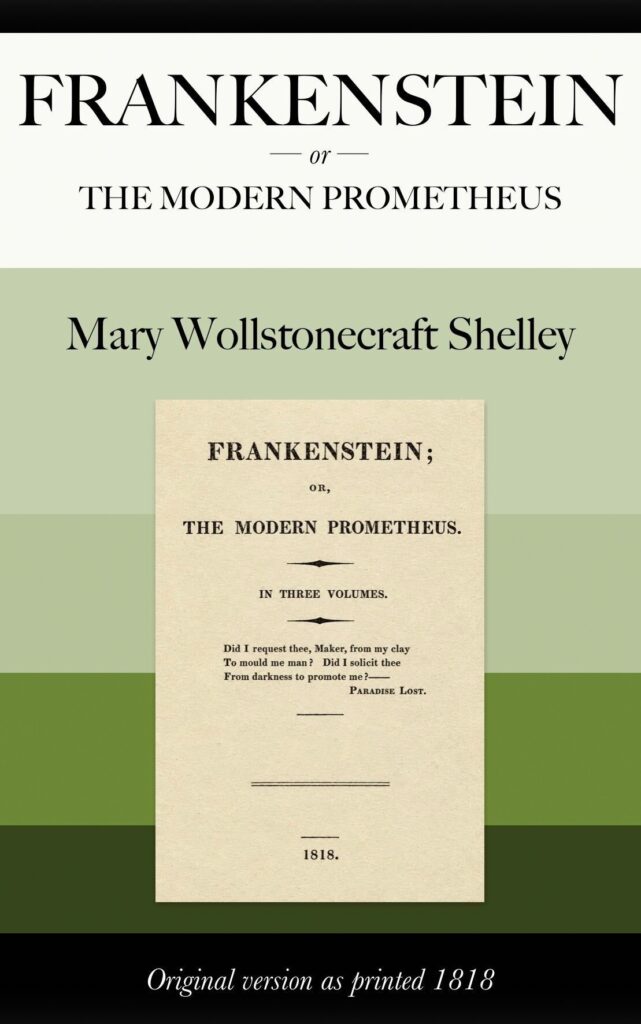
5 / 5 · 1 ratingsRate this bookMary Shelley connects the pursuit of discovery with questions of care, responsibility, and ambition. This text is transcribed from a photo-reprint of the 1818 edition and preserves its three-volume structure. The guide examines Walton’s first letter and the creation scene in Volume I, Chapter IV, using references specific to this edition.
Read on the publisher’s website. Opens in a new tab.
 Free
About this book
Frankenstein brings a narrative of scientific ambition into a framework of letters, recollection, and personal testimony. Walton’s first letter presents discovery as a source of glory and a possible benefit to humanity. Victor’s account of animating the creature exposes a different side of achievement: the desired result produces horror and flight instead of welcome. The selected scenes make the relationship between ambition and responsibility a central subject for close reading.
Project Gutenberg eBook 41445 was digitally released in 2012. Its transcriber states that it was prepared from a photo-reprint of the 1818 edition, and its title pages reproduce the original London publication. The text contains a preface, four opening letters, and three volumes with 7, 9, and 7 chapters respectively. Chapter numbering restarts in each volume. The HTML ISBN and displayed year identify the Gutenberg publication. MIT’s Reading Fiction: Imaginary Journeys course assigns Shelley’s novel in a different specified edition; this verifies academic use of the work. The guide covers Letter I, Volume I, Chapter IV, and Volume II, Chapter II and includes spoilers.
This edition is especially useful when an assignment requires references to the 1818 structure. A chapter number alone can be misleading: the creation scene occurs in Volume I, Chapter IV here, and the encounter on the glacier occurs in Volume II, Chapter II. Students comparing another edition should check the scene as well as the number before transferring a citation. The contents on this page preserve the source’s volume divisions for that reason.
The glacier encounter extends the questions raised by Victor’s withdrawal after creation. The being he describes as intolerable becomes a speaker who asks to be heard, invokes obligations between creator and creature, and connects his suffering with rejection. Victor’s hostile descriptions remain present, but they no longer provide the only account available in the scene. The reader must compare accusation, appeal, threat, and the eventual decision to listen.
Academic Master’s analysis focuses on how Shelley makes responsibility a matter of relationship and interpretation. Walton’s imagined discovery, Victor’s recoil, Clerval’s care, and the creature’s appeal offer different responses to dependence and vulnerability. Reading them together supports a more precise discussion than a general claim that ambition is simply good or bad. The point is to identify what a particular character wants, what that character notices, and what obligations the character accepts or refuses.
Book contents
Preface, four opening letters, and three volumes. Volume I has 7 chapters, Volume II has 9, and Volume III has 7. Numbering restarts in each volume.
View the verified contents
- Preface
- Letter I.
- Letter II.
- Letter III.
- Letter IV.
- Volume I — Chapter I.
- Volume I — Chapter II.
- Volume I — Chapter III.
- Volume I — Chapter IV.
- Volume I — Chapter V.
- Volume I — Chapter VI.
- Volume I — Chapter VII.
- Volume II — Chapter I.
- Volume II — Chapter II.
- Volume II — Chapter III.
- Volume II — Chapter IV.
- Volume II — Chapter V.
- Volume II — Chapter VI.
- Volume II — Chapter VII.
- Volume II — Chapter VIII.
- Volume II — Chapter IX.
- Volume III — Chapter I.
- Volume III — Chapter II.
- Volume III — Chapter III.
- Volume III — Chapter IV.
- Volume III — Chapter V.
- Volume III — Chapter VI.
- Volume III — Chapter VII.
Book summary
Spoiler notice: This guide discusses important events and, where covered, the ending.
Study overview of selected passages
Walton’s first letter makes exploration both a practical undertaking and an imaginative project. He envisions the pole as a region of beauty and discovery, hopes to investigate magnetism, and argues that a new passage could benefit humanity. His account of physical preparation gives those hopes the appearance of discipline. Yet he also recalls his wish for poetic fame and directly asks whether he deserves a great accomplishment.
The letter’s confidence is therefore qualified by its need for reassurance. Walton’s sister is a recipient of affection and a witness to the danger he accepts. The uncertain date of his return leaves the promise of achievement beside the possibility of permanent loss. Academic Master’s reading asks students to examine how claims of public benefit and a desire for personal glory occupy the same voice.
Volume I, Chapter IV presents the moment when Victor’s long-awaited achievement becomes unbearable to him. His carefully selected features do not produce the beauty he expected once the creature moves. He withdraws, dreams of death, and flees again when the being approaches. The account makes a change in perception central to his response; it does not give readers independent access to the creature’s intentions in this scene.
Clerval’s arrival and prolonged care introduce a different response to vulnerability. Victor receives attention while the being he animated receives rejection. Reading the letter and chapter together brings ambitious self-description into contact with the demands of relationship. This selective guide invites analysis of care, secrecy, and narrative perspective without treating the novel as a simple prohibition on discovery or claiming that these two sections exhaust its argument.
Selected chapter and passage summaries
Letter I
Writing to his sister from St. Petersburgh, Walton describes the attractions and possible benefits of a northern expedition. He recounts reading, preparation, hardship, and an earlier desire for poetic fame. Confidence alternates with a wish for encouragement and uncertainty about returning. The letter introduces ambition through Walton’s own account, allowing students to distinguish his imagined destination, practical training, and need for personal recognition.
Volume I, Chapter IV
Victor animates the creature but recoils from its appearance and leaves it. A disturbing dream and another encounter intensify his fear. Clerval arrives, observes his condition, and later nurses him through a lengthy illness. The chapter contrasts Victor’s withdrawal with the care he receives from his friend. Its events are filtered through Victor’s recollection; the creature’s gestures are described without an independent account of its intentions.
Further chapter analysis
Volume II, Chapter II — The glacier encounter
Victor seeks relief in an Alpine landscape before meeting the creature on the glacier. His first response is anger and the desire for combat. The creature asks for a hearing, claims that exclusion has altered his character, and appeals to the duties of his creator. Threats accompany that appeal, so it should not be treated as an uncomplicated declaration of innocence. Victor eventually agrees to listen, moved by curiosity, compassion, and a growing recognition of responsibility. The chapter ends as the creature prepares to tell his own story.
Reading the major connections
Achievement and the response it creates
Academic Master suggests setting Walton’s first letter beside Victor’s description of the creature’s animation. Walton anticipates wonder, recognition, and benefit; Victor finds that the achievement he desired no longer produces the feeling he expected. Their situations differ, but the contrast allows students to analyse a gap between an imagined outcome and a response to its reality. An argument about ambition should account for that gap rather than assuming that the desire to discover determines everything that follows.
Receiving care and accepting responsibility
Clerval’s attention helps Victor recover after the creation scene. On the glacier, the creature asks Victor to recognize obligations toward a being whose life depends on his actions. Academic Master proposes comparing these relationships carefully. Receiving help does not automatically teach Victor to offer it, while the creature’s appeal also includes the possibility of retaliation. A useful discussion separates the claim to care from the means used to enforce that claim.
Appearance, testimony, and the right to be heard
Victor repeatedly interprets the creature through its appearance and his own distress. The glacier conversation challenges that exclusive perspective by giving the creature an argument and a request for a hearing. Students should distinguish the creature’s claims from independently confirmed events: agreeing to listen is a change in Victor’s response, not proof that every subsequent statement must be true. The chapter shows why testimony needs attention before judgment, while leaving the work of evaluating it to the continuing narrative.
Landscape and changing emotion
The Alpine setting briefly consoles Victor, then becomes the location of confrontation. His mood responds to rain, obscured peaks, clearing mist, and the glacier’s scale. Academic Master’s reading asks how a landscape that appears to offer escape instead brings an unresolved relationship back into view. Compare the emotion Victor attaches to the scene before the creature arrives with the emotions that govern the conversation afterward.
Questions for discussion and written work
- How does Walton support his confidence, and which parts of his letter reveal uncertainty?
- Which details in the creation scene belong to Victor’s assessment rather than to an independently established intention of the creature?
- What comparison can be made between Clerval’s care for Victor and the creature’s demand for care?
- How does the glacier encounter change the reader’s access to the creature’s perspective?
- Does Victor agree to listen for one reason or several? Trace the motives he identifies.
Suggested close-reading approach
Build an argument around a precise change in a character’s response. Record the speaker, the evidence available, and the language of judgment before and after that change. When citing this edition, include the volume and chapter, and check whether your instructor requires another text. These prompts are Academic Master’s editorial study material.
Sources and coverage
This expanded selective guide is based on Letter I, Volume I, Chapter IV, and Volume II, Chapter II, read in full in Project Gutenberg eBook 41445. Edition information and the complete chapter structure were checked. The remaining text was not reviewed in full. This is selective study coverage, not an exhaustive chapter-by-chapter account.
Read the source text · Edition and format details · Course reading list
About access & copyright
This page provides book information and study material. Full-text access is provided by the original publisher or authorised source; a listing does not grant permission to republish the book.
Read our Library Access & Copyright policyAmbition and recognition
Compare Walton’s proposed public benefits with his desire for glory.
Perspective and evidence
Separate Victor’s descriptions from what is known about the creature’s intentions.
Care and responsibility
Compare Victor’s withdrawal with Clerval’s sustained attention.
Edition awareness
Use volume and chapter references appropriate to the 1818 text.
Reader ratings & reviews
Share your thoughts
Your review helps other students choose the right resources.
KEEP LEARNING
Your next great read
Literature Literature
Adam Bede
View Adam Bede — book Literature
The Odyssey
View The Odyssey — book Literature
Tess of the d'Urbervilles: A Pure Woman
View Tess of the d'Urbervilles: A Pure Woman — book Literature
Lady Audley's Secret
View Lady Audley's Secret — book Literature
Mrs. Dalloway
View Mrs. Dalloway — book Literature
Don Quixote
View Don Quixote — book Literature
Heart of Darkness
View Heart of Darkness — book Literature
Pride and Prejudice
View Pride and Prejudice — book Literature



