
 Psychology
Student SuccessTextbook
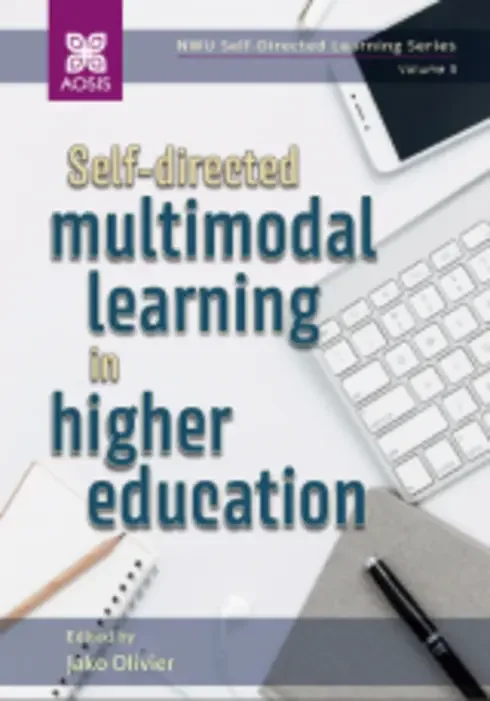
Self-directed multimodal learning in higher education
Not rated yetRate this bookSelf-directed multimodal learning in higher education is a 2020 research collection edited by Jako Olivier, with chapters by several education researchers. Its eleven chapters connect learner agency, blended and distance education, open practices, collaboration, cultural context, and course design. The studies are situated primarily in Southern African higher education. This guide preserves the difference between conceptual proposals, literature reviews, reflective inquiry, and empirical studies, helping readers assess what each chapter establishes and how cautiously its findings should be transferred to another setting.
Free reading is available at the official source. Opens in a new tab.
 Free
About this book
Self-directed multimodal learning in higher education is a 2020 research collection edited by Jako Olivier, with chapters by several education researchers. Its eleven chapters connect learner agency, blended and distance education, open practices, collaboration, cultural context, and course design. The studies are situated primarily in Southern African higher education. This guide preserves the difference between conceptual proposals, literature reviews, reflective inquiry, and empirical studies, helping readers assess what each chapter establishes and how cautiously its findings should be transferred to another setting.
Book summary
Self-directed multimodal learning in higher education is a 2020 research collection edited by Jako Olivier, with chapters by several education researchers. Its eleven chapters connect learner agency, blended and distance education, open practices, collaboration, cultural context, and course design. The studies are situated primarily in Southern African higher education. This guide preserves the difference between conceptual proposals, literature reviews, reflective inquiry, and empirical studies, helping readers assess what each chapter establishes and how cautiously its findings should be transferred to another setting.
Chapter-by-chapter summaries
Chapter 1 — Self-Directed Multimodal Learning and Transformative Open Education
Jako Olivier establishes the collection’s conceptual vocabulary by relating learning to communication and meaning-making. Multimodality is examined through individual, interactional, instructional, and institutional dimensions, rather than reduced to putting several media formats on a course website. Self-direction concerns learners’ participation in identifying needs, selecting resources and strategies, and evaluating learning; it does not imply that support disappears. The chapter connects these ideas with open education and transformation. Build a map distinguishing an individual’s resources, interactions with others, the design of instruction, and institutional arrangements. Then explain which dimension a proposed intervention changes. This prevents a technological change from being mistaken automatically for greater learner agency or educational transformation.
Chapter 2 — Community of Inquiry in South African Research
Chantelle Bosch, Dorothy Laubscher, and Jako Olivier review South African articles and postgraduate research from 2009–2019 concerning blended learning, self-directed learning, and the Community of Inquiry framework. Cognitive, social, and teaching presence provide a way to examine how inquiry is supported. The review also investigates methods, contexts, instruments, and gaps in the literature. Distinguish a study’s mention of self-direction from direct investigation of it. Make an evidence table recording the population, design, measure, and conclusion of several included studies. The chapter’s value lies partly in showing where apparently connected concepts have been studied unevenly, creating questions for further research rather than a universal prescription for every online course.
Chapter 3 — Adaptive Learning Technology
Donnavan Kruger considers how adaptive systems might support learners with different prior knowledge, needs, and progress. The chapter proposes connections between adaptive learning and self-direction through goal orientation, diagnosis and planning, resource use, monitoring, motivation, and the affective domain. Its conceptual model should not be treated as proof that every adaptive product develops these capacities. Ask who controls the learning path and whether the learner understands or can question the system’s recommendations. Compare automatic personalization with a design that helps students become better judges of their own learning. A useful application identifies what evidence would be needed to establish both improved task performance and increased self-direction.
Chapter 4 — Design Guidelines from a Systematic Literature Review
Dorothy Laubscher and Chantelle Bosch examine literature to develop guidelines for self-directed blended learning environments. Course design, structure, evaluation, feedback, resources, tasks, collaboration, motivation, reflection, and facilitation are treated as connected design concerns. The review’s search and coding processes matter because they shape which evidence informs its recommendations. Trace one guideline back to the problem it addresses and the support offered for it. Then apply it to a sample course: identify a concrete learner action, the support available, and how its usefulness could be evaluated. The chapter helps turn broad enthusiasm for blended learning into explicit design decisions that can be examined and revised.
Chapter 5 — Diffractive Pathways in Botswana and South Africa
Mmabaledi Seeletso and Jako Olivier compare lived experiences at institutions in Botswana and South Africa through autoethnographical reflection. Diffraction is used to read intersecting experiences through one another, highlighting how distance and contact traditions can reshape the interpretation of blended learning. This differs from a controlled comparison designed to isolate a single causal effect. Identify the institutional histories, participants’ positions, and situations informing each account. Ask what becomes visible through the comparison that would be missed if one institution were treated as the standard. For an original reflection, examine how a practice familiar in one setting takes on a different meaning when transferred into another.
Chapter 6 — Cooperative Learning in Google Docs
Christo van der Westhuizen and Elsa Mentz investigate cooperative-learning elements within an online, self-directed, problem-based environment. The concern is not simply whether students share a document, but whether they participate responsibly, communicate, and contribute toward a shared goal. The chapter connects the design with Community of Inquiry measures and participant feedback. Distinguish the platform’s affordances from the instructional arrangements that make collaboration meaningful. Map responsibilities, individual accountability, interdependence, and opportunities for dialogue in a sample task. When evaluating results, separate perceptions of a learning environment from demonstrated changes in knowledge or skill, and consider what the study’s context allows readers to infer.
Chapter 7 — Situated and Culturally Appropriate Learning
Jako Olivier examines how learning content and activities relate to learners’ contexts, cultural experiences, and participation in determining what is studied. Lecturer interviews and open-ended student responses provide evidence for the discussion. The chapter reports both existing practices and shortcomings, with recommendations for more situated and culturally appropriate content. Avoid treating culture as a fixed checklist or assuming all members of a group share the same needs. Compare a generic learning activity with one developed through consultation with its intended learners. Explain how the change affects meaning, access, and agency, while identifying which assumptions still need to be tested with those learners.
Chapter 8 — Scaffolding Teachers’ Critical Reflection
Corné Kruger investigates reflective journaling within a South African distance-learning teacher-education programme. A two-cycle design-based study uses evidence from an initial reflective format to revise the support provided, then examines the later cycle. The analysis distinguishes levels of reflection instead of assuming every journal entry is critically reflective. Compare a description of an event with an entry that examines assumptions, considers alternatives, and explains a future action. Trace the relationship between a revised prompt and the kind of thinking it is intended to encourage. The chapter illustrates iterative educational design, while inviting careful consideration of what coding categories and changes between cycles can establish.
Chapter 9 — Optimising Community of Inquiry Principles
Christo van der Westhuizen follows the design of an online problem-based environment using feedback from third-year geography student teachers across several years. Teaching, social, and cognitive presence provide the organizing framework, and the chapter discusses changes in the collaborative workspace, including a move from a learning-management-system wiki to Google Docs. Read the reported positive perceptions alongside the study’s design and measures. The useful question is which combination of task, facilitation, communication, and technology appears to support inquiry. Compare this chapter with Chapter 6 to identify shared concepts and differences in emphasis, rather than counting related reports as completely independent proof of a platform’s effectiveness.
Chapter 10 — Blending and Cooperating in Computer Literacy
Roxanne Bailey and Elsie Lubbe examine whether a computer-literacy module can also help pre-service teachers develop self-directed-learning skills. The discussion distinguishes computer skills from the broader demands of digital literacy and connects blended and cooperative strategies with lifelong learning. A quasi-experimental design supports the investigation, so group arrangements, measures, and alternative explanations deserve attention. Create separate outcome categories for technical performance, learner perception, and self-direction. Ask whether a change in one category establishes a change in the others. The chapter’s practical contribution is to make the development of learning capacity an explicit educational aim alongside subject content.
Chapter 11 — Conclusion
Olivier brings the conceptual, review-based, reflective, and empirical contributions into conversation. The synthesis revisits levels of multimodality, Community of Inquiry, contextual appropriateness, collaboration, and the design of support for self-direction. It also highlights that self-directed learning can be invoked without receiving sustained investigation. Build a cross-chapter matrix separating research question, approach, setting, finding, and limitation. Then formulate a bounded proposal for your own context, identifying which chapters support it and what still requires testing. A strong conclusion from the collection recognizes promising relationships without treating different forms of evidence as interchangeable or assuming that one design will work identically everywhere.
Contributor Notes, Instruments, References, and Index
The contributor notes clarify that this is an edited scholarly collection with distinct chapter authors. The instrument excerpts associated with the situated-learning chapter show how broad concepts become questions asked of participants. The references and index support tracing theoretical sources and following themes across chapters. Select one concept, such as social presence or learner agency, and compare how it is defined and investigated in several contributions. Before adapting a questionnaire or activity, examine whether its wording, purpose, and context fit your question. A final reading portfolio should show both what the collection taught you and what evidence would be needed before applying its recommendations confidently.
Study instructions
- Read Chapter 1 first, then keep a glossary that distinguishes self-directed learning, self-regulation, blended learning, and the levels of multimodality.
- For every chapter, record its authors, question, context, research approach, evidence, findings, and limitations.
- Compare the Community of Inquiry chapters through cognitive, social, and teaching presence, identifying the actual activities supporting each.
- Choose a course-design problem and develop one small intervention with an explicit learner action, support mechanism, and evaluation plan.
- Finish by comparing evidence across chapters and stating what would need to be checked before transferring a finding to your own institution.
Questions for reflection
- When does personalization support learner agency, and when might it reduce it?
- What is the difference between positive perceptions and demonstrated learning outcomes?
- How can collaborative work preserve individual responsibility?
- What makes content culturally situated without assuming a single experience for every learner?
Sources and coverage
This original reading guide follows the linked source edition’s chapter, module, unit, or lesson structure. Consult the source for full arguments, cases, worked examples, exercises, illustrations, and references. Coverage follows the 2020 AOSIS edition, NWU Self-Directed Learning Series, Volume 5. Jako Olivier is the editor; chapter contributors are identified throughout the guide. Read the source edition.
About access & copyright
This page provides book information and study material. Full-text access is provided by the original publisher or authorised source; a listing does not grant permission to republish the book.
Read our Library Access & Copyright policyExplore the contents
Check the chapters covered in this edition.
Visit the official source
See reading, preview or purchase options.
Save for later
Keep this textbook in your saved collection.
Reader ratings & reviews
Share your thoughts
Your review helps other students choose the right resources.
KEEP LEARNING
Your next great read
Psychology Student Success
College Success
View College Success — book Humanities
Writing for Success
View Writing for Success — book Student Success
Six Steps To Job Search Success
View Six Steps To Job Search Success — book Humanities
The Process of Research Writing
View The Process of Research Writing — book Law
Law School Materials for Success
View Law School Materials for Success — book Student Success
Bridges: United States Academia for First-Generation and International College Students
View Bridges: United States Academia for First-Generation and International College Students — book Student Success
Writing for Inquiry and Research
View Writing for Inquiry and Research — book Social Sciences
Practicing and Presenting Social Research
View Practicing and Presenting Social Research — book Humanities



