
 Intellectual property law
LawTextbook
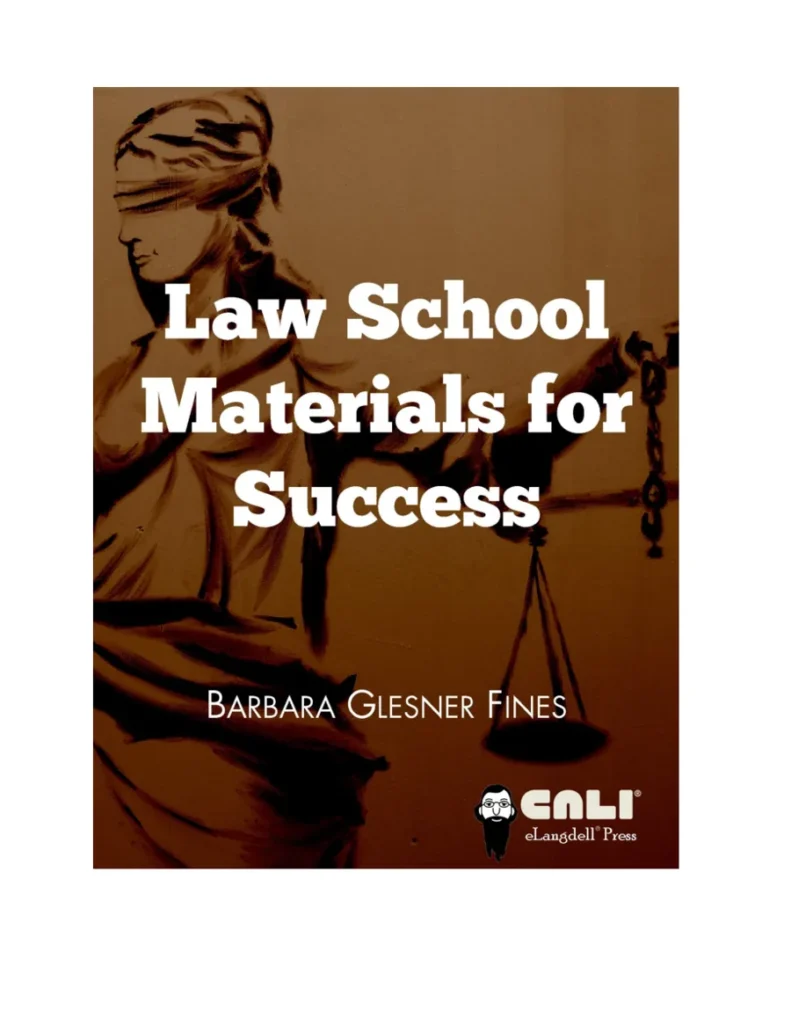
Law School Materials for Success
Not rated yetRate this bookBarbara Glesner Fines’s Law School Materials for Success approaches study as a cycle of preparation, participation, consolidation, and assessment. The linked 2014 text contains seven chapters, beginning with personal resources and ending with planning for the next semester. Its practical emphasis is on making learning activities serve the skills assessed in legal education. Use the recommendations to design and evaluate a workable routine rather than treating more hours or longer notes as automatic evidence of progress. Adapt exercises to the actual requirements of a course.
Free reading is available at the official source. Opens in a new tab.
 Free
About this book
Barbara Glesner Fines’s Law School Materials for Success approaches study as a cycle of preparation, participation, consolidation, and assessment. The linked 2014 text contains seven chapters, beginning with personal resources and ending with planning for the next semester. Its practical emphasis is on making learning activities serve the skills assessed in legal education. Use the recommendations to design and evaluate a workable routine rather than treating more hours or longer notes as automatic evidence of progress. Adapt exercises to the actual requirements of a course.
Cover: source-edition cover, displayed to identify the linked book. Publisher and third-party rights remain with their respective holders.
Book summary
Barbara Glesner Fines’s Law School Materials for Success approaches study as a cycle of preparation, participation, consolidation, and assessment. The linked 2014 text contains seven chapters, beginning with personal resources and ending with planning for the next semester. Its practical emphasis is on making learning activities serve the skills assessed in legal education. Use the recommendations to design and evaluate a workable routine rather than treating more hours or longer notes as automatic evidence of progress. Adapt exercises to the actual requirements of a course.
Chapter-by-chapter summaries
1. Assessing resources
Study performance depends on time, attention, health, support, expectations, and existing skills. An honest inventory identifies constraints without turning them into fixed judgments about ability. Map obligations and available study periods, including recovery and predictable disruptions. Compare the time a plan assumes with the time genuinely available. The chapter frames success through deliberate resource use rather than an idealized schedule that fails immediately when ordinary life intervenes. Set specific priorities and identify support before a small difficulty becomes an avoidable crisis.
2. Preparing for class
Reading cases requires identifying issues, facts, posture, holdings, reasoning, and unresolved questions. A case brief should support understanding and participation rather than reproduce every sentence. Distinguish the court’s rule from facts that may limit its application. Prepare a question or counterexample to test comprehension. Reading ahead without organizing relationships can create familiarity without usable knowledge. The chapter connects preparation with the ability to explain and apply a principle when class discussion changes the factual setting.
3. Getting the most from class
Participation and note-taking should refine understanding, expose disagreements, and record the reasoning behind distinctions. Transcribing every word can crowd out active thought. Compare your prepared account with the instructor’s questions and identify why an initially plausible answer needs qualification. Record unresolved points for follow-up. The chapter treats class as an opportunity to test a model of the law, not simply acquire authoritative phrases to repeat later. Listening and revising are as important as speaking frequently.
4. After-class review
Prompt review consolidates relationships while the reasons for a discussion remain recoverable. Reconcile notes with the reading and identify errors or gaps. Turn a vague feeling of confusion into a specific question, then resolve it through appropriate sources or discussion. Retrieval is a useful check: explain the principle without looking before returning to notes. The chapter makes review a continuing process, avoiding the accumulation of disconnected class records that must be reconstructed from scratch before an exam.
5. Outlining and exam preparation
An outline organizes doctrine for analysis rather than serving as a compressed transcript. Build structures around elements, competing rules, exceptions, policy, and fact-sensitive distinctions. Practice applying them to unfamiliar problems. Compare an answer with its reasoning demands instead of judging preparation by outline length. Timed practice exposes both knowledge gaps and execution problems. The chapter links synthesis with retrieval and transfer, explaining why a borrowed polished outline may be less useful than an actively developed, tested one.
6. Taking an exam
Exam performance requires reading instructions, allocating time, identifying issues, applying rules to facts, and communicating justified conclusions. A correct rule stated without analysis may leave the central task unfinished. Plan a response that addresses plausible competing arguments and explains the significance of facts. Track time against the assessment’s structure rather than perfection on the first issue. Review a practice answer for omitted analysis, unsupported assertions, and unclear organization. Technique helps reveal knowledge but cannot replace the underlying preparation.
7. The next semester
Reflection turns experience into a revised study process. Use feedback to distinguish problems in comprehension, recall, application, timing, and expression. A disappointing result does not identify its own cause. Compare the routine used with the skills the course assessed and choose a specific change that can be evaluated. Retain effective practices rather than replacing everything at once. The final chapter treats learning as iterative and supports a plan grounded in evidence from prior work instead of vague promises to work harder.
Study instructions
- Create a realistic weekly plan covering preparation, class, review, practice, and recovery.
- Use short retrieval and application tasks to test whether reading produced usable understanding.
- Build and revise your own outline through actual problems.
- After feedback, identify one error pattern, its likely cause, and a measurable change for the next cycle.
Questions for reflection
- What makes a case brief useful rather than merely complete?
- How can an outline create familiarity without application skill?
- Which evidence would explain an exam result better than the score alone?
Sources and coverage
This original reading guide follows the linked source edition’s chapter, module, unit, or lesson structure. Consult the source for full arguments, cases, worked examples, exercises, illustrations, and references. Guide to the linked 2014 text. Course-specific assessment instructions and contemporary institutional requirements take priority in actual study planning. Read the source edition.
About access & copyright
This page provides book information and study material. Full-text access is provided by the original publisher or authorised source; a listing does not grant permission to republish the book.
Read our Library Access & Copyright policyExplore the contents
Check the chapters covered in this edition.
Visit the official source
See reading, preview or purchase options.
Save for later
Keep this textbook in your saved collection.
Reader ratings & reviews
Share your thoughts
Your review helps other students choose the right resources.
KEEP LEARNING
Your next great read
Intellectual property law Contract Law
The Story of Contract Law: Formation
View The Story of Contract Law: Formation — book Psychology
Interpersonal Communication: A Mindful Approach to Relationships
View Interpersonal Communication: A Mindful Approach to Relationships — book Student Success
College Success
View College Success — book Humanities
Writing for Success
View Writing for Success — book Law
Introduction to Criminal Law
View Introduction to Criminal Law — book Student Success
Six Steps To Job Search Success
View Six Steps To Job Search Success — book Law
Evidence: Best Evidence Rule
View Evidence: Best Evidence Rule — book Law
Federal Rules of Appellate Procedure
View Federal Rules of Appellate Procedure — book Law



