
 Psychology
Textbook
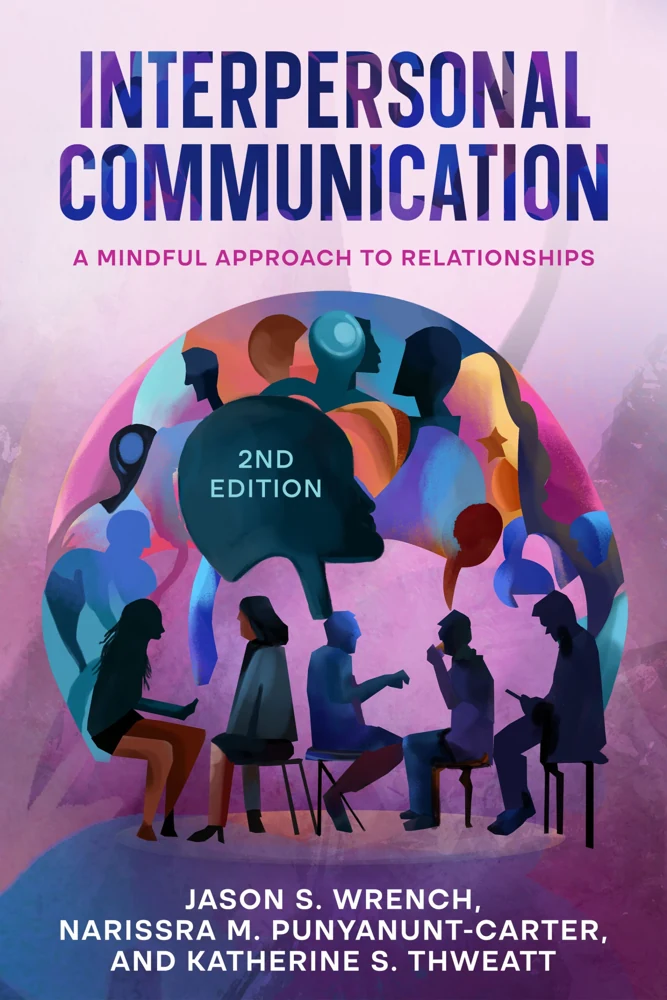
Interpersonal Communication: A Mindful Approach to Relationships
Not rated yetRate this bookInterpersonal Communication: A Mindful Approach to Relationships examines communication as an ongoing, contextual process through which people understand themselves and relate to others. This guide follows the publisher's complete online…
Read on the publisher’s website. Opens in a new tab.
 Free
About this book
Interpersonal Communication: A Mindful Approach to Relationships examines communication as an ongoing, contextual process through which people understand themselves and relate to others. This guide follows the publisher's complete online second edition, published in 2025, by Jason S. Wrench, Narissra M. Punyanunt-Carter, and Katherine S. Thweatt. Fourteen chapters connect perception, language, nonverbal behavior, culture, listening, relationships, conflict, digital contexts, and work. Mindfulness supplies a recurring practice of noticing and choosing responses rather than reacting automatically. The chapter guide distinguishes educational theories and research examples from claims about any particular person's motives, personality, or mental health.
AI-assisted book summary
Interpersonal Communication: A Mindful Approach to Relationships examines communication as an ongoing, contextual process through which people understand themselves and relate to others. This guide follows the publisher's complete online second edition, published in 2025, by Jason S. Wrench, Narissra M. Punyanunt-Carter, and Katherine S. Thweatt. Fourteen chapters connect perception, language, nonverbal behavior, culture, listening, relationships, conflict, digital contexts, and work. Mindfulness supplies a recurring practice of noticing and choosing responses rather than reacting automatically. The chapter guide distinguishes educational theories and research examples from claims about any particular person's motives, personality, or mental health.
Chapter-by-chapter summaries
Chapter 1: Introduction to Human Communication
Communication involves symbols, shared meanings, purposes, cultural expectations, and a changing context. The chapter distinguishes forms of human communication while examining physical, identity, social, and practical needs. Competence combines effectiveness with appropriateness and requires adaptation to an audience rather than one universally successful style. Mindful awareness and mindful practice connect observation with intentional response. The five-facet framework encourages noticing, describing, acting attentively, and responding without immediately judging internal experience. Communication is therefore more than transmitting a correct sentence: participants continually interpret one another through relationships, circumstances, and prior understandings.
Study task. Analyze a brief everyday exchange for its symbols, context, needs, and one moment where a deliberate pause could change the response.
Chapter 2: Overview of Interpersonal Communication
Interpersonal interaction helps people meet needs, learn about themselves and others, and build relationships under uncertainty. Sender, receiver, message, channel, feedback, environment, and noise provide a vocabulary for examining that process. Action, interaction, and transactional models emphasize different aspects, with transactional thinking highlighting simultaneous interpretation and mutual influence. Perception involves attending, organizing, and interpreting, so disagreement can begin before anyone intentionally misleads another person. Listening, emotional intelligence, ethical choices, and appropriate skill selection connect theory with practice. A model is useful when it helps identify an overlooked influence rather than merely supplies labels for a diagram.
Study task. Map one misunderstanding using a transactional model and distinguish what was observed from what each participant inferred.
Chapter 3: Intrapersonal Communication
Self-concept, self-esteem, self-compassion, personality, and relational dispositions influence how a person interprets encounters. The chapter introduces frameworks such as the Big Five, locus of control, attachment, and rejection sensitivity alongside empathy and self-monitoring. These concepts can organize reflection, but a classroom scale or a single interaction should not become a diagnosis or a fixed prediction of character. Internal talk can also shape how a response is selected and remembered. Compare a person's account of themselves with the situational evidence rather than assume one label explains every behavior. Self-compassion is presented as a way of responding to difficulty without equating an error with an entire identity.
Study task. Record an example of internal interpretation, identify an alternative explanation, and describe a response that avoids assigning yourself or another person a fixed label.
Chapter 4: Verbal Elements of Communication
Words acquire meaning through semantic, syntactic, and pragmatic conventions as well as the relationship and situation in which they are used. Levels of abstraction affect precision: a broad judgment and a concrete description can communicate very different claims. Language also names identities, signals affiliation, expresses attitudes, and can reproduce exclusion through biased or ambiguous terms. The chapter compares formal and informal usage, euphemisms, relative language, and static evaluations. Improving verbal communication requires checking what a message implies about both its subject and its recipient. A speaker's intended meaning does not guarantee that the same meaning is available to the listener.
Study task. Rewrite an abstract accusation as a specific observation and request, then explain how the relational message changes.
Chapter 5: Nonverbal Communication
Nonverbal behavior works with spoken language through functions such as emphasizing, regulating, substituting, and contradicting a message. Touch, vocal qualities, movement, space, objects, time, scent, and appearance offer several channels for interpretation. Their meanings depend on context and culture, so one gesture cannot reliably reveal a person's private state. The chapter's emphasis on nonverbal mindset and immediacy encourages awareness of both one's own behavior and assumptions about others. Distinguish a description of a cue from an inference about its cause. Checking an interpretation through appropriate conversation is often more informative than collecting body-language rules as if they were a universal code.
Study task. Describe several nonverbal cues in one interaction without assigning motives, then identify what context would be needed to interpret them responsibly.
Chapter 6: Cultural and Environmental Factors in Interpersonal Communication
Culture, co-cultures, and microcultures shape expectations about meaning, relationships, and appropriate behavior. Hall, Hofstede, and Ting-Toomey provide frameworks for examining those differences, while cultural intelligence and mindful interaction encourage flexible inquiry. Broad dimensions can support comparison but should not be used to predict every individual from a national or group label. Stereotyping substitutes an assumed category for attention to the actual person. Environment and social position also affect who can speak, whose style is treated as normal, and what resources are available. The practical task is to recognize one's own assumptions and negotiate understanding with curiosity and respect.
Study task. Identify an expectation you initially treated as universal and draft a respectful question that would clarify another person's preference without stereotyping.
Chapter 7: Talking and Listening
Everyday conversation supports needs, information sharing, and relationship development. Self-disclosure varies in purpose, depth, and risk; social penetration theory and the Johari Window offer ways to examine what is known or shared. Listening involves attention, interpretation, and response rather than mere hearing. Different listening styles and response types can help or frustrate a speaker depending on what they need. Perception checking makes uncertainty explicit by distinguishing an observed behavior from competing interpretations. The chapter connects mindful attention with a response chosen for the situation, rather than assuming advice, agreement, or disclosure is always the most helpful contribution.
Study task. Practice a response that paraphrases the speaker's meaning, checks an interpretation, and asks whether they want advice or simply to be heard.
Chapter 8: Building and Maintaining Relationships
Relationships develop through attraction, repeated interaction, disclosure, and patterns of maintenance. Stage models organize possible changes, while relational dialectics describe tensions such as connection and autonomy or openness and privacy. These models are interpretive tools rather than a compulsory path every relationship follows. Dating scripts, love styles, and discussions of gender illustrate how expectations shape behavior and judgment. Disclosure also has alternatives, including choosing a boundary, and greater openness is not automatically appropriate in every context. The chapter asks readers to examine how communication sustains a relationship over time and how partners negotiate changing needs.
Study task. Analyze a fictional relationship through one dialectical tension and propose a maintenance practice that respects both participants' boundaries.
Chapter 9: Conflict in Relationships
Interdependent people can perceive incompatible goals or disagree about how to reach a shared outcome. Conflict therefore concerns both a substantive issue and a relationship in which influence and emotion matter. The chapter examines power bases, emotional awareness, accusatory statements, and approaches that avoid, battle, or collaborate. Its Stop-Think-Listen-Communicate sequence encourages a pause before escalation and a clearer understanding of the problem. Collaboration requires attention to actual interests and power differences, not a demand that both sides always compromise equally. Ordinary disagreement should also be distinguished from coercion or abuse, where a routine conflict-management exercise may be inappropriate.
Study task. Use the STLC sequence on a low-stakes fictional disagreement, separating the issue, feelings, interests, and available choices.
Chapter 10: Friendship Relationships
Friendships are sustained through voluntary interaction, shared experiences, support, and expectations that may differ between participants. The chapter examines formation, stages, styles, dialectical tensions, and the qualities associated with helpful or harmful friendships. Cross-group and mediated contexts show that friendship cannot be reduced to one location or one communication channel. A change in contact frequency does not explain itself; obligations, access, and preferences need to be considered. Maintaining a friendship can involve both closeness and the acceptance of differences. Evaluate patterns over time rather than judging the whole relationship from a single missed message or disagreement.
Study task. Compare two friendship contexts and explain how expectations about support, frequency of contact, and privacy might need to be discussed explicitly.
Chapter 11: Family and Marriage Relationships
Family is examined through relationships, roles, shared practices, boundaries, and systems rather than one narrow household form. Communication-pattern frameworks connect orientations toward conformity and discussion with different interaction climates. Family-systems thinking emphasizes that one person's change can affect other relationships, while life-cycle models require care because families follow varied trajectories. Sibling maintenance and marriage relationships add distinct settings for support, conflict, and negotiated expectations. The chapter encourages attention to a family's own meanings while critically examining the assumptions built into classification systems. Statistical categories and a lived family identity may describe different aspects of the same group.
Study task. Map a fictional family system and explain how one transition changes roles and communication without assuming a single normal family sequence.
Chapter 12: Interpersonal Communication in Mediated Contexts
Communication technologies differ in timing, available cues, norms, and the opportunities they create for presenting oneself. Synchronous and asynchronous exchanges ask participants to manage delay and interpretation differently. Social presence, media richness, and social information processing offer competing or complementary explanations of mediated relationships. The second edition also considers human-machine communication and interpersonal interaction with AI, including identity, expectations, and ethical implications. A convincing interpretation should distinguish what a system actually does from the social meaning a user attributes to it. Privacy, permanence, and co-present attention matter alongside convenience when selecting a medium for a personal exchange.
Study task. Compare two media for a sensitive message, considering timing, cues, privacy, permanence, and the assumptions a recipient might make.
Chapter 13: Interpersonal Relationships at Work
Professional interaction combines ethics, respect, responsibility, and language choices with organizational roles and power. Leader-follower frameworks, coworker relationships, workplace friendships, and romance illustrate how personal and institutional expectations overlap. A relationship may change when one participant controls evaluation, opportunity, or resources. Problematic interactions also require distinguishing a mild annoyance from harassment or coercion rather than treating every difficulty as a style mismatch. The chapter invites analysis of the workplace environment as well as individual behavior. Appropriate communication depends partly on recognizing authority, consent, boundaries, and the procedures available within the organization.
Study task. Analyze a workplace scenario for role expectations and power differences, then choose a professional response and explain the boundary it preserves.
Chapter 14: The Dark Side of Interpersonal Communication
The final chapter examines secret relationship tests, empty apologies, hurtful messages, infidelity, deception, aggression, bullying, and intimate partner violence. These topics show why communication skill cannot be equated with getting a desired response from another person. Some strategies manipulate uncertainty or undermine autonomy rather than develop understanding. Distinguish a genuine repair, which involves responsibility and changed behavior, from words that simply seek to end criticism. The chapter also differentiates forms and contexts of aggression. Its educational classifications should support careful recognition and discussion; they are not grounds for diagnosing a person from one anecdote or treating unsafe conduct as an ordinary mutual disagreement.
Study task. Evaluate a fictional apology by identifying acknowledgment, responsibility, proposed repair, and evidence of change, while distinguishing repair from pressure to forgive.
Study instructions
- Keep a reflective communication journal that separates observation, interpretation, emotion, intention, and the other person's possible perspective.
- Practice one specific skill in a low-stakes interaction, such as paraphrasing or perception checking, and evaluate what happened rather than assuming success.
- Use the publisher's workbook and chapter exercises alongside the reading; do not substitute a summary for the case analysis.
- Treat personality scales, cultural frameworks, and stage models as learning tools with limits, avoiding diagnosis or stereotypes.
- Complete a final case analysis that connects intrapersonal influences, language, nonverbal behavior, context, listening, power, and ethical choices.
Questions for reflection
- How can a message be effective for the speaker yet inappropriate or harmful?
- When does a cultural framework help inquiry, and when does it become a stereotype?
- How do timing, power, and privacy change the meaning of the same words?
Sources and coverage
This original study guide follows the linked source edition and its complete main chapter sequence. It explains the ideas in new wording and adds reading tasks; it does not replace the textbook, reproduce its exercises, or supply an answer key. Publisher and book source; Complete online textbook.
About access & copyright
This page provides book information and study material. Full-text access is provided by the original publisher or authorised source; a listing does not grant permission to republish the book.
Read our Library Access & Copyright policyExplore the contents
Check the chapters covered in this edition.
Visit the official source
See reading, preview or purchase options.
Save for later
Keep this textbook in your saved collection.
Reader ratings & reviews
Share your thoughts
Your review helps other students choose the right resources.
KEEP LEARNING
Your next great read
Psychology Student Success
College Success
View College Success — book Humanities
Writing for Success
View Writing for Success — book Psychology
Principles of Social Psychology (University of Minnesota, 2015 Edition)
View Principles of Social Psychology (University of Minnesota, 2015 Edition) — book Student Success
Six Steps To Job Search Success
View Six Steps To Job Search Success — book Natural Sciences
Mind, Body, World: Foundations of Cognitive Science
View Mind, Body, World: Foundations of Cognitive Science — book Humanities
The Process of Research Writing
View The Process of Research Writing — book Psychology
Introduction to Psychology (First Canadian Edition)
View Introduction to Psychology (First Canadian Edition) — book Psychology
Research Methods in Psychology
View Research Methods in Psychology — book Law



