
 Civil Engineering
Textbook
Building Maintenance & Construction: Tools and Maintenance Tasks (Interactive)
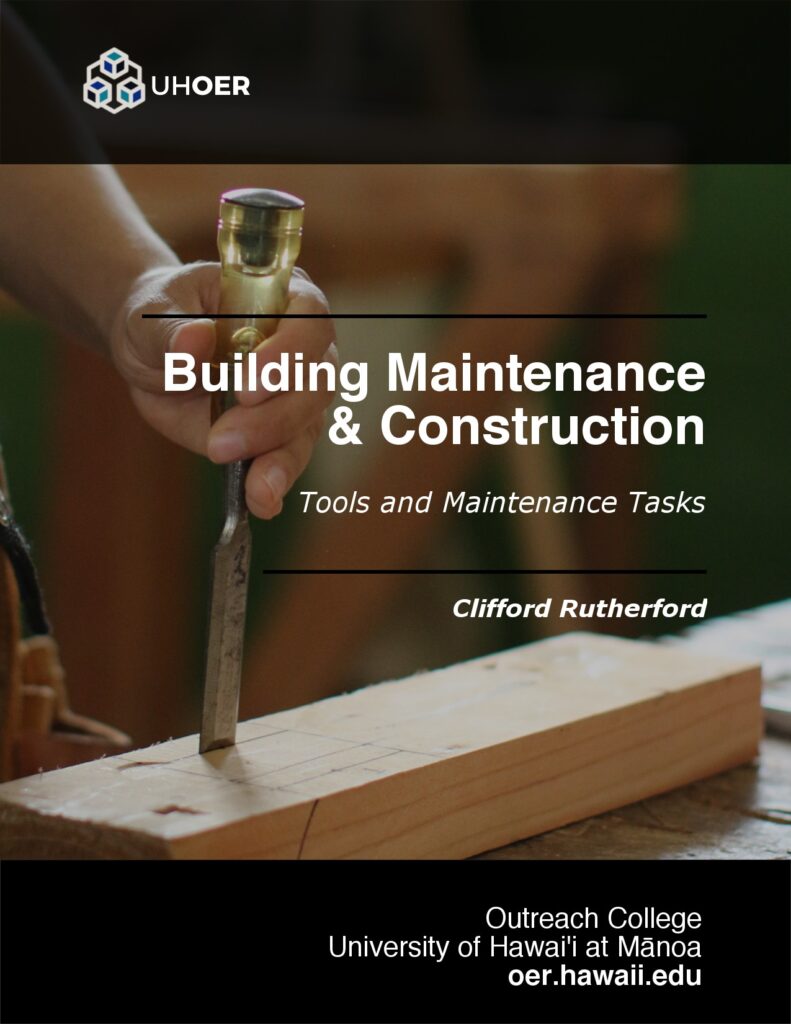
Not rated yetRate this bookClifford Rutherford’s Building Maintenance & Construction: Tools and Maintenance Tasks introduces maintenance work through six parts covering safety, tools, mathematics, plumbing, electrical systems, and maintenance management. The numbered lessons connect recognizing equipment with understanding the system and task in which it is used. This guide follows those individual lessons rather than offering only six broad part descriptions. It supports classroom learning and supervised preparation; the original procedures, current local requirements, professional licensing boundaries, and employer authorization govern actual work, particularly electrical and other hazardous tasks.
 Free
About this book
Clifford Rutherford’s Building Maintenance & Construction: Tools and Maintenance Tasks introduces maintenance work through six parts covering safety, tools, mathematics, plumbing, electrical systems, and maintenance management. The numbered lessons connect recognizing equipment with understanding the system and task in which it is used. This guide follows those individual lessons rather than offering only six broad part descriptions. It supports classroom learning and supervised preparation; the original procedures, current local requirements, professional licensing boundaries, and employer authorization govern actual work, particularly electrical and other hazardous tasks.
The verified contents include protective equipment, hand and power tools, maintenance mathematics, and building-system material such as plumbing. The opening discussion emphasizes training and awareness of the injuries associated with tools and work environments. This page provides a reading guide to that educational structure. It does not reproduce operating procedures, certify competence, or present the source’s historical standards and regulations as current requirements for every location.
Building Maintenance & Construction: Tools and Maintenance Tasks — Clifford Rutherford. Original publisher copyright and third-party credits remain in the unmodified book.
Original publication · CC BY 4.0
The attached PDF is organized into six parts.
Book summary
Clifford Rutherford’s Building Maintenance & Construction: Tools and Maintenance Tasks introduces maintenance work through six parts covering safety, tools, mathematics, plumbing, electrical systems, and maintenance management. The numbered lessons connect recognizing equipment with understanding the system and task in which it is used. This guide follows those individual lessons rather than offering only six broad part descriptions. It supports classroom learning and supervised preparation; the original procedures, current local requirements, professional licensing boundaries, and employer authorization govern actual work, particularly electrical and other hazardous tasks.
Part and lesson summaries
1.1 First Aid and Personal Protective Equipment
The opening lesson connects readiness for incidents with prevention and suitable protection. A first-aid kit has a purpose within a wider workplace response system, while protective equipment must match the task. Identify the hazard before selecting equipment, and distinguish knowing where supplies are kept from being trained and authorized to use them.
1.2 Eye and Face Protection
Different exposure types require different protection for the eyes and face. The lesson encourages matching equipment to the actual hazard rather than treating all protective eyewear as interchangeable. Compare flying particles with splash exposure in a classroom scenario. Explain why coverage, fit, and condition matter alongside the equipment’s label.
1.3 Hearing Protection
Noise exposure and protective options introduce a hazard that may be less immediately visible than a cutting tool. The self-check encourages learners to think about the work environment as well as personal equipment. Explain why a short quiet interval does not establish that the whole job is safe from noise-related exposure.
1.4 Head Protection
Hard hats and bump hats serve different purposes. The chapter discusses fit, care, and the relationship between the hazard and the selected equipment. Make a comparison of falling-object exposure and minor contact with a fixed obstruction. The distinction demonstrates why similar-looking protective products cannot be selected only by convenience or appearance.
1.5 Hand Protection
Glove selection depends on the material, contact hazard, and task. Protection against one exposure may not suit another, and damaged equipment may no longer serve its purpose. Build a hazard-to-material comparison from the source rather than prescribing one glove for every job. Include inspection and care as parts of selection.
1.6 Respiratory Protection
The lesson distinguishes several respirator types and the different functions of particulate filters, cartridges, powered systems, and supplied-air arrangements. Selection requires understanding the exposure and the applicable protection program. A familiar-looking mask is not a universal solution. For study, compare categories and identify the assessment and training information that must precede practical use.
1.7 Foot Protection
Protective footwear addresses task-specific hazards and must be considered alongside fit and care. The chapter’s special-purpose examples show that a general work shoe does not automatically meet every exposure. Compare the demands of different maintenance settings and explain which footwear characteristics require confirmation. Include condition and replacement considerations in the study checklist.
1.8 Tool and Shop Safety
Safe tool use involves condition, suitability, workspace organization, and the way the operation is performed. The lesson distinguishes hand- and power-tool considerations. Before a simulated task, identify the energy source, working edge, material support, and people nearby. Explain why using a damaged or unsuitable tool cannot be made acceptable merely by wearing protective equipment.
1.9 Ladder Safety and Fall Protection
Access equipment and fall protection require planning around the task, surface, height, and surroundings. The chapter introduces ladder and harness concepts rather than making height work a routine extension of ground-level tasks. Compare ways to reach a work area and identify the training and approved equipment needed. Do not improvise a setup from a short summary.
2.1 Tool Choices and Applications
Choosing a tool begins with the operation and material. Familiarity alone is not sufficient if the tool does not fit the work. Make a table of task, tool purpose, limitations, and required accessories. This prepares learners to explain a choice and recognize when another method or a qualified specialist is needed.
2.2 Measuring, Marking, Leveling, and Layout
Measurement and layout establish reference points for later work. Accuracy depends on selecting the appropriate tool, reading it correctly, and transferring marks consistently. Compare a dimension with a level or alignment check: they answer different questions. Use a small drawing exercise to trace how an early reference error can propagate through an assembly.
2.3 Nails, Hammers, and Pneumatic Nailers
Fastener types and driving tools are connected to material, joint, and task. The extended nailer discussion emphasizes trigger systems and the ways unintended discharge or poor handling can cause injury. Compare fastening requirements before choosing equipment. Study the complete source and approved training for operation; faster installation does not by itself justify a tool or method.
2.4 Threaded Fasteners, Drivers, Pliers, and Wrenches
Threaded connections require compatible fasteners and tools that engage them appropriately. Drivers, pliers, and wrenches have different purposes even when more than one can physically grip a part. Identify the connection, dimensions, and intended action first. Explain how an incorrect tool can damage the fastener, workpiece, or the worker’s control of the task.
2.5 Saws
Saw choice depends on material, cut direction, geometry, and required control. Blade terminology and several portable and stationary saws provide a basis for comparison. Sketch the intended cut and identify the guiding and support arrangements in the complete procedure. A tool’s ability to cut a material does not establish that every improvised setup is appropriate.
2.6 Drills and Accessories
Drill parts, bit types, accessories, and operating considerations connect the equipment with the hole or fastening task. Distinguish choosing the tool from choosing the correct bit and support method. In supervised preparation, explain how the material and required result influence the setup. Review the original operating procedure rather than treating a parts diagram as sufficient instruction.
2.7 Grinders, Sanders, and Accessories
Grinding and sanding use abrasive systems with different shapes, purposes, and operating requirements. Grit and accessory choice influence both the work and the finish. Compare stock removal with surface preparation, and identify which machine or accessory the source assigns to each. Correct compatibility and complete operating training matter more than the superficial similarity of rotating abrasive tools.
3.1 Required Math Concepts
Numbers, fractions, decimals, measurement, geometry, and unit conversion support practical maintenance decisions. The chapter develops a foundation for quantities, dimensions, areas, and volumes. Write units at every step and estimate an answer before calculating. A result that is arithmetically correct can still be unusable if it expresses the wrong dimension or mixes measurement systems.
3.2 Electrical Laws and Series/Parallel Formulas
Ohm’s law, electrical power relationships, and series and parallel circuits connect quantities through simplified circuit models. Draw the topology before calculating equivalent values, and distinguish voltage, current, resistance, power, and energy. Use supplied classroom problems to practise the relationships. Mathematical understanding is preparation for training, not authorization to test or alter an energized installation.
4.1 Piping and Fittings
Pipe materials, fittings, joining products, threaded assembly, and copper joining illustrate that plumbing connections depend on compatibility and intended service. Compare how different materials are connected and identify the manufacturer or system information required. The chapter provides vocabulary for recognizing components; actual assembly should follow the complete approved procedure and applicable requirements.
4.2 Domestic Water Service
Potable-water systems, meters, specialty tools, and residential piping connect a supply network with individual uses. The meter discussion illustrates how observations can inform an investigation. Draw a simple supply path and label the points at which flow is controlled or measured. Distinguish locating a possible issue from proving its cause or deciding that a repair is authorized.
4.3 Drain, Waste, and Vent
DWV terminology explains how fixtures, branches, stacks, cleanouts, and vents function within a network. Supply and drainage systems should not be confused merely because both use piping. Trace a fixture’s relationship with the wider drainage and vent arrangement in a diagram. Correct naming helps communicate a problem accurately and recognize why changing one component may affect other parts of the system.
4.4 Valves and Prevention Devices
Isolation, outlet, and protective devices have different functions. The lesson links recognition of a valve with the reason it appears in a system. Compare controlling ordinary flow with preventing an unwanted pressure or flow condition. Identify the device’s intended service before considering an intervention. Familiarity with its appearance does not establish that a substitute would serve the same protective purpose.
4.5 Faucets, Fixtures, and Fixture Drains
Faucets and common fixtures combine supply, user control, and drainage components. The chapter compares assemblies rather than treating a visible leak or blockage as a complete diagnosis. Draw a fixture and label its main connections and functions. Use that map to distinguish an observed symptom from several possible locations or causes requiring further assessment.
4.6 Plumbing for Appliances
Dishwashers, disposers, washing machines, and related appliances have different combinations of water and drainage connections. The comparison table helps learners organize those requirements. Identify which services a particular appliance needs and which manufacturer instructions must be checked. The practical lesson is to verify the whole connection context instead of assuming that replacing a similar-looking appliance requires no additional planning.
4.7 Water Heating
Conventional, electric, gas, tankless, and solar arrangements illustrate different ways of supplying heated water. Components and diagnostic topics are considered in relation to their systems. Compare energy source, storage, control, and delivery in a concept diagram. Because these systems can involve heat, pressure, electricity, or fuel, use the chapter for understanding and authorized training rather than unsupervised troubleshooting instructions.
5.1 Electrical Safety
Shock, arc hazards, isolation, lockout-tagout, testing terminology, and appropriate tools introduce the safety framework for electrical work. The critical distinction is between learning concepts and being qualified to perform a task. Analyze a provided scenario for sources of energy and required controls. Follow current employer and professional requirements; do not infer safe isolation or permission from the absence of visible activity.
5.2 Electrical Tools and Testing Equipment
Meters and testers differ in purpose and suitability. Their safe use involves the equipment’s condition, ratings, correct selection, and the authorized procedure. Compare what several instruments are intended to indicate without attempting live measurements from a summary. A reading only has meaning when the instrument, connection, and conditions are appropriate to the question being asked.
5.3 Electrical Terminology and Lighting
Lighting terminology helps distinguish the luminaire, lamp, and associated components. Different technologies and applications provide a basis for comparing function rather than selecting solely by appearance. Build a labeled lighting-system diagram and identify the information needed for an appropriate replacement. Check the original technical requirements and current approved instructions for practical work.
5.4 Conduit, Boxes, and Wiring
Raceways, enclosures, and conductors form an organized installation rather than a loose collection of parts. The chapter introduces component types and their purposes. Trace how protection, routing, and connection relate in a diagram. Selection and installation depend on the environment and applicable requirements, so a visually similar box or conductor is not automatically an equivalent substitute.
5.5 Fuses and Breakers
Overcurrent protection, panelboards, loadcenters, and branch circuits explain how protection fits within an electrical distribution system. A protective device’s role is not merely to restore operation after an interruption. Compare its intended function with the symptoms reported in a case. Practical evaluation or replacement requires qualification and the full approved procedure, not repeated resetting without understanding the cause.
5.6 Receptacles and Switches
Receptacle and switch types correspond to particular functions and circuit arrangements. The chapter develops recognition and terminology, including specialty configurations. Create a comparison chart using the source illustrations and state what cannot be determined from appearance alone. Actual wiring work requires current applicable rules and authorization; identifying a device is only one part of understanding the complete installation.
5.7 Outdoor Wiring Considerations
Outdoor conditions add exposure concerns to the electrical-system concepts already introduced. Receptacles and lighting must be considered in relation to moisture, location, and suitable protection. Compare an indoor and outdoor case to identify what information changes. The lesson reinforces system and environmental compatibility rather than suggesting that an indoor arrangement can simply be moved outside.
6.1 Maintenance Categories
Maintenance can be organized by different purposes and timing rather than treated as a stream of unrelated repairs. Compare planned work with responses to failures and identify the information needed to prioritize each. This chapter connects technical tasks with management: deciding what should happen, when, and why affects reliability, cost, and service to building users.
6.2 Work Order Process
A service request becomes actionable through clear information, assignment, work execution, and documentation. The chapter’s commercial process highlights communication before and after a visit. Practise writing a request that separates symptoms from assumptions and a completion note that records what was actually done. Accurate records support continuity and reduce repeated investigation or misunderstanding.
6.3 Parts and Material Resources
Manufacturers, vendors, part identification, procurement, quantities, and standardized measures connect the maintenance task with the supply process. Ordering the wrong compatible-looking item can delay work or create a new problem. Build a parts request with identifying information, quantity, units, and the source of the specification. The closing lesson links technical accuracy with organized records and responsible follow-through.
Study instructions
- Study the individual numbered lessons within each part. Keep a glossary with the component, purpose, identifying features, and information required before practical use.
- Work measurement and circuit problems on paper with units, diagrams, and reasonableness checks. Keep calculations separate from authorization to perform the task.
- For each workshop activity, review the original procedure with the instructor and identify equipment, hazards, controls, limits of competence, and completion checks.
- Draw separate water-supply, drainage, and electrical-system maps so that component names remain connected to their functions.
- Create a mock work order, inspection note, and parts request for one classroom scenario. Record observations accurately without inventing a diagnosis or claiming work was completed.
Questions for reflection
- Why must a protective product be matched to the actual hazard?
- How can a correct measurement still lead to the wrong part being ordered?
- What is the difference between observing a symptom, establishing a cause, and being authorized to repair it?
- How do complete work-order records improve the next technician’s understanding?
Sources and coverage
This original study guide follows all main chapters of the source edition linked below. Summaries explain the central concepts and their connections; practice tasks and reflection questions are editorial study aids. Consult the complete text for worked examples, figures, exercises, and references. Trade work must follow current local requirements, licensing limits, manufacturer instructions, and authorized supervised practice. Read the source edition.
About access & copyright
Check this edition’s source and licence before reusing its files or content. A library listing does not grant additional rights.
Read our Library Access & Copyright policySafety foundations
Recognize the role of protective equipment and shop safety.
Tools and materials
Connect tool choices with maintenance tasks.
Applied mathematics
Relate quantitative skills to building systems.
Maintenance systems
Understand work orders and resource planning.
Reader ratings & reviews
Share your thoughts
Your review helps other students choose the right resources.
KEEP LEARNING
Your next great read
Civil Engineering Civil Engineering
Ports and Waterways: Navigating the changing world
View Ports and Waterways: Navigating the changing world — book Engineering & Technology
Building with Nature & Beyond: Principles for designing nature based engineering solutions
View Building with Nature & Beyond: Principles for designing nature based engineering solutions — book Applied
Introduction to Probability
View Introduction to Probability — book Civil Engineering
Basics of Fluid Mechanics
View Basics of Fluid Mechanics — book Business
Developing New Products and Services
View Developing New Products and Services — book Engineering & Technology
Notes on Diffy Qs: Differential Equations for Engineers
View Notes on Diffy Qs: Differential Equations for Engineers — book Electrical Engineering
Introduction to Linear, Time-Invariant, Dynamic Systems for Students of Engineering
View Introduction to Linear, Time-Invariant, Dynamic Systems for Students of Engineering — book Electrical Engineering
AC Circuits
View AC Circuits — book Electrical Engineering



