
 Civil Law
Textbook
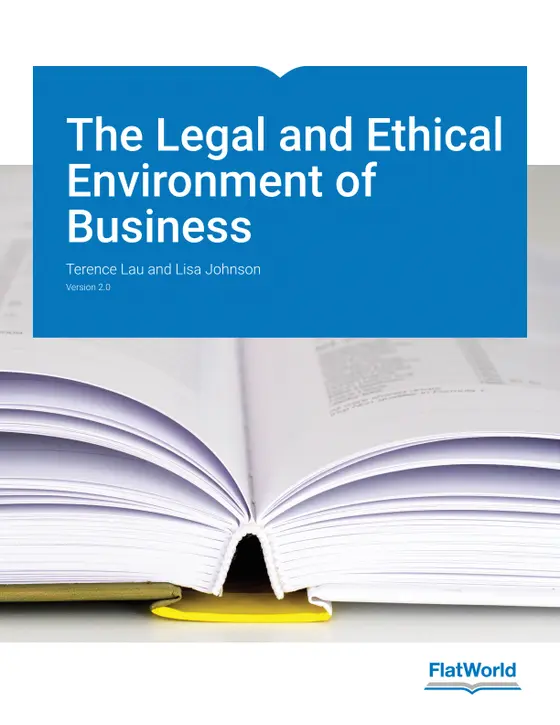
The Legal and Ethical Environment of Business
Not rated yetRate this bookThe Legal and Ethical Environment of Business introduces the United States legal setting in which organizations make decisions. This guide follows the thirteen chapters of the anonymous LibreTexts source, connecting legal institutions with contracts, responsibility for harm, property, organizations, employment, and international activity.
Free reading is available at the official source. Opens in a new tab.
 Free
About this book
The Legal and Ethical Environment of Business introduces the United States legal setting in which organizations make decisions. This guide follows the thirteen chapters of the anonymous LibreTexts source, connecting legal institutions with contracts, responsibility for harm, property, organizations, employment, and international activity.
How to study this book
Work with fictional business situations and a structured issue–rule–application–conclusion approach. Identify the parties, jurisdiction, legal source, and missing facts before drawing a conclusion. Keep an ethical evaluation separate from the question of legal liability, and distinguish the source’s historical examples from current authorities needed for a real matter.
Chapter-wise explanations and study tasks
Chapter 1 — Introduction to Law
The opening establishes law as part of the business environment and introduces ways of thinking about legal rules and obligations. Clarify what kind of authority supports a proposition rather than treating every statement of good practice as law.
Study task: Classify the rules in a fictional business scenario by source and distinguish a legal issue from an ethical concern.
Chapter 2 — The Court System
The court framework explains the institutions through which disputes are heard and reviewed. Separate the role of a trial court from appellate review and identify the relevant state or federal setting.
Study task: Draw a simplified route for a hypothetical dispute and explain what changes between trial and appeal.
Chapter 3 — Litigation
Litigation requires attention to parties, procedure, and the forum as well as the substance of a claim. A persuasive account of wrongdoing does not resolve questions about how and where the dispute can proceed.
Study task: Create a procedural issue checklist for a fictional commercial dispute before analyzing its merits.
Chapter 4 — Alternative Dispute Resolution
Negotiation, mediation, and arbitration offer different ways to resolve a disagreement. Compare the role of the parties and third parties, the process, and the source of any resulting decision.
Study task: Compare three resolution methods for a supplier disagreement using control, relationship, cost, and decision authority.
Chapter 5 — The Constitution
Federalism, preemption, taxing and spending powers, commerce, and constitutional protections shape government interaction with business. Identify the challenged government action before selecting a constitutional framework.
Study task: Frame the questions raised by a fictional conflict between state and federal business requirements.
Chapter 6 — Contracts
Formation, performance, discharge, breach, defenses, remedies, and third-party arrangements form a sequence of connected questions. Establish what was agreed before deciding whether an obligation was broken.
Study task: Analyze a fictional agreement by separating formation, performance, alleged breach, and the facts needed to assess a remedy.
Chapter 7 — Torts
Intentional torts, negligence, and strict liability provide different approaches to civil harm. Identify the theory and its elements rather than assuming any unfortunate result establishes liability.
Study task: Compare two possible theories for a fictional business injury and list the facts required for each.
Chapter 8 — The Property System
Personal and real property involve different interests and relationships. Distinguish ownership, possession, and contractual rights when describing a business asset.
Study task: Map the interests in a fictional leased workspace and its equipment, identifying what each party owns or controls.
Chapter 9 — Intellectual Property
Patents, trade secrets, trademarks, and copyright concern different kinds of intangible assets and conduct. Begin with the asset and the alleged use before deciding which framework is relevant.
Study task: Classify four fictional business assets and identify the distinct intellectual-property questions each raises.
Chapter 10 — Criminal Law
The criminal-law discussion connects offenses, responsibility, constitutional protections, and organizational responses. Separate an allegation from proof of the relevant conduct and mental state.
Study task: Build an element-and-evidence chart for a fictional business-crime allegation without resolving disputed facts.
Chapter 11 — Business Organizations
Sole proprietorships, partnerships, corporations, and limited-liability entities organize ownership, management, and responsibility differently. Compare features in context rather than assuming one form suits every venture.
Study task: Compare organizational forms for a fictional business and state which jurisdiction-specific details remain necessary.
Chapter 12 — Employment Discrimination
The chapter introduces Title VII, enforcement, and other federal anti-discrimination frameworks. A careful analysis identifies the conduct, protected interest, relevant facts, and procedural questions.
Study task: Analyze a fictional workplace allegation by separating the claim, supporting facts, missing information, and enforcement questions.
Chapter 13 — Global Legal Environment
International activity adds questions about legal sources, trade regulation, contracts, and prohibited conduct. A cross-border transaction may involve several legal systems and distinct issues.
Study task: Map the jurisdictions and relationships in a fictional international sale and identify which questions cannot be answered from one domestic rule.
Applied assignment
Prepare an academic issue memorandum about a fictional business that hires staff, buys goods, uses a brand, and sells internationally. Select four connected legal issues, identify relevant chapter frameworks, apply them to stated facts, and distinguish legal analysis from an ethical recommendation. List the current authorities needed before applying the analysis to a real situation.
Suggested reading plan
Read Chapters 1–5 for institutions and processes, 6–10 for obligations and assets, and 11–13 for organizations, employment, and cross-border activity. Revisit one fictional business after each block and add the newly relevant questions.
Questions for reflection
- Which legal source and jurisdiction govern the issue?
- What facts are missing from the proposed conclusion?
- Can an action be legally permissible while still raising an ethical concern?
Edition and source notes
The LibreTexts source explicitly requests anonymous/no-attribution authorship. This guide follows its thirteen chapters in a United States teaching context. Its statutes, procedures, and international examples are study material and should not be assumed to state current law for a particular jurisdiction.
About access & copyright
This page provides book information and study material. Full-text access is provided by the original publisher or authorised source; a listing does not grant permission to republish the book.
Read our Library Access & Copyright policyExplore the contents
Check the chapters covered in this edition.
Visit the official source
See reading, preview or purchase options.
Save for later
Keep this textbook in your saved collection.
Reader ratings & reviews
Share your thoughts
Your review helps other students choose the right resources.
KEEP LEARNING
Your next great read
Civil Law Civil Law
Law of Commercial Transactions
View Law of Commercial Transactions — book Civil Law
Fundamentals of Business Law
View Fundamentals of Business Law — book Civil Law
Legal Aspects of Property, Estate Planning, and Insurance
View Legal Aspects of Property, Estate Planning, and Insurance — book Civil Law
Computer-Aided Exercises in Civil Procedure
View Computer-Aided Exercises in Civil Procedure — book Civil Law
Civil Procedure: Pleading
View Civil Procedure: Pleading — book Administrative Law
Introduction to Contracts, Sales and Product Liability
View Introduction to Contracts, Sales and Product Liability — book Business
 Law and the Legal Environment
View Business Law and the Legal Environment — book Civil Law
Torts: Cases, Principles, and Institutions
View Torts: Cases, Principles, and Institutions — book Civil Law



