
 Civil Law
Textbook
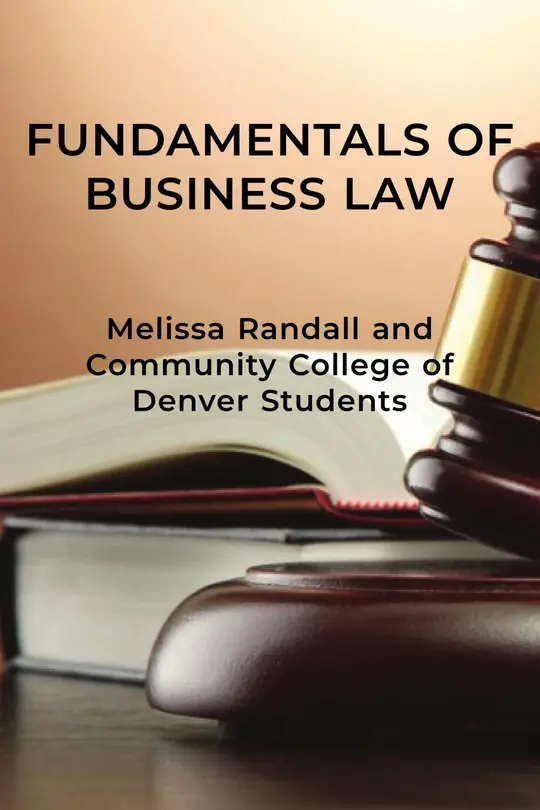
Fundamentals of Business Law
Not rated yetRate this bookFundamentals of Business Law introduces the United States legal environment of business through courts, dispute resolution, regulation, contracts, employment, organizations, property, and bankruptcy. Developed by Melissa Randall and Community College of Denver students, it is best studied through structured issue analysis and short fictional business problems.
Free reading is available at the official source. Opens in a new tab.
 Free
About this book
Fundamentals of Business Law introduces the United States legal environment of business through courts, dispute resolution, regulation, contracts, employment, organizations, property, and bankruptcy. Developed by Melissa Randall and Community College of Denver students, it is best studied through structured issue analysis and short fictional business problems.
How to study this book
For each problem, identify the issue, locate the relevant rule in the chapter, apply it to the stated facts, and explain what missing information could change the conclusion. Keep federal, state, and international sources distinct. The tasks below develop academic legal reasoning; verify current authorities separately before applying a rule to a real dispute.
Chapter-wise explanations and study tasks
Chapter 1 — Introduction to Law and Types of Legal Systems
The opening considers what law does, the differences between legal systems, and the sources from which legal rules derive. Distinguish a binding legal source from an ethical preference or an informal business custom.
Study task: Classify a fictional business rule as legislation, judicial authority, administrative action, or a private policy, explaining your choice.
Chapter 2 — The United States Court System
Separation of powers, federalism, and the distinction between trial and appellate courts establish the institutional framework. A court’s role in finding facts differs from reviewing legal decisions.
Study task: Draw a simplified court-system map and trace a hypothetical dispute from trial to a possible appeal.
Chapter 3 — Litigation
The litigation chapter covers parties, standing, jurisdiction, venue, pretrial procedure, trial, and appeal. The merits of a claim do not remove the need to establish an appropriate forum and procedure.
Study task: For a fictional interstate dispute, list the jurisdiction and venue questions before considering who should win.
Chapter 4 — Alternative Dispute Resolution
Negotiation, mediation, and arbitration organize dispute resolution in different ways. Compare who controls the process, who decides the outcome, and how the result is reached.
Study task: Compare the three processes for a supplier dispute, using cost, relationship, decision authority, and procedure as criteria.
Chapter 5 — The Constitution
Federalism, preemption, the Commerce Clause, and constitutional protections affect the legal environment of business. Identify the government action and constitutional issue before applying the chapter’s framework.
Study task: Analyze a fictional conflict between state and federal requirements, stating what information would be needed to assess preemption.
Chapter 6 — International Law
International business raises questions about the nature and sources of international law and the reach of domestic rules abroad. Different legal systems and enforcement settings complicate a cross-border transaction.
Study task: Map the countries, parties, and possible legal sources in a hypothetical international sale without assuming one rule governs every issue.
Chapter 7 — Administrative Law
Administrative agencies are created to carry out public functions through specialized powers and procedures. The chapter connects agency functions with judicial review and access to government information.
Study task: Trace a fictional agency action from its legal authority through the process of review, identifying the relevant procedural questions.
Chapter 8 — Criminal Law
The chapter distinguishes criminal responsibility from other forms of legal liability and introduces constitutional protections, defenses, and business crimes. Analyze the required conduct and mental state rather than relying on a general impression of wrongdoing.
Study task: Build an issue checklist for a fictional business offense and separate allegations from facts requiring proof.
Chapter 9 — Torts
Intentional torts, negligence, and strict liability offer different frameworks for civil wrongs. A structured analysis identifies the relevant elements, supporting facts, and possible defenses before considering a remedy.
Study task: Compare how the same fictional injury might be analyzed under negligence and a different tort theory.
Chapter 10 — Contracts
Formation, contract types, performance, breach, defenses, third-party rights, evidence, and remedies form a connected sequence. Establish the agreement and obligations before evaluating a failure to perform.
Study task: Analyze a short fictional agreement using separate headings for formation, obligation, breach, defense, and possible remedy.
Chapter 11 — Sales Contracts
The sales chapter introduces the UCC context, formation, performance, and warranties. Begin by asking whether the transaction falls within the framework being studied instead of applying sales rules to every agreement.
Study task: Compare a goods transaction with a service transaction and identify the classification questions raised by a mixed agreement.
Chapter 12 — Writing Contracts
Clear drafting translates the intended transaction into organized obligations. The discussion of structure and common mistakes encourages precision about parties, definitions, performance, payment, and contingencies.
Study task: Rewrite an ambiguous delivery clause for a fictional exercise and explain which uncertainties your revision resolves.
Chapter 13 — Employment Law
Employment at will, workplace torts, compensation, leave, safety, benefits, and labor relations involve different legal frameworks. Organize a workplace problem by issue rather than expecting a single rule to govern the entire relationship.
Study task: Create an issue map for a fictional employment scenario and identify which topics require separate factual inquiries.
Chapter 14 — Anti-Discrimination Law
The chapter surveys major federal anti-discrimination frameworks and their enforcement. Pay attention to the protected interest, alleged conduct, relevant facts, and procedure instead of reducing every workplace unfairness to the same legal claim.
Study task: Compare two fictional discrimination allegations and identify the distinct facts needed to analyze each under the chapter.
Chapter 15 — Agency
Agency connects the relationship between principal and agent with duties, authority, third-party liability, and termination. Internal instructions and a third party’s understanding may raise different questions.
Study task: Diagram a principal–agent–customer relationship and identify whose conduct or communication supports each claim about authority.
Chapter 16 — Business Organizations
The overview compares sole proprietorships, partnerships, franchises, joint ventures, corporations, and limited-liability entities. Ownership, control, continuity, and exposure to liability are separate comparison dimensions.
Study task: Create a form-comparison table for a fictional venture and state which additional jurisdiction-specific details would be needed.
Chapter 17 — Partnerships
Partnership analysis concerns types, agreements, partner rights and duties, and termination. Treat the internal agreement and the relationship with outsiders as related but distinct parts of the problem.
Study task: Outline a fictional partnership agreement’s decision-making and exit provisions, explaining the conflict each provision addresses.
Chapter 18 — Corporations
Corporate structure separates several roles among shareholders, directors, and officers. The chapter also examines legal theories and changes such as mergers or dissolution; identify the actor and decision before considering responsibility.
Study task: Draw a corporate-governance chart and explain who acts in three different fictional business decisions.
Chapter 19 — Antitrust Law
Antitrust analysis examines monopoly, restraints on trade, price discrimination, and enforcement within the chapter’s historical and legal framework. Distinguish market structure from the specific conduct under examination.
Study task: Describe a fictional competitive restraint and list the market and conduct facts needed before reaching a conclusion.
Chapter 20 — Consumer Law
Purchaser and debtor protection bring different aspects of a consumer transaction into view. Identify the product, representation, credit relationship, and enforcing authority instead of assuming that one consumer rule covers everything.
Study task: Separate the potential issues in a fictional advertised credit sale into purchase, representation, and debtor-protection questions.
Chapter 21 — Workplace Privacy and Information Security
The chapter connects privacy interests with workplace practices and information-security concerns. A careful analysis identifies the information, how it was obtained, who controls it, and the setting in which it is used.
Study task: Map the flow of employee information in a fictional monitoring system and list the questions needed for a legal review.
Chapter 22 — Property
Personal property, real property, wills and trusts, land-use regulation, and environmental law cover different interests in assets. Distinguish ownership from the restrictions and competing interests that may affect its exercise.
Study task: Analyze a fictional site proposal by separating ownership, land use, and environmental issues.
Chapter 23 — Intellectual Property
Patents, trade secrets, trademarks, and copyright address different subject matter and interests. The appropriate analysis begins with the asset and conduct involved, not with the vague claim that an idea is owned.
Study task: Classify the assets of a fictional product business and explain which intellectual-property questions each asset raises.
Chapter 24 — Bankruptcy
The final chapter introduces bankruptcy types and proceedings. Organize the discussion around the debtor, creditors, assets, and procedural route while distinguishing reorganization questions from liquidation questions.
Study task: Create a stakeholder diagram for a fictional insolvent business and identify which claims require further procedural analysis.
Applied assignment
Write an academic issue memorandum about a fictional small business that buys goods, hires staff, appoints a purchasing agent, and sells a branded product. Select four connected legal issues, apply the relevant chapter frameworks to stated facts, and identify unresolved factual or jurisdictional questions. Include a separate note explaining which authorities would need updating for a real-world matter.
Suggested reading plan
Read Chapters 1–7 for institutions and procedures, 8–12 for liability and transactions, 13–18 for workplace and organizational relationships, and 19–24 for market, asset, and financial-distress topics. Complete one fictional case analysis in each block and revise it after comparing neighboring chapters.
Questions for reflection
- Which legal source and jurisdiction control the issue you are analyzing?
- What facts are necessary to apply the rule rather than merely name it?
- How can the same business event create several different legal questions?
Edition and source notes
The source identifies Melissa Randall and Community College of Denver students and describes the textbook as finalized in Spring 2020. This guide follows its twenty-four chapters in the LibreTexts edition. It is a United States business-law teaching text; its statutory and procedural discussions should not be assumed to state current law in every jurisdiction.
About access & copyright
This page provides book information and study material. Full-text access is provided by the original publisher or authorised source; a listing does not grant permission to republish the book.
Read our Library Access & Copyright policyExplore the contents
Check the chapters covered in this edition.
Visit the official source
See reading, preview or purchase options.
Save for later
Keep this textbook in your saved collection.
Reader ratings & reviews
Share your thoughts
Your review helps other students choose the right resources.
KEEP LEARNING
Your next great read
Civil Law Civil Law
Law of Commercial Transactions
View Law of Commercial Transactions — book Civil Law
Legal Aspects of Property, Estate Planning, and Insurance
View Legal Aspects of Property, Estate Planning, and Insurance — book Civil Law
The Legal and Ethical Environment of Business
View The Legal and Ethical Environment of Business — book Civil Law
Computer-Aided Exercises in Civil Procedure
View Computer-Aided Exercises in Civil Procedure — book Civil Law
Civil Procedure: Pleading
View Civil Procedure: Pleading — book Administrative Law
Introduction to Contracts, Sales and Product Liability
View Introduction to Contracts, Sales and Product Liability — book Business
 Law and the Legal Environment
View Business Law and the Legal Environment — book Civil Law
Torts: Cases, Principles, and Institutions
View Torts: Cases, Principles, and Institutions — book Civil Law



