
 Business
Textbook
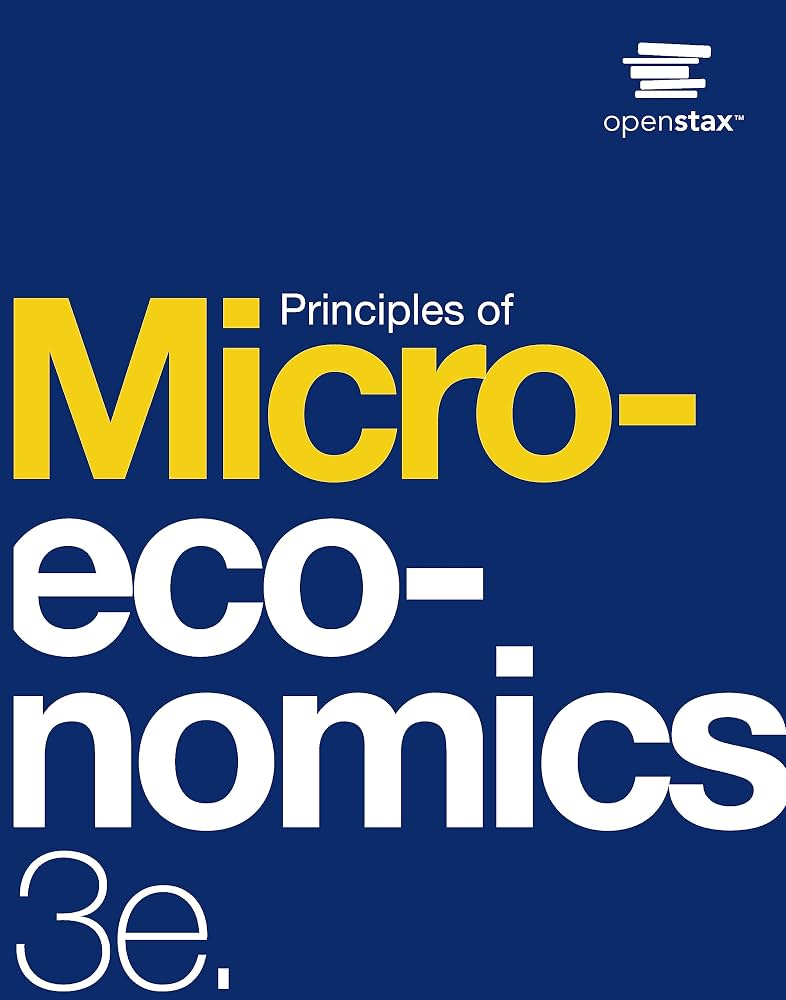
Principles of Microeconomics 3e
Not rated yetRate this bookPrinciples of Microeconomics 3e studies how households, firms, markets, and institutions allocate scarce resources. Steven A. Greenlaw, David Shapiro, Daniel MacDonald, and contributors develop twenty chapters covering choice, market structures, externalities, labor, inequality, information, finance, public decisions, and trade. This guide connects diagrams and calculations with assumptions, distributional effects, and chapter-specific analytical tasks.
Free reading is available at the official source. Opens in a new tab.
 Free
About this book
Principles of Microeconomics 3e studies how households, firms, markets, and institutions allocate scarce resources. Steven A. Greenlaw, David Shapiro, Daniel MacDonald, and contributors develop twenty chapters covering choice, market structures, externalities, labor, inequality, information, finance, public decisions, and trade. This guide connects diagrams and calculations with assumptions, distributional effects, and chapter-specific analytical tasks.
Chapter-wise summaries and study tasks
Chapter 1 Welcome to Economics!
Economics studies choices made when resources have competing uses. Microeconomics focuses on individuals, firms, and particular markets, while macroeconomics examines economy-wide outcomes. Models deliberately simplify reality to reveal a relationship, so their usefulness depends on the question and assumptions. Economic systems combine different arrangements of markets, institutions, and public decision-making. The chapter establishes a way of asking about incentives, constraints, and trade-offs rather than a claim that money explains every human purpose. Distinguish descriptive analysis of likely consequences from judgments about which outcomes society should prefer.
Study task. Choose a local economic issue, separate a positive claim from a value judgment, and identify the actors, constraints, and evidence a model would need.
Chapter 2 Choice in a World of Scarcity
Budget constraints describe feasible combinations given income and prices. Opportunity cost identifies the next-best alternative forgone, and marginal analysis compares the additional benefit and cost of a small change. A production possibilities frontier extends scarcity to society's use of resources, distinguishing inefficient production from changes in productive capacity. Points on a frontier need not be equally desirable. The chapter also considers objections to economic reasoning, reminding readers that a model of choice is not an endorsement of selfishness. Explain the mechanism behind a trade-off before performing arithmetic on it.
Study task. Construct a two-good budget and a production frontier; explain the difference between moving along a boundary and shifting it.
Chapter 3 Demand and Supply
Demand and supply connect buyers' and sellers' choices with market equilibrium. A change in a good's own price produces movement along a curve, while other determinants can shift the curve. The four-step method requires identifying the affected curve, direction, and resulting price and quantity changes. Simultaneous shifts can leave one outcome ambiguous. Price ceilings and floors alter incentives and can produce shortages or surpluses when binding. Consumer and producer surplus help evaluate gains from exchange under model assumptions, but distribution and external effects require additional analysis.
Study task. Analyze a demand increase combined with a supply decrease; state which equilibrium effect is determinate and what additional information is needed for the other.
Chapter 4 Labor and Financial Markets
Labor and financial markets can be analyzed with demand and supply, but the traded quantities and prices require careful definition. Firms demand labor, households supply it, and wages influence incentives under stated conditions. In financial markets, saving and borrowing connect present resources with future obligations, with interest rates helping coordinate decisions. Institutions, information, and bargaining arrangements complicate a simple competitive model. Prices communicate scarcity and changing conditions, yet a market signal does not by itself establish fairness or full information. Identify the relevant actors and constraints before transferring a goods-market diagram to another setting.
Study task. Draw a labor-market and a financial-market example, label the price and quantity correctly, and explain one institutional limitation of each model.
Chapter 5 Elasticity
Elasticity measures responsiveness using percentage changes, allowing comparisons across units and scales. Price elasticity of demand affects how a price change influences total revenue, while supply elasticity depends partly on adjustment opportunities and time. Perfectly elastic and perfectly inelastic cases clarify limiting behavior rather than describe every real market. Income and cross-price elasticities address different relationships. A steep line is not enough to establish low elasticity without considering the point and scale. Use a consistent calculation method and distinguish a revenue result from a profit result, since costs may also change.
Study task. Calculate midpoint elasticity for a hypothetical price change, predict revenue direction, and explain why the same calculation does not determine profit.
Chapter 6 Consumer Choices
Consumer-choice analysis connects preferences, marginal utility, and a budget constraint. Allocating spending involves comparing additional utility per unit of expenditure, while changing prices or income changes feasible choices. A price change can operate through substitution and purchasing-power effects. Behavioral economics examines patterns such as framing, limited attention, and departures from conventional rational-choice predictions. These approaches should be compared by what they explain and predict in a setting, rather than treated as mutually exclusive descriptions of all behavior. Utility is an analytical representation of preferences, not an objective measure of moral worth or well-being.
Study task. Compare two feasible consumption bundles using marginal utility per unit of cost, then show how framing could alter the observed choice.
Chapter 7 Production, Costs, and Industry Structure
Production decisions link inputs, output, and costs across different time horizons. The short run includes at least one fixed input, whereas the long run allows all inputs to vary. Diminishing marginal returns to a variable input differ from economies or diseconomies of scale. Explicit and implicit costs explain why accounting profit and economic profit can diverge. Marginal, average variable, average fixed, and average total costs answer different questions. Opportunity costs remain relevant even when no payment occurs. A useful cost analysis identifies the decision and horizon before deciding which costs can change.
Study task. Build a small output-and-cost table, calculate marginal and average costs, and explain the difference between an owner's accounting and economic profit.
Chapter 8 Perfect Competition
Perfect competition assumes many sellers, a standardized product, and conditions that leave an individual firm unable to set the market price. The firm compares marginal revenue with marginal cost to choose output, subject to whether operating is preferable to shutdown. Short-run losses do not automatically imply immediate shutdown if revenue covers variable costs. Long-run entry and exit change supply and tend to eliminate economic profit under the model's conditions. The efficiency result depends on those conditions and the absence of unpriced effects. Keep the individual firm's decision separate from market adjustment.
Study task. Use a hypothetical cost table to choose output at two market prices; distinguish operating at a loss, short-run shutdown, and long-run exit.
Chapter 9 Monopoly
Monopoly arises when barriers prevent effective entry into a market served by one seller. A monopolist faces the market demand curve and must account for the effect of additional sales on revenue. The profit-maximizing quantity is selected using marginal revenue and marginal cost; the corresponding price comes from demand. Market power does not imply unlimited profit or freedom from customer substitution. Relative to a competitive benchmark, restricted output can generate deadweight loss as well as redistribute surplus. Explain both the entry barrier and the relevant market before labeling an organization a monopoly.
Study task. Given demand and cost information, identify monopoly quantity and price, then compare surplus and output with a competitive benchmark.
Chapter 10 Monopolistic Competition and Oligopoly
Monopolistic competition combines product differentiation with entry, while oligopoly makes strategic interdependence central. Differentiated sellers have some pricing discretion, but rivals and substitutes constrain it. In oligopoly, a firm's best action depends on expectations about others, making game-theoretic reasoning useful. Incentives to cooperate and to deviate help explain why a jointly attractive outcome may be unstable. Advertising and product variation can inform customers or reshape perceived differences. Compare structures through entry conditions, number of significant firms, differentiation, and strategic behavior rather than assigning them solely by company size.
Study task. Construct a two-firm payoff table, identify best responses, and explain why a mutually preferred outcome may not be a stable equilibrium.
Chapter 11 Monopoly and Antitrust Policy
Antitrust policy examines whether mergers and conduct reduce competition, while regulation addresses situations such as natural monopoly where duplicated infrastructure may be costly. Market concentration can flag a question but does not replace analysis of the relevant market, entry, efficiencies, and behavior. Price regulation creates trade-offs among access, cost recovery, incentives, and quality. Deregulation can change competition and performance in ways that depend on industry conditions. The chapter presents policy reasoning and historical examples, not a universal rule that large firms are harmful or that removing regulation always improves outcomes.
Study task. Evaluate a fictional merger using market definition, concentration, entry, efficiencies, and possible harms; identify what evidence would change your assessment.
Chapter 12 Environmental Protection and Negative Externalities
Pollution creates a negative externality when private decisions impose costs on others that market prices do not fully reflect. The efficient pollution level in the model balances marginal benefits of reduction with marginal costs, rather than automatically requiring either zero pollution or no control. Standards, taxes, tradable permits, and other tools differ in information needs and incentives. Environmental harms can cross borders and involve uncertainty or unequal exposure. Cost-benefit analysis helps organize trade-offs but depends on measurement choices. Distinguish aggregate efficiency from the distribution of risks and protection.
Study task. Compare a pollution standard, tax, and tradable permit system for a fictional industry; discuss information requirements, incentives, and unequal community exposure.
Chapter 13 Positive Externalities and Public Goods
Positive externalities arise when an activity benefits others beyond the decision maker. Innovation can produce spillovers that weaken private incentives to invest, while patents, public research, and subsidies offer different responses with their own trade-offs. Public goods combine non-rivalry and non-excludability, creating free-rider problems that may limit voluntary provision. Not every publicly supplied service is a pure public good. Identify the specific market failure before proposing a policy. A corrective intervention still requires attention to implementation, information, and whether its benefits justify its costs.
Study task. Classify several fictional services by rivalry and excludability, then compare two policies to support innovation without assuming either is costless.
Chapter 14 Labor Markets and Income
Labor income reflects demand for workers' productive contributions alongside labor supply, bargaining institutions, and market power. A monopsonistic employer and an organized union can produce outcomes different from the competitive benchmark. Bilateral monopoly emphasizes bargaining rather than a uniquely determined simple-market result. Discrimination and unequal opportunity complicate explanations based only on productivity, while immigration can affect groups and markets differently. Avoid reading a wage difference as proof of its cause. The chapter asks readers to examine mechanisms, evidence, and institutional conditions when assessing employment and earnings.
Study task. Compare competitive and monopsonistic labor markets, then list evidence needed to distinguish productivity differences from discrimination in an observed wage gap.
Chapter 15 Poverty and Economic Inequality
Poverty and inequality concern related but different questions: whether people fall below a threshold and how resources are distributed. Measurement depends on income definitions, household circumstances, time periods, and treatment of taxes or transfers. Safety-net programs can reduce hardship while facing design trade-offs involving incentives, eligibility, and administration. A poverty trap describes how benefit withdrawal and taxes can reduce gains from additional earnings. Inequality measures summarize distributions without fully explaining causes. Evaluate policy using both material outcomes and the opportunities or constraints faced by affected households.
Study task. Calculate a fictional household's disposable resources as earnings rise under a benefit schedule; identify effective withdrawal rates and a possible poverty-trap region.
Chapter 16 Information, Risk, and Insurance
Imperfect information can prevent beneficial exchange or produce poorly matched decisions. Asymmetric information gives one party knowledge the other lacks, creating problems such as adverse selection before a transaction and moral hazard after it. Insurance pools risks but must address both issues through contract design, screening, incentives, or regulation. Warranties, reputation, credentials, and collateral can reduce uncertainty without eliminating it. Distinguish a hidden characteristic from a hidden action before choosing a remedy. Measures that reduce insurer risk may also restrict access, so efficiency and inclusion require separate attention.
Study task. Create one adverse-selection and one moral-hazard example; compare remedies and explain the cost or access trade-off each introduces.
Chapter 17 Financial Markets
Financial markets connect organizations seeking funds with households and institutions supplying them. Debt and equity allocate claims, control, and risk differently, while banks and other intermediaries help manage information and transactions. Household accumulation involves saving, compounding, diversification, and exposure to uncertainty. A promised or historical return is not equivalent to a certain future result. The chapter introduces financial reasoning within microeconomics, so focus on incentives, institutions, and risk allocation rather than selecting investments. Fees, liquidity needs, and time horizons also affect how a financial arrangement serves its purpose.
Study task. Compare fictional debt and equity financing arrangements and calculate a hypothetical compounding example; state the risks and assumptions rather than recommending an investment.
Chapter 18 Public Economy
Public-economy analysis applies incentives and constraints to political decision-making. Voting requires time and information, while an individual's probability of changing an outcome may be small. Concentrated benefits and widely dispersed costs can give organized interests strong incentives to influence policy. Democratic processes also face problems of information, representation, and translating preferences into collective choices. Identifying government failure does not establish that a market alternative will work better; the relevant comparison is between feasible institutions. Evaluate who participates, who bears costs, and how decisions can be scrutinized.
Study task. Analyze a fictional subsidy with concentrated benefits and dispersed costs; compare the incentives to organize and propose a transparency or accountability measure.
Chapter 19 International Trade
Comparative advantage depends on opportunity cost rather than absolute productivity. Two economies can gain from specialization and exchange even when one produces every good with fewer resources, provided their relative costs differ. Trade also occurs within industries through scale, variety, and differentiated products. Aggregate gains do not imply that every worker, firm, or region benefits equally. A model of gains from exchange should be distinguished from a claim about adjustment being immediate or painless. State production assumptions and the terms of trade before concluding that a particular exchange benefits both parties.
Study task. Calculate opportunity costs for two producers, identify comparative advantage, and find mutually beneficial terms of trade; name a likely adjustment cost.
Chapter 20 Globalization and Protectionism
Protectionist policies redistribute benefits and costs through tariffs, quotas, and related restrictions. Domestic producers may gain while consumers face higher prices, and aggregate efficiency losses can arise under the standard model. Employment, wages, working conditions, national security, and other arguments require separate evidence rather than a single verdict on all trade. International and regional arrangements shape how policy is negotiated and enforced. Compare a proposed restriction with alternative ways to address the stated problem. A policy can protect one group while imposing less visible costs on downstream industries and households.
Study task. Draw a tariff's effects on consumers, producers, revenue, and deadweight loss; compare it with a targeted response to the same stated policy concern.
How to study this book
- For every graph, label variables and units, state the assumptions, and explain the mechanism in words before drawing a conclusion.
- Keep shifts separate from movements along curves and distinguish marginal from average quantities.
- Use fictional numerical exercises to check the logic, then identify evidence needed for a real-world application.
- Assess efficiency and distribution separately, and compare feasible policy alternatives rather than idealized extremes.
Questions for reflection
- Which assumption is doing the most work in a model's conclusion?
- Who gains and who loses even when total surplus rises?
- Does a proposed policy address the identified problem or a different one?
Source edition and coverage
This guide follows all twenty main chapters of the linked OpenStax Principles of Microeconomics 3e PDF. Legal, financial, and policy examples are summarized as textbook analysis; historical figures and cases should not be read as current advice or automatically updated data. These are original study explanations and learning tasks. Read the complete book at the official source.
About access & copyright
This page provides book information and study material. Full-text access is provided by the original publisher or authorised source; a listing does not grant permission to republish the book.
Read our Library Access & Copyright policyExplore the contents
Check the chapters covered in this edition.
Visit the official source
See reading, preview or purchase options.
Save for later
Keep this textbook in your saved collection.
Reader ratings & reviews
Share your thoughts
Your review helps other students choose the right resources.
KEEP LEARNING
Your next great read
Business Social Sciences
Psychology 2e
View Psychology 2e — book Business
Principles of Marketing
View Principles of Marketing — book Business
Principles of Management
View Principles of Management — book Business
Principles of Macroeconomics 3e
View Principles of Macroeconomics 3e — book Business
Principles of Finance 2e
View Principles of Finance 2e — book Business
Principles of Data Science
View Principles of Data Science — book Business
Organizational Behavior
View Organizational Behavior — book Social Sciences
Lifespan Development
View Lifespan Development — book Business