
 Business
Textbook
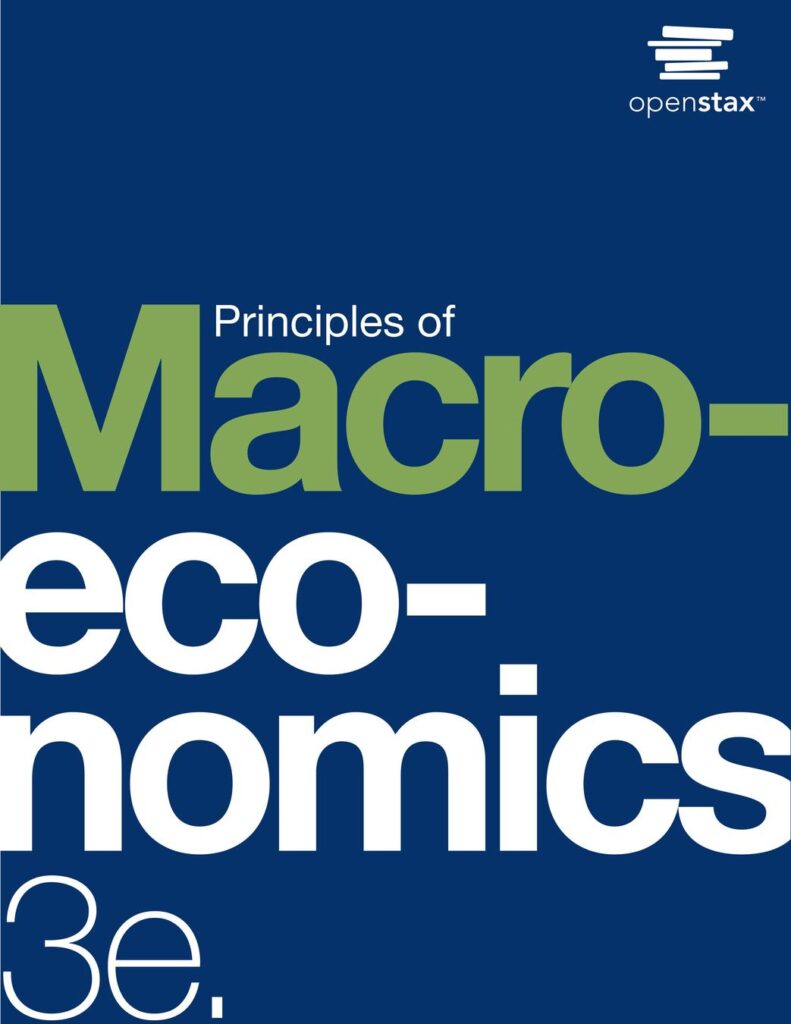
Principles of Macroeconomics 3e
Not rated yetRate this bookPrinciples of Macroeconomics 3e examines economy-wide production, growth, employment, prices, money, and international connections. Steven A. Greenlaw, David Shapiro, Daniel MacDonald, and contributors organize twenty-one chapters around measurement, competing models, banking, monetary and fiscal policy, exchange rates, and trade. This guide links each chapter to a focused exercise and distinguishes accounting relationships, behavioral assumptions, and policy judgments.
Free reading is available at the official source. Opens in a new tab.
 Free
About this book
Principles of Macroeconomics 3e examines economy-wide production, growth, employment, prices, money, and international connections. Steven A. Greenlaw, David Shapiro, Daniel MacDonald, and contributors organize twenty-one chapters around measurement, competing models, banking, monetary and fiscal policy, exchange rates, and trade. This guide links each chapter to a focused exercise and distinguishes accounting relationships, behavioral assumptions, and policy judgments.
Chapter-wise summaries and study tasks
Chapter 1 Welcome to Economics!
The opening chapter introduces economics as a study of choices, constraints, incentives, and coordination. Macroeconomics asks how output, employment, prices, and other aggregate outcomes develop, while drawing on the decisions studied in microeconomics. Models isolate selected relationships so that explanations can be examined, not because every feature of reality is unimportant. Economic systems combine market exchange with institutions and public decisions in different ways. To begin macroeconomic analysis, identify the question, distinguish observation from judgment, and explain what a simplified model leaves out before applying it to a national outcome.
Study task. Choose a question about economy-wide performance and identify its aggregate variables, relevant individual decisions, and one model assumption that would need checking.
Chapter 2 Choice in a World of Scarcity
Scarcity constrains individual budgets and society's productive possibilities. Opportunity cost makes trade-offs explicit by asking what alternative is forgone. Marginal reasoning compares additional gains and costs rather than total amounts alone. A production possibilities frontier illustrates feasible combinations, inefficiency, and changes in capacity. This groundwork matters for macroeconomics because a recession can leave resources unused, while long-run growth changes what can be produced. A movement toward existing capacity differs from an expansion of capacity. The framework helps separate recovery, allocation, and growth rather than treating every output increase as the same phenomenon.
Study task. Use a production frontier to illustrate unemployment, recovery, and long-run growth; explain how the three cases differ in resource use and capacity.
Chapter 3 Demand and Supply
Demand and supply explain the determination of price and quantity in a particular market. Changes in income, preferences, input costs, or other conditions can shift curves, whereas a change in the good's price moves along them. Equilibrium analysis becomes clearer when changes are handled in a stated sequence. Price controls may create shortages or surpluses when they bind. This model provides foundations for later aggregate analysis, but a single-market price change is not the same as inflation across an economy. Keep the level of analysis explicit when connecting a market shock with broader consequences.
Study task. Analyze an energy-market supply disruption, then distinguish its direct relative-price effect from the additional mechanisms needed to affect economy-wide inflation.
Chapter 4 Labor and Financial Markets
Labor and financial markets coordinate employment and the use of funds through wages, interest rates, and institutional arrangements. Demand and supply diagrams identify pressures, but participation, bargaining, information, and rules influence actual adjustment. Financial markets connect saving with borrowing and investment, linking decisions made today to expected future outcomes. Prices transmit information without eliminating uncertainty or guaranteeing fair access. These foundations help explain later discussions of unemployment, monetary transmission, and capital flows. Always define whether a variable is a flow over time or a stock measured at a particular date.
Study task. Construct a hypothetical labor-market and loanable-funds change; explain the actors, price response, and one reason adjustment might be delayed.
Chapter 5 Elasticity
Elasticity expresses how responsive one quantity is to a percentage change in another. Demand and supply responsiveness influence how shocks are divided between price and quantity changes and can vary across time horizons. The same nominal price change can represent very different proportional changes, making units and denominators important. Revenue responses depend on demand elasticity, while income and cross-price elasticities answer different questions. In macroeconomic applications, responsiveness helps explain why identical shocks may have different consequences across sectors or countries. Do not confuse an elasticity estimate with a permanent behavioral law.
Study task. Calculate midpoint demand elasticity from a fictional dataset and compare short- and long-run adjustment possibilities after a supply shock.
Chapter 6 The Macroeconomic Perspective
Gross domestic product measures the value of final production within an economy over a period, with expenditure and income approaches describing related sides of activity. Avoiding double counting requires distinguishing final goods from intermediate inputs. Nominal GDP reflects both prices and quantities, whereas real measures aim to isolate changes in production. Cross-country comparison also requires attention to population, exchange conversion, and purchasing power. GDP is informative but incomplete as a measure of well-being: distribution, unpaid work, environmental costs, and other dimensions may be absent. Explain what the statistic measures before interpreting what a higher value means.
Study task. Calculate nominal and real output for a two-good economy, then explain why rising real GDP per person need not show that every household is better off.
Chapter 7 Economic Growth
Long-run growth depends substantially on productivity: how effectively labor and other resources generate output. Physical and human capital, technology, institutions, and infrastructure influence that process. Compounding means modest persistent differences in growth can produce large differences in living standards over time. Investment alone does not guarantee convergence if complementary capabilities and institutions are missing. Distinguish a larger workforce from greater output per worker, and distinguish a one-time level increase from a sustained growth rate. The chapter encourages analysis of mechanisms and conditions rather than a single universal recipe for national prosperity.
Study task. Compare two hypothetical growth paths using compounding; explain how education, capital, and technology could interact and why convergence is not automatic.
Chapter 8 Unemployment
The unemployment rate depends on definitions of employment, unemployment, and labor-force participation. People outside the labor force are not counted in the same way as active job seekers, and underemployment can be missed by a headline rate. Cyclical unemployment relates to economic downturns, while frictional and structural factors concern matching and longer-term conditions. Institutions and adjustment frictions affect outcomes across economies. A falling unemployment rate can have different explanations, so it should be examined alongside participation and employment measures. Use consistent populations and time periods when comparing figures.
Study task. Classify fictional individuals by labor-force status and calculate unemployment and participation rates; show how the headline rate can fall without new employment.
Chapter 9 Inflation
Inflation describes a sustained rise in a price index, not simply a high price level or an increase in one good. Price indexes depend on baskets, weights, and methods, creating measurement challenges when quality and purchasing patterns change. Nominal amounts must be adjusted to compare purchasing power over time. Inflation's consequences depend partly on expectations and whether contracts or incomes adjust; unexpected changes can redistribute resources between borrowers and lenders. Indexing can protect some payments but cannot eliminate every distortion. Distinguish inflation, disinflation, and deflation before drawing a policy conclusion.
Study task. Construct a simple weighted price index, calculate inflation and a real wage change, and explain who gains or loses from an unexpected price rise.
Chapter 10 The International Trade and Capital Flows
Trade balances record the difference between exports and imports, while international capital flows connect those transactions with financing. A deficit is not the same thing as low trade volume, and a surplus is not automatically proof of economic strength. The national saving and investment identity helps connect domestic saving, investment, government balances, and external financing. An identity constrains accounting relationships but does not by itself establish the direction of causation. Evaluate what borrowed resources finance, how obligations are structured, and whether conditions are sustainable before judging a country's external balance.
Study task. Use fictional national-account figures to calculate saving, investment, and the external balance; explain two different economic stories consistent with the same deficit.
Chapter 11 The Aggregate Demand/Aggregate Supply Model
The aggregate demand and aggregate supply model links the overall price level with real output. Aggregate demand responds to consumption, investment, government purchases, and net exports, while aggregate supply reflects productive conditions and adjustment over time. Demand and supply shocks can produce different combinations of output and inflation, so identifying the cause matters for policy. Potential output supplies a reference for longer-run capacity, not a claim that the economy always operates there. The chapter brings growth, unemployment, and price change into one framework while requiring clarity about time horizons and curve assumptions.
Study task. Compare a negative demand shock with a negative supply shock in AD/AS diagrams; explain why a policy helping output may have different inflation consequences.
Chapter 12 The Keynesian Perspective
Keynesian analysis emphasizes that insufficient aggregate demand and slow adjustment of wages or prices can leave an economy below its productive capacity. Changes in spending can generate multiplier effects as one person's expenditure becomes another's income, though saving, imports, taxes, and other responses limit the process. The Phillips curve examines relationships between inflation and unemployment that depend on expectations and supply conditions rather than a permanent menu of choices. Policy analysis should therefore identify slack and the source of a disturbance. The framework explains why waiting for markets to adjust can impose substantial costs.
Study task. Trace a hypothetical spending increase through successive rounds, state the leakages, and explain why a supply shock complicates a simple inflation-unemployment trade-off.
Chapter 13 The Neoclassical Perspective
The neoclassical perspective emphasizes potential output, longer-run adjustment, and the importance of productive capacity. Flexible prices and wages can restore coordination in the model, while policy aimed solely at boosting demand cannot permanently raise output beyond capacity. Incentives, investment, technology, and institutions shape the supply side. The chapter also compares this perspective with Keynesian reasoning: their usefulness can depend on the time horizon and economic conditions. Rather than choose a theory as an identity, ask which assumptions fit the problem and which adjustment mechanisms are plausible within the period being considered.
Study task. Analyze one recession using short-run Keynesian and longer-run neoclassical assumptions; identify evidence needed to judge the speed of adjustment.
Chapter 14 Money and Banking
Money serves as a medium of exchange, unit of account, and store of value, with monetary aggregates grouping instruments by characteristics such as liquidity. Banks connect deposits, lending, payments, and balance-sheet obligations. Lending can create deposit money, but capital, liquidity, regulation, credit risk, and demand constrain the process. A simplified multiplier model clarifies relationships under stated assumptions and should not be mistaken for an unlimited mechanical lending rule. Distinguish a bank's assets from its liabilities and reserves from all deposits. These distinctions prepare readers to understand monetary policy and financial stability.
Study task. Build a simplified bank balance sheet before and after a loan; identify the new asset and liability and explain constraints omitted by a mechanical multiplier example.
Chapter 15 Monetary Policy and Bank Regulation
Central banks influence monetary and financial conditions through policy tools and their effects on credit, spending, expectations, and prices. Bank regulation and supervision address risks that arise from interconnected balance sheets and maturity transformation. The chapter's Federal Reserve examples illustrate institutions within the source's U.S. context. Policy transmission is indirect and uncertain: a changed instrument does not guarantee an immediate proportional change in output or inflation. Lags, weak borrowing demand, financial stress, and expectations can alter results. Study the causal chain and its assumptions rather than memorize a permanent direction of policy for every situation.
Study task. Trace an expansionary monetary-policy action through banks, borrowing, spending, output, and prices; identify two points where transmission could weaken.
Chapter 16 Exchange Rates and International Capital Flows
Foreign-exchange markets price one currency in terms of another, making the quotation convention essential. Trade, investment, expectations, and interest-rate differences can shift currency demand and supply. Appreciation and depreciation affect import costs, export competitiveness, and foreign-currency obligations differently. Fixed, floating, and managed arrangements involve trade-offs concerning stability, adjustment, reserves, and policy autonomy. A stronger currency is not automatically better for every participant. Keep nominal exchange-rate movements separate from changes in relative purchasing power, and specify whose perspective is being used when calculating gains or losses.
Study task. Calculate a currency movement under a stated quotation, then compare its effects on an exporter, an importer, and a borrower with foreign-currency debt.
Chapter 17 Government Budgets and Fiscal Policy
Fiscal policy uses government spending and taxation within a budget that also reflects economic conditions. A deficit is a flow, while debt accumulates outstanding obligations. Automatic stabilizers respond without a new discretionary decision, whereas deliberate changes can face recognition, legislative, and implementation delays. Fiscal expansion may support demand during a downturn, but effects depend on capacity, monetary conditions, financing, and timing. A balanced-budget rule can constrain responses when revenues fall. Evaluate a proposal through its mechanism, distribution, and time horizon rather than treating all spending increases or deficits as economically identical.
Study task. Compare automatic and discretionary responses to a recession, calculate a fictional budget balance, and explain why annual balance could intensify a downturn.
Chapter 18 The Impacts of Government Borrowing
Government borrowing interacts with private saving, investment, and international flows. Crowding out can occur when borrowing raises financing pressures and displaces private activity, but its extent depends on economic slack, capital mobility, saving responses, and monetary conditions. Public investment may also improve future productive capacity, making the use of funds central to assessment. Accounting identities organize the connections without resolving every behavioral question. Separate short-run stabilization from long-run debt service and growth. A credible evaluation asks what the borrowing finances, what alternative was available, and how risks and benefits are distributed over time.
Study task. Compare borrowing for a recession response with borrowing for productive infrastructure; explain possible crowding-out and growth channels under different economic conditions.
Chapter 19 Macroeconomic Policy Around the World
Macroeconomic policy differs across economies because institutions, income levels, demographic conditions, productive structures, and external constraints differ. Low living standards, unemployment, inflation, and external imbalances may arise through different mechanisms and therefore need different responses. A policy effective in one setting can fail where financial access, administrative capacity, infrastructure, or credibility differ. Country comparisons should use compatible definitions and avoid inferring causes from a ranking alone. The chapter encourages diagnosis before prescription and attention to how growth and stabilization interact with the practical constraints faced by a particular economy.
Study task. Compare two fictional economies with different inflation and employment problems; identify the diagnosis, institutional constraints, and evidence needed before selecting policies.
Chapter 20 International Trade
International trade can expand consumption possibilities when producers specialize according to comparative rather than absolute advantage. Relative opportunity costs determine the potential for mutual gains, even if one country is more productive in every activity. Trade among similar economies can also reflect scale and product variety. Aggregate benefits coexist with adjustment pressures on particular workers and regions. The chapter's models help separate the logic of gains from the empirical question of how those gains are distributed. State assumptions about resources, costs, and trading terms rather than assuming specialization is always complete or frictionless.
Study task. Calculate comparative advantage and a mutually beneficial trading range for two economies; then identify a group that might still face adjustment costs.
Chapter 21 Globalization and Protectionism
Globalization and protectionism involve choices about tariffs, quotas, agreements, and the rules governing international exchange. Restrictions can transfer income toward protected producers while raising costs for consumers and downstream firms. Employment, labor conditions, security, and adjustment arguments require evidence about specific mechanisms. International institutions and agreements influence how policies are negotiated, but no arrangement removes every conflict. Assess a proposal against feasible alternatives, including support for affected workers or targeted responses to a documented problem. Trade policy has distributional consequences that a single total-gains calculation cannot fully describe.
Study task. Evaluate a fictional import restriction using consumer, producer, employment, and downstream effects; compare it with a targeted adjustment policy addressing the stated concern.
How to study this book
- Define every statistic, denominator, time period, and price adjustment before interpreting a change.
- Draw models with clearly labeled axes and state whether your explanation concerns the short run or long run.
- Separate accounting identities from causal claims and identify the behavioral assumptions behind a prediction.
- Use the source's data as historical examples; consult official releases separately when applying concepts to current conditions.
Questions for reflection
- Could the same headline statistic arise from different underlying changes?
- Does a policy address a demand problem, a supply problem, or both?
- How do timing, institutions, and distribution change the assessment of an aggregate result?
Source edition and coverage
The guide follows all twenty-one main chapters of the linked OpenStax Principles of Macroeconomics 3e PDF. Numerical exercises are hypothetical, and source-edition policy cases and monetary definitions should not be treated as automatically updated current statistics or individualized financial guidance. These are original study explanations and learning tasks. Read the complete book at the official source.
About access & copyright
This page provides book information and study material. Full-text access is provided by the original publisher or authorised source; a listing does not grant permission to republish the book.
Read our Library Access & Copyright policyExplore the contents
Check the chapters covered in this edition.
Visit the official source
See reading, preview or purchase options.
Save for later
Keep this textbook in your saved collection.
Reader ratings & reviews
Share your thoughts
Your review helps other students choose the right resources.
KEEP LEARNING
Your next great read
Business Social Sciences
Psychology 2e
View Psychology 2e — book Business
Principles of Microeconomics 3e
View Principles of Microeconomics 3e — book Business
Principles of Marketing
View Principles of Marketing — book Business
Principles of Management
View Principles of Management — book Business
Principles of Finance 2e
View Principles of Finance 2e — book Business
Principles of Data Science
View Principles of Data Science — book Business
Organizational Behavior
View Organizational Behavior — book Social Sciences
Lifespan Development
View Lifespan Development — book Business



