
 Math
MathTextbook
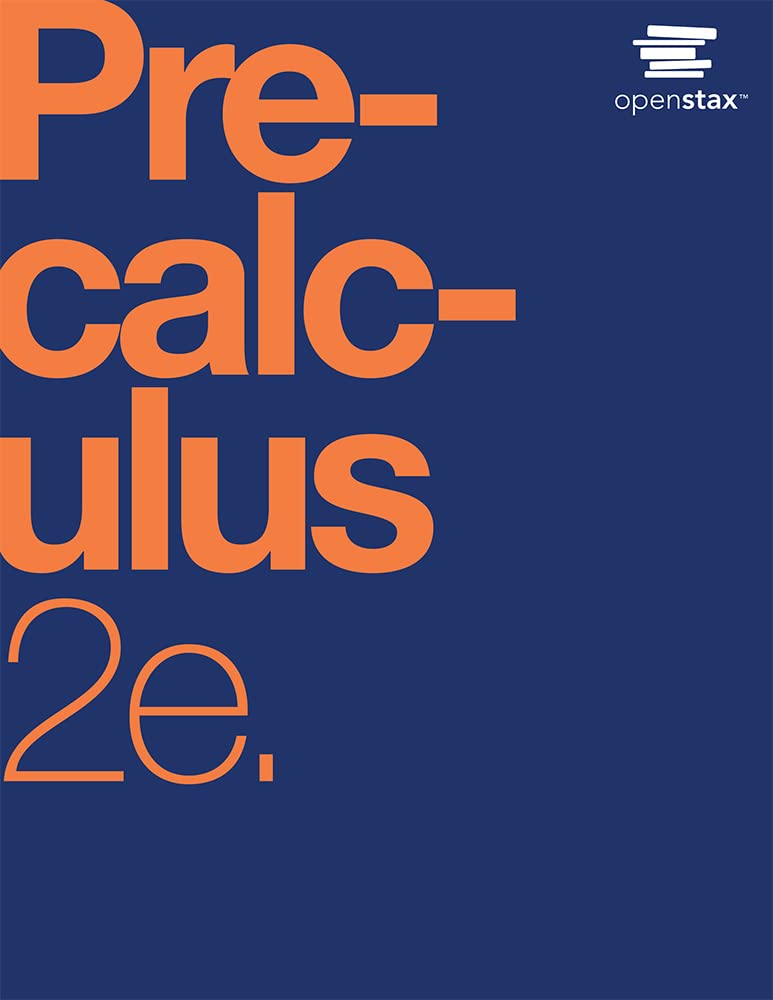
Precalculus 2e
Not rated yetRate this bookPrecalculus 2e prepares students for calculus by connecting symbolic techniques with functions, graphs, geometry, and models. Jay Abramson and contributors develop twelve chapters, from function notation through algebra, trigonometry, systems, conics, counting, and introductory limits and derivatives. This guide emphasizes domains, assumptions, representations, and checking results, with a focused study task for every chapter.
Free reading is available at the official source. Opens in a new tab.
 Free
About this book
Precalculus 2e prepares students for calculus by connecting symbolic techniques with functions, graphs, geometry, and models. Jay Abramson and contributors develop twelve chapters, from function notation through algebra, trigonometry, systems, conics, counting, and introductory limits and derivatives. This guide emphasizes domains, assumptions, representations, and checking results, with a focused study task for every chapter.
Chapter-wise summaries and study tasks
Chapter 1 Functions
Functions provide the language for describing how an output depends on an input. The chapter develops notation, domain and range, rates of change, composition, transformations, absolute-value graphs, and inverses. A formula is only one representation; tables, graphs, and verbal rules reveal different aspects of the same relationship. Domain restrictions must be established before combining rules or reversing a function. An inverse requires an appropriate one-to-one relationship, sometimes obtained by restricting the original domain. Connect every algebraic operation to its effect on inputs, outputs, and the graph.
Study task. Define a function with a restricted domain, compose it with another rule, and find an inverse where possible; verify the domain of each result.
Chapter 2 Linear Functions
Linear functions model constant rates of change. Slope represents change in output per unit of input, while an intercept needs interpretation within the problem's units and realistic domain. Parallel and perpendicular lines connect algebraic coefficients with geometry. Modeling begins by identifying quantities and assumptions, not by selecting a memorized formula. Fitting a line to data introduces the difference between an exact relationship and an approximation. A line may describe observed values reasonably well while becoming inappropriate outside the observed interval, especially when the underlying process cannot maintain a constant rate.
Study task. Fit a line to a small dataset, interpret slope and intercept with units, inspect residuals, and explain one reason extrapolation could fail.
Chapter 3 Polynomial and Rational Functions
Polynomial and rational functions extend the range of shapes and behaviors available for modeling. Complex numbers allow quadratic equations to be solved beyond the real number system. Degree, leading coefficient, factors, and multiplicities help predict polynomial graphs; division and zero-finding connect symbolic structure with intercepts. Rational functions require attention to excluded inputs, holes, asymptotes, and end behavior. Radical functions and variation models add further domain and interpretation questions. Equivalent-looking expressions may differ in their permitted inputs, so simplification must preserve the restrictions of the original expression.
Study task. Analyze a rational function with a removable hole and a vertical asymptote; state its original domain and verify your sketch numerically.
Chapter 4 Exponential and Logarithmic Functions
Exponential functions represent constant multiplicative change, and logarithms reverse that relationship. Their graphs, transformations, and inverse properties support equation solving and interpretation of growth and decay. Logarithm laws depend on valid domains and should not be applied to sums as if they were products. Models for compounding, population, and other processes require a consistent time unit and a justified rate. Fitting an exponential model to data is different from proving a process is exponential. Check whether proportional change is plausible before accepting a good-looking curve as an explanation.
Study task. Model a hypothetical decay process, solve for a threshold time using logarithms, and compare the result with a graph and a numerical substitution.
Chapter 5 Trigonometric Functions
Trigonometric functions connect angular motion with coordinates and ratios. Radian measure links angles directly to arc length, making it central to later calculus. On the unit circle, cosine and sine describe horizontal and vertical coordinates; the other four functions follow from ratios and reciprocals with their own restrictions. Right-triangle definitions remain useful, but the circle extends the ideas to arbitrary angles and signs. Reference angles and symmetry provide reasons for exact values. Keep angle units visible throughout calculations, because a calculator in the wrong mode can produce plausible but incorrect answers.
Study task. Determine all six trigonometric values for a non-acute angle using a reference triangle, then explain each sign from its unit-circle position.
Chapter 6 Periodic Functions
Periodic functions describe repeating behavior through amplitude, period, phase, and vertical position. Sine and cosine graphs can be understood through transformations of the unit-circle relationships rather than separate memorized shapes. Tangent and related functions add asymptotes and different periods. Inverse trigonometric functions use restricted ranges so that each permitted input has a unique output. Their principal values do not automatically list every angle satisfying a trigonometric equation. Distinguish a function's full periodic behavior from the chosen branch used by its inverse.
Study task. Sketch a transformed sinusoid and label its key features; compare a principal inverse-trigonometric value with all equivalent angles in one full revolution.
Chapter 7 Trigonometric Identities and Equations
Trigonometric identities express relationships that hold throughout a shared domain, whereas equations ask for particular solutions. Sum, difference, double-angle, half-angle, and product-sum formulas provide tools for rewriting expressions and finding exact values. Verification should transform expressions through justified steps without assuming the identity to be proved. Solving equations requires attention to periodic solutions and to values lost or introduced through division or squaring. Modeling adds an interpretive step: parameters must match observed amplitude, timing, baseline, and units before a symbolic solution can answer the original question.
Study task. Verify an identity with explicit domain restrictions, then solve a related equation over a stated interval and check every proposed solution.
Chapter 8 Further Applications of Trigonometry
Further trigonometry broadens the coordinate and geometric tools available for problems. The laws of sines and cosines handle non-right triangles, including the ambiguous case where given measurements can describe two triangles. Polar coordinates represent location through radius and angle and allow multiple representations of the same point. Polar complex form simplifies multiplication and powers. Parametric equations describe coordinates through a common parameter, while vectors represent magnitude and direction independently of a fixed starting point. Selecting a representation should simplify the geometry without obscuring restrictions or direction of motion.
Study task. Solve an ambiguous-case triangle problem and justify the number of solutions; then compare Cartesian and polar descriptions of a simple curve.
Chapter 9 Systems of Equations and Inequalities
Systems require values that satisfy several conditions simultaneously. Substitution, elimination, and graphical interpretation establish the meaning of solutions before matrix methods organize larger computations. Nonlinear systems and inequalities may have multiple intersections or feasible regions. Partial fractions decompose suitable rational expressions under algebraic conditions. Gaussian elimination, matrix inverses, and Cramer's rule provide different tools, but singular systems require special attention. A correct calculation should distinguish a unique solution from inconsistency or infinitely many solutions, rather than forcing every system into a single numerical answer.
Study task. Solve three small systems representing unique, inconsistent, and dependent cases; use both row reduction and geometric reasoning to classify them.
Chapter 10 Analytic Geometry
Conic sections connect algebraic equations with geometric definitions involving distances, foci, and directrices. Ellipses, hyperbolas, and parabolas have characteristic structures that can be recognized after completing squares and interpreting parameters. A rotated coordinate system can remove a mixed term and reveal an otherwise hidden standard form. Polar equations provide another representation in which eccentricity and a focus can be central. Translate the equation into a labeled sketch rather than treating classification as a pattern-matching exercise. Degenerate cases and sign choices also matter when deciding what curve an equation actually represents.
Study task. Convert a quadratic equation to standard form, identify its conic and key geometric features, and verify selected points in the original equation.
Chapter 11 Sequences, Probability and Counting Theory
Sequences describe ordered patterns through explicit or recursive rules. Arithmetic sequences have constant differences, while geometric sequences have constant ratios; their sums lead to finite-series formulas and conditions for infinite geometric convergence. Counting principles distinguish choices made in sequence from selections where order does not matter. The binomial theorem connects algebraic expansion with combinatorial coefficients. Probability uses these counting tools only when the underlying outcomes and assumptions justify them. Establishing a sample space is therefore as important as choosing a formula.
Study task. Compare a permutation and a combination built from the same objects; explain the difference in outcomes, then calculate a probability from a justified sample space.
Chapter 12 Introduction to Calculus
The final chapter introduces calculus through limits, continuity, and derivatives. Numerical tables and graphs suggest limiting behavior, while algebraic properties support exact reasoning when their conditions hold. A limit concerns nearby behavior and can exist even when the function value is absent or different. Continuity links that limiting value with the value at the point. The derivative emerges from limiting average rates of change and gives a local rate or tangent slope. This transition connects the function, graph, and modeling work of earlier chapters with a new way to study change.
Study task. Use a function with a removable discontinuity to distinguish limit from function value; estimate and then derive a derivative from a difference quotient.
How to study this book
- Before each chapter, review the algebraic skills needed for its examples and diagnose errors with a short practice set.
- For each new function family, connect its formula, graph, domain, range, and one plausible application.
- Attempt problems without a solution visible; check results by substitution, a graph, or an independent method.
- Keep an error log separating algebra, domain, notation, units, and interpretation errors; revisit the underlying reason.
Questions for reflection
- When do equivalent algebraic expressions have different domains?
- What does a graph reveal that an equation can hide?
- Which assumptions justify using a model outside the data used to construct it?
Source edition and coverage
This guide follows all twelve main chapters of the linked OpenStax Precalculus 2e PDF, including its introductory calculus chapter. The textbook supplies examples, review exercises, and further practice beyond these original explanations. These are original study explanations and learning tasks. Read the complete book at the official source.
About access & copyright
This page provides book information and study material. Full-text access is provided by the original publisher or authorised source; a listing does not grant permission to republish the book.
Read our Library Access & Copyright policyExplore the contents
Check the chapters covered in this edition.
Visit the official source
See reading, preview or purchase options.
Save for later
Keep this textbook in your saved collection.
Reader ratings & reviews
Share your thoughts
Your review helps other students choose the right resources.
KEEP LEARNING
Your next great read
Math Business
Principles of Data Science
View Principles of Data Science — book Math
Prealgebra 2e
View Prealgebra 2e — book Math
Introductory Statistics 2e
View Introductory Statistics 2e — book Business
Introductory Business Statistics 2e
View Introductory Business Statistics 2e — book Math
Intermediate Algebra 2e
View Intermediate Algebra 2e — book Math
Elementary Algebra 2e
View Elementary Algebra 2e — book Math
Contemporary Mathematics
View Contemporary Mathematics — book Math
College Algebra 2e with Corequisite Support
View College Algebra 2e with Corequisite Support — book Math



