
 Math
MathTextbook
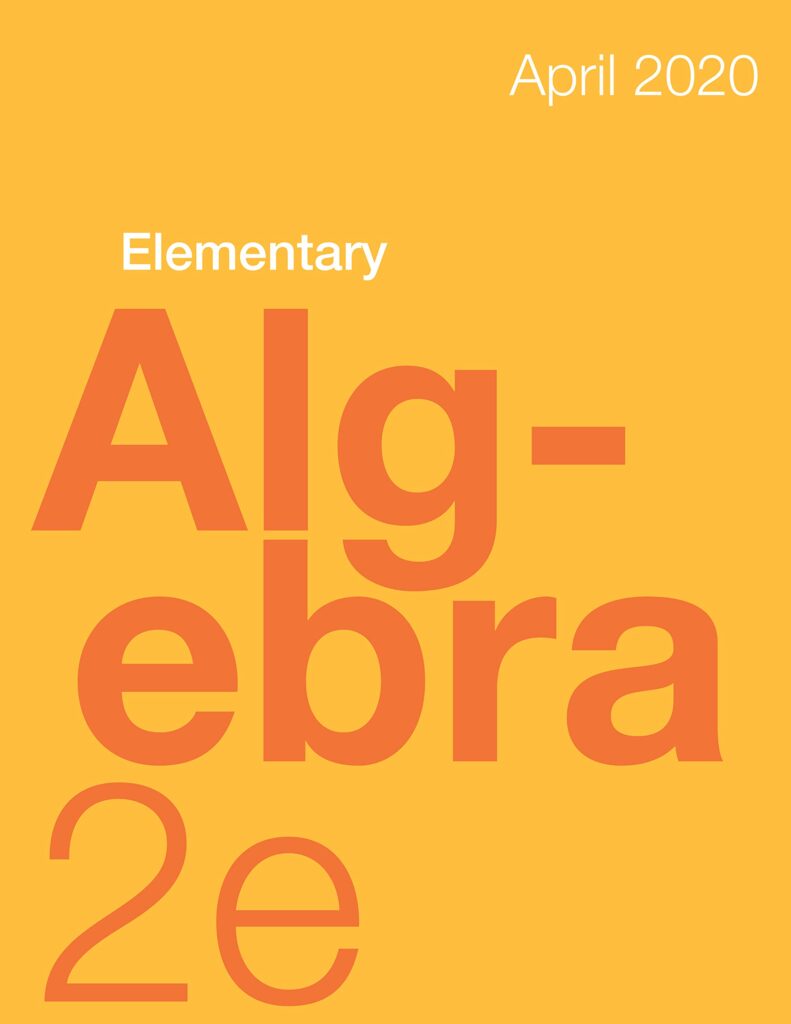
Elementary Algebra 2e
Not rated yetRate this bookElementary Algebra 2e builds a foundation for algebra through ten chapters combining arithmetic, symbolic reasoning, graphs, applications, and equations. Lynn Marecek, MaryAnne Anthony-Smith, and Andrea Honeycutt Mathis develop skills gradually from real numbers to quadratics. This guide follows that introductory progression, emphasizing what each operation means and how to check a result. Its scope differs from Intermediate Algebra 2e, which extends to additional function families and topics.
Free reading is available at the official source. Opens in a new tab.
 Free
About this book
Elementary Algebra 2e builds a foundation for algebra through ten chapters combining arithmetic, symbolic reasoning, graphs, applications, and equations. Lynn Marecek, MaryAnne Anthony-Smith, and Andrea Honeycutt Mathis develop skills gradually from real numbers to quadratics. This guide follows that introductory progression, emphasizing what each operation means and how to check a result. Its scope differs from Intermediate Algebra 2e, which extends to additional function families and topics.
Chapter-wise summaries and study tasks
Chapter 1 Foundations
Foundational arithmetic and notation make later algebra dependable. The chapter reviews whole numbers, integers, fractions, decimals, real-number properties, measurement, and the language of expressions. A variable represents a quantity, while an equation asserts a relationship rather than simply naming a calculation. Signed-number operations require careful grouping, especially when a negative value is raised to a power. Fractions represent numbers as well as parts of a whole, so their operations should be understood rather than inferred from appearance. Measurement introduces units as part of a quantity’s meaning. Readers should explain each step, estimate answers, and check that equivalent representations preserve the value before attempting longer symbolic work.
Study task. Evaluate a mixed expression with signed numbers and fractions, explaining the order of operations. Convert a related measurement with units and compare the exact result with an estimate.
Chapter 2 Solving Linear Equations and Inequalities
Linear equations are solved through operations that preserve equality. The chapter develops addition, subtraction, multiplication, and division properties before combining them in equations with variables on both sides, fractions, decimals, and formulas. The aim is to isolate a variable while keeping every transformation justified. An equation may identify one solution, express an identity, or reveal a contradiction. Inequalities require a different check: multiplying or dividing by a negative reverses their direction. Readers should record what each line means instead of describing a term as simply moving across the equals sign. Substitution into the original equation and testing points on a number line make the result interpretable.
Study task. Solve one equation containing fractions and verify it in the original form. Then solve an inequality requiring division by a negative and test a point inside and outside its solution set.
Chapter 3 Math Models
Math models translate a situation into relationships among defined quantities. This chapter applies a general problem-solving strategy to percentages, mixtures, geometry, motion, and inequalities. The most important step often occurs before calculation: deciding what the variable means and which conditions the model must satisfy. Percent problems require a clear base, while mixture and motion problems depend on consistent units and correctly identified rates. Geometric formulas connect a drawing with numerical constraints. Readers should distinguish an algebraic solution from an acceptable contextual answer, rejecting negative lengths or other impossible values where appropriate. A final sentence should answer the original question rather than leave an unexplained number.
Study task. Create a fictional mixture or travel problem, define variables with units, and build its equation from a table. Check the answer against both the mathematics and the situation’s constraints.
Chapter 4 Graphs
Graphs make relationships between two variables visible. The chapter develops coordinate plotting, linear equations, intercepts, slope, slope-intercept form, line equations, and linear inequalities. A plotted point must satisfy the equation, while a whole line represents all such ordered pairs. Slope compares vertical change with horizontal change and should be interpreted in context rather than memorized only as a formula. Vertical and horizontal lines require special attention because their slopes behave differently. An inequality describes a region whose boundary may be included or excluded. Readers should use a test point and label axes and units so the picture communicates the same relationship as the equation.
Study task. Represent a simple pricing relationship with a table, equation, and labeled graph. Interpret slope and intercept, then shade a related budget inequality and justify the boundary choice.
Chapter 5 Systems of Linear Equations
Systems of linear equations combine conditions that must hold at the same time. Graphing, substitution, and elimination offer different routes to the same solution. The chapter applies these methods to practical and mixture problems and extends to systems of inequalities. Intersecting lines give a unique solution, parallel distinct lines give none, and equivalent equations describe infinitely many. These outcomes reflect the relationships among conditions rather than a method malfunction. Readers should select a method based on structure and check every candidate in both equations. For inequalities, the intersection of shaded regions shows feasible combinations rather than a single required point.
Study task. Solve a two-condition purchase problem by substitution and elimination. Explain the common answer, then alter one condition to create either no solution or infinitely many solutions.
Chapter 6 Polynomials
Polynomial operations connect distributive reasoning with exponent rules. The chapter covers addition, subtraction, multiplication, special products, division, integer exponents, and scientific notation. Like terms combine because they contain the same variable powers; unlike terms cannot be merged simply because they share a letter. Exponent rules concern particular products, quotients, and powers, not arbitrary sums. Special-product patterns help make multiplication efficient but should be verified through expansion. Polynomial division can be checked by multiplying back and including the remainder. Readers should organize work by degree and preserve grouping carefully, using numerical checks to locate mistakes while recognizing that one matching value does not prove an identity.
Study task. Expand a binomial square and explain why the middle term is necessary. Divide a small polynomial and reconstruct the original from divisor, quotient, and remainder.
Chapter 7 Factoring
Factoring expresses a polynomial as a product and provides a route to solving equations. The chapter begins with common factors and grouping, then develops trinomial and special-product cases before applying a general strategy. Factoring should start by checking for a greatest common factor so no factor or root is lost. Expansion tests whether the proposed product reproduces the original. The zero-product property applies when a product equals zero, which explains why setting the original equation to zero is essential. Readers should distinguish factoring an expression from solving an equation and continue until the relevant factors are as simple as the chosen number system permits.
Study task. Factor an expression with a common factor and a quadratic remainder. Solve the corresponding equation, preserving every factor, and verify each root by substitution.
Chapter 8 Rational Expressions and Equations
Rational expressions extend fraction reasoning to algebraic numerators and denominators. The chapter covers simplification, operations, complex fractions, equations, proportions, similar figures, motion, work, and variation. Values making an original denominator zero must be excluded even if a factor later cancels. Cancellation removes common factors, not individual terms inside sums. Clearing denominators helps solve equations but does not make prohibited values valid. Applications require translating rates and proportional relationships carefully; direct and inverse variation describe different patterns. Readers should record restrictions before manipulation and check candidates in the original equation, then decide whether the answer fits the situation.
Study task. Simplify a rational expression and retain its original restrictions. Model a fictional shared-work problem, solve it, and explain why a rate equation is needed rather than adding completion times.
Chapter 9 Roots and Radicals
Roots and radicals connect powers with inverse operations. The chapter develops square-root meaning, simplification, arithmetic, radical equations, higher roots, and rational exponents. Principal even roots are nonnegative over the real numbers, while an equation involving a square can have two real solutions. This distinction prevents a common confusion between evaluating a radical and solving an equation. Combining radicals requires compatible simplified forms. Squaring both sides can introduce extraneous candidates, so a result must be checked before acceptance. Readers should also state domain restrictions for real even roots and interpret rational-exponent notation through its root-and-power meaning rather than applying it mechanically.
Study task. Simplify and combine several square-root expressions, then solve a radical equation. Explain the principal-root convention, state restrictions, and reject any candidate that fails the original equation.
Chapter 10 Quadratic Equations
Quadratic equations bring together factoring, square roots, completing the square, and the quadratic formula. The chapter develops multiple methods, applications, and graphing in two variables. Structure should guide method choice: a factored equation or perfect square may be easier to solve directly than through a general formula. Completing the square explains how a quadratic’s algebra connects to its vertex, while the discriminant helps classify the roots. A graph reveals intercepts and overall shape, but an approximate picture should not replace an exact solution when one is needed. Readers should interpret units and contextual restrictions in applications and compare two methods to strengthen understanding of equivalent forms.
Study task. Solve one quadratic by completing the square and by the formula. Sketch the related parabola, connect its intercepts with the roots, and explain which answers would be valid in a chosen application.
How to study this book
- Build fluency through small sets of practice followed by mixed review. Write reasons for each step and revisit mistakes after enough time has passed to require fresh reasoning.
- Translate word problems with a labeled sketch or table before choosing an equation. Carry units and interpret the final value in a sentence.
- Check answers through substitution, expansion, estimates, and graphs. Keep an error log that separates arithmetic mistakes from misunderstood concepts or omitted restrictions.
Questions for reflection
- Why is an equation different from an expression?
- When can a legal-looking manipulation create an invalid answer?
- How do a graph and an equation provide complementary checks?
Source edition and coverage
This guide follows the ten numbered chapters of the OpenStax second edition. It provides original conceptual explanations and study tasks; the publisher’s book contains worked examples, complete exercises, and selected answers. This guide provides original explanations and learning tasks. Read the complete book at the publisher’s official source.
About access & copyright
This page provides book information and study material. Full-text access is provided by the original publisher or authorised source; a listing does not grant permission to republish the book.
Read our Library Access & Copyright policyExplore the contents
Check the chapters covered in this edition.
Visit the official source
See reading, preview or purchase options.
Save for later
Keep this textbook in your saved collection.
Reader ratings & reviews
Share your thoughts
Your review helps other students choose the right resources.
KEEP LEARNING
Your next great read
Math Business
Principles of Data Science
View Principles of Data Science — book Math
Precalculus 2e
View Precalculus 2e — book Math
Prealgebra 2e
View Prealgebra 2e — book Math
Introductory Statistics 2e
View Introductory Statistics 2e — book Business
Introductory Business Statistics 2e
View Introductory Business Statistics 2e — book Math
Intermediate Algebra 2e
View Intermediate Algebra 2e — book Math
Contemporary Mathematics
View Contemporary Mathematics — book Math
College Algebra 2e with Corequisite Support
View College Algebra 2e with Corequisite Support — book Math



