
 Math
MathTextbook
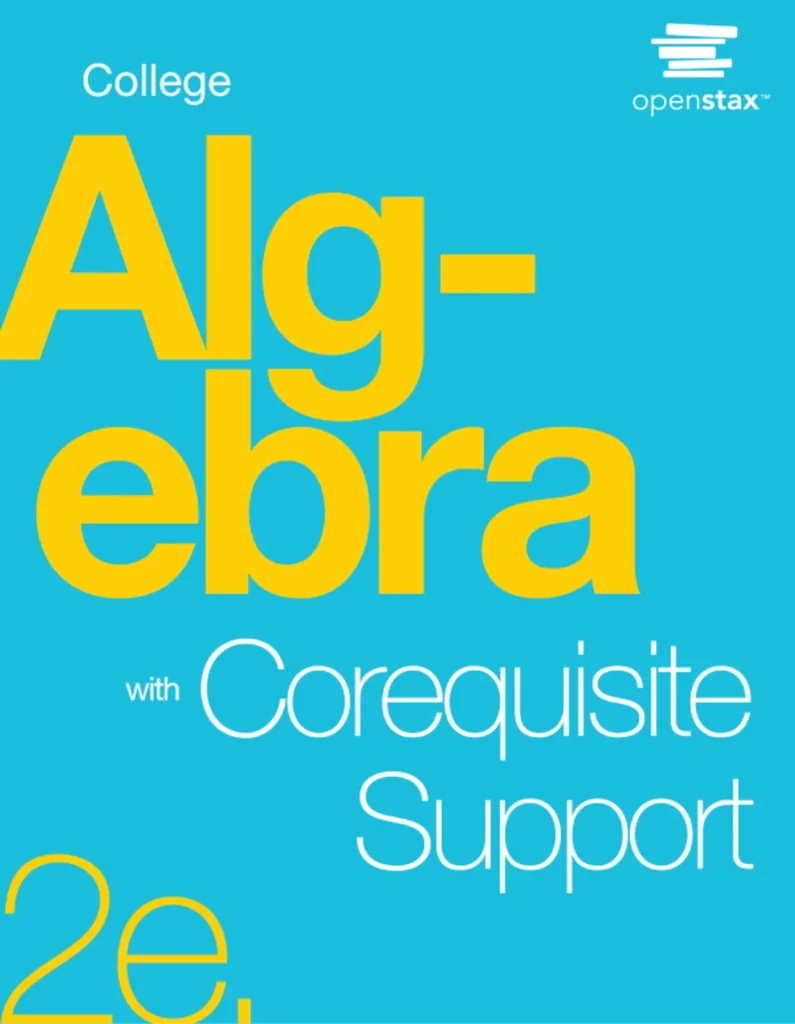
College Algebra 2e with Corequisite Support
Not rated yetRate this bookCollege Algebra 2e with Corequisite Support pairs the nine-chapter college-algebra sequence with aligned foundational skills modules. Jay Abramson’s core text and Sharon North’s support material help students review a needed technique immediately before applying it to functions and models. This guide gives each chapter a scaffolded study focus: diagnose the prerequisite, work through the main idea, and check whether the understanding transfers to a new problem.
Free reading is available at the official source. Opens in a new tab.
 Free
About this book
College Algebra 2e with Corequisite Support pairs the nine-chapter college-algebra sequence with aligned foundational skills modules. Jay Abramson’s core text and Sharon North’s support material help students review a needed technique immediately before applying it to functions and models. This guide gives each chapter a scaffolded study focus: diagnose the prerequisite, work through the main idea, and check whether the understanding transfers to a new problem.
Chapter-wise summaries and study tasks
Chapter 1 Prerequisites
The prerequisite chapter is an opportunity to identify specific gaps before they affect the whole course. Real-number operations, exponent rules, roots, polynomials, factoring, and rational expressions provide the working tools for later function analysis. In this edition, aligned review and guided practice make it possible to repair a skill where it is needed rather than restart an entire subject. Readers should distinguish a sign error from a misapplied rule and write the condition under which a transformation is valid. Factoring and domain restrictions deserve particular attention because they recur throughout the book. Successful review means being able to explain and apply a rule in a changed example, not merely recognize a familiar worked solution.
Study task. Use three short diagnostic examples to locate one weak skill. Review the matching support material, solve a fresh example without help, and explain the rule and its restrictions aloud.
Chapter 2 Equations and Inequalities
Equation solving becomes more reliable when the supporting arithmetic and notation are secure. This chapter combines linear and quadratic equations, coordinate relationships, applications, complex numbers, other equation types, and inequalities. Before a longer solution, readers can review distribution, fraction operations, signed numbers, or equation properties as needed. The central idea is to preserve or carefully track the solution set, not move symbols according to appearance. Application problems add another layer: variables, units, and constraints must be defined before manipulation. The support pathway should end with independent checking in the original statement, especially after squaring, clearing denominators, or interpreting an absolute-value condition.
Study task. Select an equation you initially find difficult and separate prerequisite steps from new reasoning. Repair the weak step, solve independently, and compare the solution set with a related inequality.
Chapter 3 Functions
Function language can be unfamiliar even when the underlying arithmetic is manageable. The chapter develops input-output reasoning, notation, domain, range, rates, composition, transformations, absolute value, and inverses. Support work should first check whether a student can substitute and evaluate expressions with grouping intact. From there, tables and point tracking can clarify composition order and graph transformations. An inverse is not the reciprocal of a function, and function notation does not mean multiplication. Readers should connect these distinctions with examples rather than memorize definitions in isolation. Domain restrictions are part of the relationship, including when a one-to-one restriction is needed for an inverse.
Study task. Start with an input-output table, express it in function notation, and explain each symbol. Then compose two simple functions and test whether a proposed inverse actually reverses them on the stated domain.
Chapter 4 Linear Functions
Linear modeling connects the familiar idea of a rate with function notation and data interpretation. The chapter studies linear functions, applications, and fitting lines. A useful review checks coordinate plotting, fraction arithmetic, and solving for an intercept or unknown parameter. Readers should interpret slope as an output change per input unit rather than merely a rise-over-run calculation. A fitted line can be useful even when points do not lie exactly on it, but residual patterns and context affect confidence. The scaffolded goal is to progress from calculating two points to explaining what the model predicts and where its assumptions stop being reasonable.
Study task. Review slope from two points, then construct a model for a fictional cost situation. Interpret the parameters with units and explain why extending the line to every possible input would be inappropriate.
Chapter 5 Polynomial and Rational Functions
Polynomial and rational functions require earlier symbolic skills to work together. Quadratic behavior, power functions, zeros, division, rational graphs, inverse and radical functions, and variation are developed in this chapter. A focused support check can reveal whether difficulty comes from factoring, exponent rules, polynomial division, or the new interpretation of a graph. Once the calculation is secure, readers should connect multiplicity with graph behavior and denominator restrictions with holes or asymptotes. A sketch supported by intercepts, signs, and end behavior is stronger than plotting many unexplained points. The aim is a reusable reasoning sequence that keeps algebra and the meaning of the function connected.
Study task. Diagnose one factoring or division obstacle, review it, and use the repaired skill to analyze a new function. Explain its domain and graph features without relying only on a graphing display.
Chapter 6 Exponential and Logarithmic Functions
Exponential and logarithmic work builds on powers, function transformations, and equation solving. The chapter connects growth and decay, inverse graphs, logarithm properties, equations, and fitted models. Corequisite review can help separate a computational difficulty from a conceptual one, such as confusing additive growth with percentage change. Readers should practice translating an exponent statement into a logarithmic statement before using properties to solve more complex equations. Real-valued logarithms require positive arguments, and a proposed solution must satisfy that condition. A model’s base and time unit must agree. The final goal is to explain why a logarithm is needed and what the answer means in context.
Study task. Review exponent laws, translate between exponential and logarithmic forms, and solve a hypothetical growth-target problem. Check the domain and explain why a logarithm rule does not split a sum.
Chapter 7 Systems of Equations and Inequalities
Systems and matrices extend equation reasoning to several linked conditions. This chapter introduces linear and nonlinear systems, inequalities, partial fractions, matrix arithmetic, elimination, inverses, and Cramer’s rule. Review should target operations that can undermine a long calculation, including signed arithmetic and consistent substitution. Row operations have a purpose: they replace equations with an equivalent system, not merely produce an attractive matrix pattern. Readers should connect a unique, absent, or nonunique solution with both equations and geometry. A method involving an inverse or determinant requires its conditions to hold. Checking an answer in every original equation provides an independent assessment of the procedure.
Study task. Solve a two-variable system, annotate the meaning of each elimination step, and check the result. Then explain what a zero row or contradiction reveals and identify when an inverse method would be unavailable.
Chapter 8 Analytic Geometry
Conic sections connect algebraic form with geometric definitions and coordinate choices. Ellipses, hyperbolas, parabolas, rotated axes, and polar representations require careful work with squares and transformations. A support module can help restore completing-the-square fluency before it is used to identify a curve. Readers should separate the calculation of standard form from interpretation of a center, focus, vertex, or orientation. The same curve can have different equations under different coordinates. A labeled sketch checks whether the signs and scales have been understood. The scaffolded approach is to master one conversion, then vary a parameter and explain the geometric effect.
Study task. Review completing the square with a simple expression, then convert a conic equation. Label its features and predict how one parameter change alters the graph before checking the calculation.
Chapter 9 Sequences, Probability, and Counting Theory
The final chapter combines discrete patterns with counting and probability. Sequences, series, arithmetic and geometric rules, the binomial theorem, and sample-space reasoning depend on accurate indexing and basic fraction operations. Readers can begin with small lists or diagrams and then connect the observed structure to a general expression. Order and replacement determine the counting method, while probability requires a defensible model of outcomes. A recursive definition needs a starting value; a finite sum differs from a claim about infinite convergence. The support approach should end with a new scenario where the student selects the method rather than follows a label supplied by the exercise.
Study task. List a small sample space, solve the same count with a formula, and explain the match. Build a sequence with an initial condition and test its explicit rule at several indices.
How to study this book
- Use each aligned Corequisite Skills module before its main section when a diagnostic attempt reveals a gap. Review selectively, then return to the college-level task.
- Keep a two-column error record separating prerequisite execution from new conceptual reasoning. Use fresh examples to confirm that a repaired skill transfers.
- Use the edition’s labs and guided practice as instructed by your course, then complete an independent explanation or mixed problem. Check the result through a different representation.
Questions for reflection
- Is the obstacle a missing prerequisite or a new concept?
- What would demonstrate transfer beyond a worked example?
- How does a table or graph reveal a mistake hidden in symbolic work?
Source edition and coverage
This guide follows the nine main chapters of College Algebra 2e with Corequisite Support. Its distinguishing resources are topically aligned Corequisite Skills modules and labs; the main chapter names match the standard edition. The study tasks here are original prompts, not reproductions of those labs. This guide provides original explanations and learning tasks. Read the complete book at the publisher’s official source.
About access & copyright
This page provides book information and study material. Full-text access is provided by the original publisher or authorised source; a listing does not grant permission to republish the book.
Read our Library Access & Copyright policyExplore the contents
Check the chapters covered in this edition.
Visit the official source
See reading, preview or purchase options.
Save for later
Keep this textbook in your saved collection.
Reader ratings & reviews
Share your thoughts
Your review helps other students choose the right resources.
KEEP LEARNING
Your next great read
Math Business
Principles of Data Science
View Principles of Data Science — book Math
Precalculus 2e
View Precalculus 2e — book Math
Prealgebra 2e
View Prealgebra 2e — book Math
Introductory Statistics 2e
View Introductory Statistics 2e — book Business
Introductory Business Statistics 2e
View Introductory Business Statistics 2e — book Math
Intermediate Algebra 2e
View Intermediate Algebra 2e — book Math
Elementary Algebra 2e
View Elementary Algebra 2e — book Math
Contemporary Mathematics
View Contemporary Mathematics — book Math



