
 Engineering & Technology
Textbook
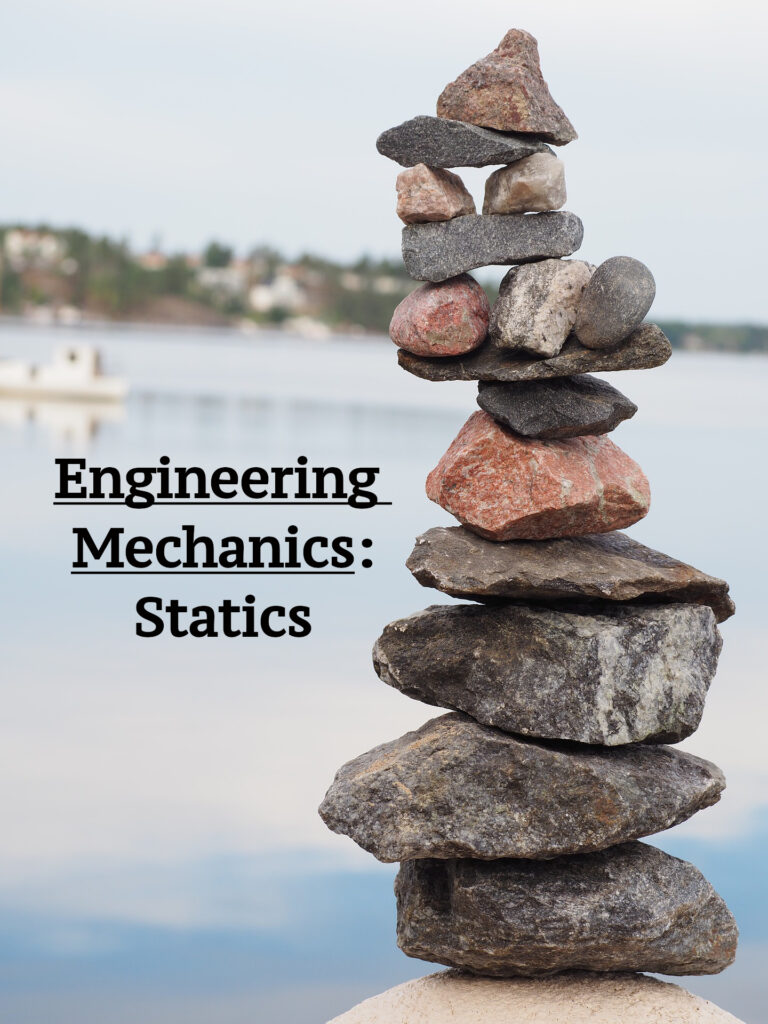
Engineering Mechanics: Statics
Not rated yetRate this bookThis statics resource connects mathematical and physical foundations with the analysis of equilibrium. The reviewed opening emphasizes structured problem solving, clear representations, and the distinction between scalar and vector quantities.
Free reading is available at the official source. Opens in a new tab.
 Free
About this book
About this book
The current text credits Libby (Elizabeth) Osgood, Gayla Cameron, Emma Christensen, Analiya Benny, Matthew Hutchison, and Deborah Areoye. Its introduction outlines a route through particles, rigid bodies, trusses, internal forces, and inertia. The resource combines material from several open sources and marks those connections for readers. Chapter takeaways and examples contributed by former students support study. This page reviews the introduction and selected preparatory concepts, rather than checking every force diagram, derivation, or worked solution.
Sources and reading coverage
Title, rights, contents, introduction on PDF sheets 13–14, and selected scalar–vector discussion on sheets 19–20 were reviewed. Later equilibrium analyses and solutions were not comprehensively checked.
Consult the official source for the available edition and publication details.
The consulted PDF contains 673 sheets, including preliminary material. PDF sheet numbers can differ from printed pagination.
Book summary
Guide to the reviewed opening
The introduction frames statics as the study of situations with zero acceleration and connects it with familiar structures and physical settings. Its learning map begins with mathematics and physics before moving toward different models of bodies and their equilibrium.
The reviewed preparatory section distinguishes a quantity specified by a number and unit from one that also needs direction. This makes the scalar–vector distinction part of representing a physical situation accurately, rather than simply a rule of notation.
The introduction also describes a learning approach involving practice, connections between concepts, and discussion with peers. The source’s examples are aids to developing a method, not a substitute for explaining why a representation or equation is appropriate. Later analytical procedures remain outside this guide’s detailed coverage.
How to study this book
Before calculating, identify the object or model under study and list the relevant quantities with units. Mark which need direction. Explain each symbol and the physical statement represented by an equation.
Attempt an assigned problem before consulting its solution. Compare your assumptions and representation with the source, not only your final number. Keep separate notes for a modelling error, an algebra error, and an incorrect unit or direction.
Questions for reflection
- Which quantities require direction as well as magnitude?
- What physical model is being assumed?
- Does the final result make sense within that model?
The study suggestions and questions are independent Academic Master editorial material.
About access & copyright
This page provides book information and study material. Full-text access is provided by the original publisher or authorised source; a listing does not grant permission to republish the book.
Read our Library Access & Copyright policyRepresentation
Distinguish scalars and vectors.
Models
Identify the body or system under study.
Method
Connect equations with physical statements.
Checking
Diagnose the source of an error.
Reader ratings & reviews
Share your thoughts
Your review helps other students choose the right resources.
KEEP LEARNING
Your next great read
Engineering & Technology Engineering & Technology
Ethics in Technology
View Ethics in Technology — book Civil Engineering
The Design of the Built Environment: The University of Illinois Urbana-Champaign Campus and Its Context
View The Design of the Built Environment: The University of Illinois Urbana-Champaign Campus and Its Context — book Contract Law
Construction Contracting: Business and Legal Principles, Second Edition
View Construction Contracting: Business and Legal Principles, Second Edition — book Engineering & Technology
Introduction to Engineering Thermodynamics
View Introduction to Engineering Thermodynamics — book Analysis
Basic Engineering Data Collection and Analysis
View Basic Engineering Data Collection and Analysis — book Engineering & Technology
Biomedical Engineering Lab Manual
View Biomedical Engineering Lab Manual — book Electrical Engineering
Radio Systems Engineering
View Radio Systems Engineering — book Engineering & Technology
Interior Materiality
View Interior Materiality — book Engineering & Technology



