
 Engineering & Technology
Textbook
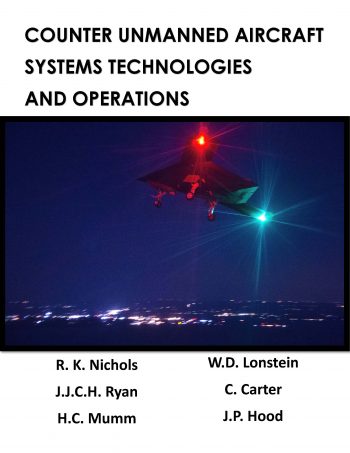
Counter Unmanned Aircraft Systems Technologies and Operations
Not rated yetRate this bookThis collection introduces counter-unmanned-aircraft questions within a discussion of changing drone technologies and uses. Its preface explains the security-oriented scope and relationship to the authors’ earlier work.
Read on the publisher’s website. Opens in a new tab.
 Free
About this book
About this book
The 2020 New Prairie Press book is credited to R. K. Nichols, J. J.C.H. Ryan, H. C. Mumm, C. Carter, W. D. Lonstein, and J. P. Hood. It was developed as a companion to earlier work on unmanned aircraft in the cyber domain. Its opening explains the applications and concerns that motivated the volume. This page discusses that framing, not countermeasure procedures, present legal authority, or a current regulatory specification.
Sources and reading coverage
Title, copyright, and selected preface passages on PDF sheets 21–22 of the publisher-hosted online edition were reviewed. Countermeasure procedures were not reproduced or validated.
See the official publication record for edition details. Read the publisher’s online edition. The external PDF provides the available source text.
The consulted PDF contains 534 sheets, including preliminary material; this count can differ from printed pagination.
Book summary
Guide to the reviewed opening
The preface argues that spreading unmanned-aircraft use creates both opportunities and security questions. Different applications, institutions, and users shape those questions, so the subject cannot be reduced to a single device.
The authors also describe rapid change as a difficulty for writing a stable textbook. Their selection of developments captures a period and a set of priorities, rather than a permanently exhaustive account. The introduction’s relationship to its companion volume helps explain those limits. Later technical arguments need direct reading and their own supporting evidence.
How to study this book
Define the setting and problem before comparing responses. Record the assumed aircraft, affected people or assets, and evidence used to characterize a concern. Avoid applying a broad statement about drones to every platform.
Separate technical feasibility from legal authority and practical suitability. Check dated policy references against current official sources before relying on them outside historical study. This is a guide to evaluating the book’s arguments, not implementing a countermeasure.
Questions for reflection
- Which context is assumed in a risk claim?
- Why does feasibility not establish legal authority?
- How does rapid change limit a collection?
The study suggestions and questions are independent Academic Master editorial material.
About access & copyright
This page provides book information and study material. Full-text access is provided by the original publisher or authorised source; a listing does not grant permission to republish the book.
Read our Library Access & Copyright policyContext
Define the problem precisely.
Scope
Recognize selective historical coverage.
Authority
Keep technical and legal questions distinct.
Sources
Check dates and evidence.
Reader ratings & reviews
Share your thoughts
Your review helps other students choose the right resources.
KEEP LEARNING
Your next great read
Engineering & Technology Engineering & Technology
Ethics in Technology
View Ethics in Technology — book Civil Engineering
The Design of the Built Environment: The University of Illinois Urbana-Champaign Campus and Its Context
View The Design of the Built Environment: The University of Illinois Urbana-Champaign Campus and Its Context — book Contract Law
Construction Contracting: Business and Legal Principles, Second Edition
View Construction Contracting: Business and Legal Principles, Second Edition — book Engineering & Technology
Introduction to Engineering Thermodynamics
View Introduction to Engineering Thermodynamics — book Engineering & Technology
Engineering Mechanics: Statics
View Engineering Mechanics: Statics — book Analysis
Basic Engineering Data Collection and Analysis
View Basic Engineering Data Collection and Analysis — book Engineering & Technology
Biomedical Engineering Lab Manual
View Biomedical Engineering Lab Manual — book Electrical Engineering
Radio Systems Engineering
View Radio Systems Engineering — book Engineering & Technology



