
 Mathematics
PureTextbook
An Introduction to the Theory of Numbers
Not rated yetRate this bookAn Introduction to the Theory of Numbers presents Leo Moser’s elementary number theory lectures. The text explores several topics and problems using basic arithmetic foundations rather than complex variable methods. The hosted Trillia version was released in July 2011.
 Free
About this book
The preface uses elementary in two senses: the mathematical approach avoids complex variable theory, and the presentation aims to be approachable. Familiarity with divisibility, greatest common divisors, least common multiples and prime factorisation is assumed. The lectures survey several directions rather than developing each one exhaustively. Problems play an important role in that exploration. The publication history should be kept distinct: the work carries a 1957 copyright, was first published in this Trillia form in 2004, and identifies the hosted version as a 2011 release.
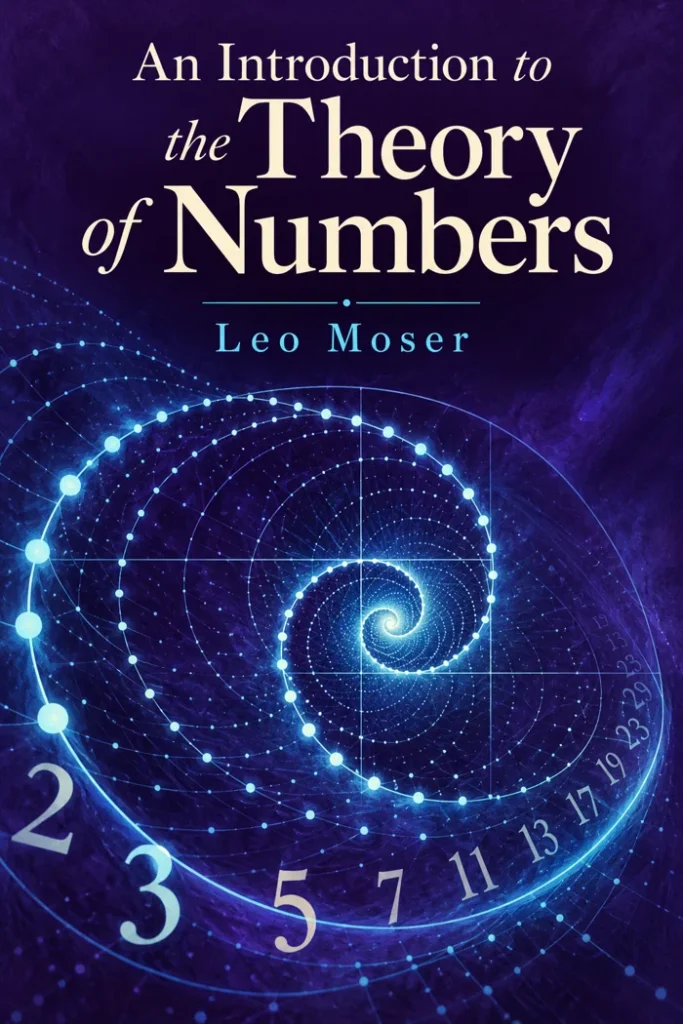
The attached edition contains 95 PDF pages, including front matter. Cover: source edition title page rendered from the PDF. The textbook and its original notices are retained; Academic Master’s study material is separate from the source text.
Book summary
Leo Moser’s An Introduction to the Theory of Numbers presents a problem-centered route through classical and combinatorial number theory. This guide follows the Trillia version released July 31, 2011, based on the author’s earlier lectures. Eight chapters are followed by classical problems, miscellaneous exercises, and conjectures. Statements labeled unsolved belong to the historical text; this guide does not claim that every such problem retains the same research status today.
Chapter-by-chapter summaries
Chapter 1: Compositions and Partitions
Compositions and partitions divide integers into parts under different conventions about order. A counting argument must identify precisely when two decompositions count as the same. Work through small integers and organize the examples before generalizing. Bijections and recurrences can explain patterns that a list only suggests. This opening develops the habit of turning a number-theoretic question into a clearly defined collection of objects.
Chapter 2: Arithmetic Functions
Functions defined on positive integers encode divisibility and factorization information. Their properties often become clearer when an integer is expressed through primes. Keep an identity about all integers distinct from evidence from several examples. When manipulating sums over divisors, account for each divisor exactly once. The chapter builds tools that connect elementary arithmetic structure with more general counting and algebraic arguments.
Chapter 3: Distribution of Primes
Prime numbers are the building blocks of factorization, but their locations raise subtler questions. The chapter examines arguments and estimates concerning their abundance and distribution. Distinguish an exact formula, an inequality, and an asymptotic statement. A trend visible in a numerical table does not establish a universal theorem. Follow how a proof turns divisibility or counting information into a claim about primes rather than rely on the apparent randomness of examples.
Chapter 4: Irrational Numbers
Irrationality proofs show that a number cannot be represented as a ratio of integers. Contradiction and divisibility provide useful techniques, but the representation must be reduced or constrained appropriately for the argument. Examine the particular property of the number that creates the contradiction. A decimal display that fails to terminate on a calculator is not an irrationality proof. Compare methods to see which ideas extend beyond a single famous example.
Chapter 5: Congruences
Congruence records equality of remainders relative to a modulus. It supports reasoning about divisibility, powers, and equations while deliberately discarding some ordinary numerical detail. State the modulus and check conditions before cancellation or inversion. A nonzero residue need not be invertible for every modulus. Small residue tables can guide exploration, while the proof must account for the complete class of integers under discussion.
Chapter 6: Diophantine Equations
Diophantine questions ask for integer solutions rather than arbitrary real solutions. A curve’s continuous points may contain few or no admissible integer points. Use divisibility, congruence, factorization, or bounds to constrain possibilities, then explain why any proposed family is complete. Finding several solutions is different from classifying all of them. Keep sign, zero, and positivity restrictions visible throughout the argument.
Chapter 7: Combinatorial Number Theory
Combinatorial reasoning reveals number-theoretic structure through arrangements, counting, and unavoidable patterns. Define the objects and constraints clearly before applying a counting principle. A constructive example can show possibility, while a general argument may establish that some configuration must exist. Compare these directions of reasoning. The chapter rewards small experiments that expose a pattern, followed by a proof explaining why the pattern cannot be escaped under the stated conditions.
Chapter 8: Geometry of Numbers
Geometric representations turn integer questions into questions about lattice points and regions. The shape, scale, and placement of a region can constrain which integer points it must contain. Distinguish an area argument from a picture-based guess and state boundary conventions carefully. Translating back to arithmetic is part of the proof: the located point must satisfy the original number-theoretic requirements rather than merely exist somewhere in the diagram.
Closing Problem Collections
Classical unsolved problems, miscellaneous problems, and conjectures invite work beyond the chapter exposition. Read each statement according to the source’s historical context and separate a conjecture from an established theorem. Attempt special cases, identify obstacles, and distinguish partial progress from a complete solution. A useful study record explains which techniques were tried and why they failed or succeeded. Independent practice can deepen understanding even when a problem is intentionally beyond the reader’s present tools.
Study instructions
- Compute small cases and state a precise conjecture before attempting a proof.
- Keep a proof notebook organized by divisibility, congruence, counting, contradiction, and geometric methods.
- Record all integer, sign, and modulus restrictions in each problem.
- For a claimed classification, prove both that the proposed solutions work and that no others are possible.
- Treat historical unsolved-problem labels as source context rather than current research claims.
- Write full arguments explaining the key idea rather than only report an answer.
Questions for reflection
- Why does order matter for a composition but not for a partition?
- What conditions make cancellation valid in modular arithmetic?
- How can a geometric statement establish an arithmetic result?
Sources and coverage
This original study guide follows the complete linked source edition and all of its substantive chapters or named teaching sections. It condenses their main ideas and relationships; the study tasks are guidance for reading alongside the complete resource. It does not reproduce the source exercises or answer key. Book source; Complete source PDF.
About access & copyright
Check this edition’s source and licence before reusing its files or content. A library listing does not grant additional rights.
Read our Library Access & Copyright policyElementary methods
Identify the stated restriction on techniques.
Arithmetic foundations
Recognise the assumed prerequisite concepts.
Problem-based inquiry
Connect simple statements with deeper questions.
Historical status
Distinguish source labels from current problem status.
Reader ratings & reviews
Share your thoughts
Your review helps other students choose the right resources.
KEEP LEARNING
Your next great read
Mathematics Algebra
College Algebra
View College Algebra — book Calculus
Precalculus (Version 3, Corrected 2013 Edition)
View Precalculus (Version 3, Corrected 2013 Edition) — book Geometry and Trigonometry
College Trigonometry
View College Trigonometry — book Calculus
Whitman Calculus
View Whitman Calculus — book Calculus
Vector Calculus
View Vector Calculus — book Calculus
 for the Life Sciences: A Modeling Approach, Volume 2
View Calculus for the Life Sciences: A Modeling Approach, Volume 2 — book Calculus
Precalculus (University of Washington, 2011 Edition)
View Precalculus (University of Washington, 2011 Edition) — book Algebra
Linear Algebra
View Linear Algebra — book Mathematics



