
 English Literature
Plays
The Puritan Widow
Thomas Middleton is the accepted author in the Folger account; the early initials W. S. helped generate the historical Shakespeare attribution.
Not rated yetRate this bookThe Puritan Widow opens with a family returning from a funeral, but its mourning quickly exposes disagreements about money, inheritance, and marriage. This guide to Act I, Scene I helps students explore comic irony, competing displays of grief, and the difference between praise and the conduct being praised.
 Free
About this book
Also known as The Puritan or The Widow of Watling Street, this comedy opens in the garden behind the Widow’s house. The family’s mourning clothes and her intense lamentation establish a public display of loss. Yet the dialogue repeatedly brings attention back to wealth, control of property, and the prospect of remarriage. The dead husband’s supposed virtues are described in terms that raise questions about how he acquired that wealth. Different family members respond with consolation, vows, impatience, or a wish for freedom. The opening therefore provides a concentrated example of how comedy can reveal conflicting values within a single household. This guide discusses the first scene only. It does not summarise the later schemes, marriages, or resolution of the comedy, and its interpretive prompts are Academic Master’s editorial material.
The hosted file is Academic Master’s 2026 PDF formatting of Project Gutenberg eBook #4214. The displayed 95-page count is the PDF sheet count, including source notices, rather than the pagination of an early printed copy. Project Gutenberg released this eBook in 2003. No separate ISBN or DOI has been verified for this PDF; the catalogue’s ISBN (HTML) identifies its HTML format.
Authorship and edition context. Thomas Middleton is the accepted author in the Folger account; the early initials W. S. helped generate the historical Shakespeare attribution.
Editorial suitability: undergraduate English literature, drama, and textual-study readers. Scholarly relevance is supported by the institutional source and Peter Kirwan’s University of Warwick research on the apocrypha. This is evidence of academic study, not a claim that this PDF is assigned in a particular course.
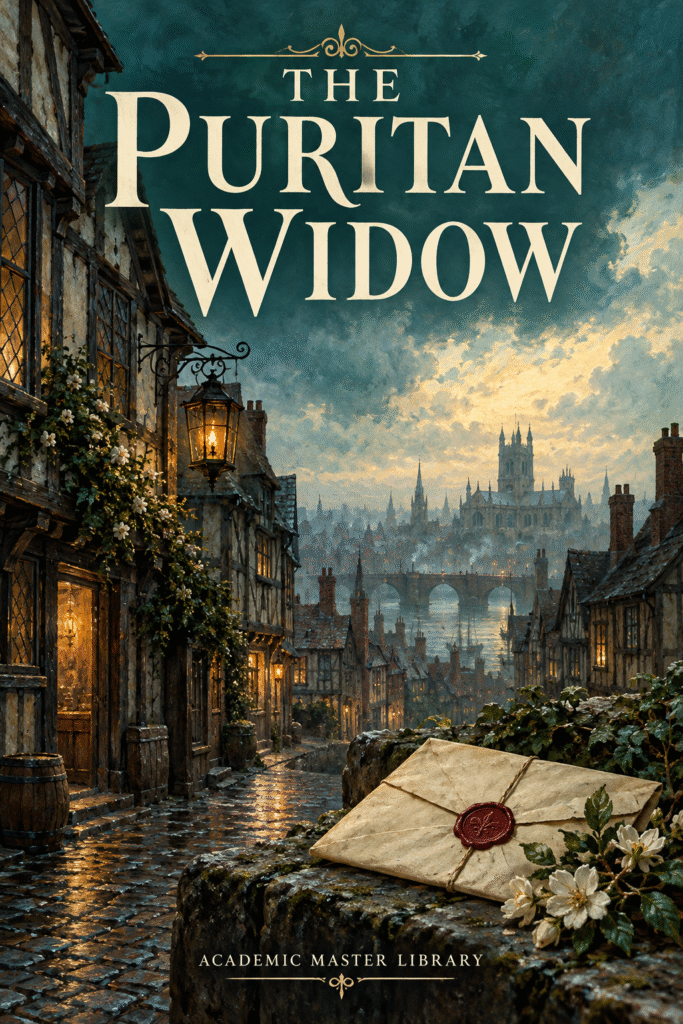
Cover design: original Academic Master library cover. The hosted PDF remains the edition described above.
Source licence: Full Project Gutenberg License. Required source notices and licence terms are retained in the downloadable files.
Book summary
The Puritan Widow is a five-act comedy of mourning, courtship, debt, and manufactured supernatural authority. This guide follows the Project Gutenberg text and expands the previous opening-only coverage through the marriage resolution. George Pye-board’s schemes reveal how apparent knowledge can be produced through eavesdropping, planted evidence, and staged events. The historical attribution attached to the play should be treated critically rather than repeated as settled authorship.
Act and scene summaries
Act I: Mourning and Opportunism
The Widow Plus and her household announce grief and resistance to remarriage, while different family members respond with different degrees of commitment. Their declarations create expectations that the later action can test. In a parallel world of scholars, soldiers, debt, and imprisonment, Pye-board begins devising ways to turn performance into practical advantage. Costume and confident speech help establish credibility. The act connects apparently private mourning with a wider economy in which people seek access, money, freedom, and marriage through the management of appearances.
Act II: Turning Information into Prophecy
Moll’s willingness to pursue marriage complicates the household’s announced refusal. Pye-board gains apparent supernatural insight through ordinary access to information, including overheard vows. He plans a staged quarrel and a sleeping potion that will make the wounded Corporal appear dead, allowing a later revival to look miraculous. A chain is deliberately removed and hidden so its recovery can support another claim to special power. The audience knows the preparations before the household sees the results, making credulity visible as a constructed response rather than a mysterious personal trait.
Act III: Credibility Through Performance
Suitors, servants, and the schemers continue to act on differing accounts of what is happening. The chain’s disappearance creates a need that the supposed conjurer is positioned to answer. Pye-board and Captain Idle build confidence through performance and promises, while their apparent abilities attract requests beyond the original scheme. The chapter of deception is social as well as technical: clothing, reputation, access, and willingness to believe all contribute. Track how one successful appearance becomes evidence for trusting the next claim, even though the underlying events have been arranged.
Act IV: Apparent Resurrection and Changed Affections
The staged death and revival bring the plot’s preparations into public view. Those who lack the audience’s information interpret the Corporal’s recovery as extraordinary intervention, and the authorities’ reaction helps validate the performance. Practical explanations, including the effects of the potion and the participants’ coordination, remain available to spectators. The Widow and Frances move away from their earlier vows, while gratitude and admiration become potential routes to marriage. The act asks how a convincing spectacle can transform both belief and personal judgment before anyone checks its basis.
Act V: Exposure and Marriage Settlement
Plans for the marriage morning bring the schemes toward their expected reward. The deception is then revealed, interrupting the conversion of fraudulent authority into permanent advantage. The closing intervention redirects the Widow and Frances toward suitors presented as men of established reputation, while Moll’s match also enters the resolution. Read that conclusion as the comedy’s social settlement rather than an unexamined guarantee that recognized status always equals honesty. The exposure discredits one performance of authority, yet the final recommendations still depend on others speaking authoritatively about who deserves trust.
Reading the Comedy’s Mechanisms
Across the five acts, eavesdropping supplies information, a theft creates a problem, a planted object supplies proof, and a drugged body supplies spectacle. These mechanisms let readers reconstruct how the illusion works. Religious language, mourning, and gentility are also available for strategic use. A close reading should distinguish satire of a posture from a blanket judgment about every person associated with it. Compare a character’s confidence with the evidence actually available, and note how the audience’s privileged knowledge produces comedy while exposing vulnerability to manipulation.
Study instructions
- Create a cause-and-effect chart of each trick, including preparation, performance, belief, and reward.
- Track who knows that the chain and apparent death are staged.
- Compare the household’s opening vows with later choices and the pressures influencing them.
- Read costume, reputation, and official reaction as parts of the production of credibility.
- Evaluate the final settlement alongside the play’s earlier demonstrations that appearances can mislead.
- Choose one scene and explain how it would work differently for an audience without advance knowledge of the trick.
Questions for reflection
- What makes an ordinary fact look like supernatural knowledge?
- How does apparent proof of one claim lead to trust in another?
- Does exposing the fraud fully resolve the problem of judging credibility?
Sources and coverage
This original guide follows the complete play’s act or scene sequence in the linked Project Gutenberg edition. It summarizes major action and develops reading questions; it is not a reproduction of the dialogue or an edition of the play. Spoilers include the ending. Attribution statements in historical title pages should not be treated as a settled modern authorship finding. The existing source text, hosted PDF, and cover remain available. Read the source play; Edition details.
About access & copyright
Check this edition’s source and licence before reusing its files or content. A library listing does not grant additional rights.
Read our Library Access & Copyright policyComic irony
Explain the gap between praise and the actions being described.
Public mourning
Analyse how grief is performed and interpreted within the family.
Inheritance
Identify the relationship between property and household authority.
Character contrast
Compare the children’s different attitudes towards their future.
Reader ratings & reviews
Share your thoughts
Your review helps other students choose the right resources.
KEEP LEARNING
Your next great read
English Literature English Literature
Thomas Lord Cromwell
View Thomas Lord Cromwell — book English Literature
Sir John Oldcastle
View Sir John Oldcastle — book English Literature
The Merry Devil of Edmonton
View The Merry Devil of Edmonton — book English Literature
The London Prodigal
View The London Prodigal — book English Literature
King Edward III
View King Edward III — book English Literature
Fair Em
View Fair Em — book English Literature
Arden of Feversham
View Arden of Feversham — book English Literature
Locrine
View Locrine — book English Literature



