
 English Literature
Plays
Sir John Oldcastle
Attributed to Anthony Munday, Michael Drayton, Robert Wilson and Richard Hathaway on the evidence of payments recorded in Henslowe’s diary; the later Shakespeare attribution did not endure.
Not rated yetRate this bookSir John Oldcastle begins with a defence of its central figure and a violent street quarrel about religion. This guide to the Prologue and Act I, Scene I helps students examine reputation, competing loyalties, public order, and the difference between an accusation and evidence of personal involvement.
 Free
About this book
Sir John Oldcastle is the surviving first part of a historical drama about the figure also called Lord Cobham. Folger documents a second part that is now lost, so the hosted text should not be confused with a surviving two-part complete series. Its Prologue explicitly prepares the audience to see a virtuous, loyal figure rather than a comic glutton. The first scene does not bring that figure on stage: instead it presents a public brawl and the way his name enters other people’s arguments. The opening is especially useful for studying how drama constructs a reputation before a character appears. It also offers material for analysing the language of religious dissent, the efforts of civic officers, and the fear that a private dispute might grow into rebellion. The guide covers that opening, rather than the whole historical narrative.
The hosted file is Academic Master’s 2026 PDF formatting of Project Gutenberg eBook #1788. The displayed 112-page count is the PDF sheet count, including source notices, rather than the pagination of an early printed copy. Project Gutenberg released this eBook in 1999. No separate ISBN or DOI has been verified for this PDF; the catalogue’s ISBN (HTML) identifies its HTML format.
Authorship and edition context. Attributed to Anthony Munday, Michael Drayton, Robert Wilson and Richard Hathaway on the evidence of payments recorded in Henslowe’s diary; the later Shakespeare attribution did not endure.
Editorial suitability: undergraduate English literature, drama, and textual-study readers. Scholarly relevance is supported by the institutional source and Peter Kirwan’s University of Warwick research on the apocrypha. This is evidence of academic study, not a claim that this PDF is assigned in a particular course.
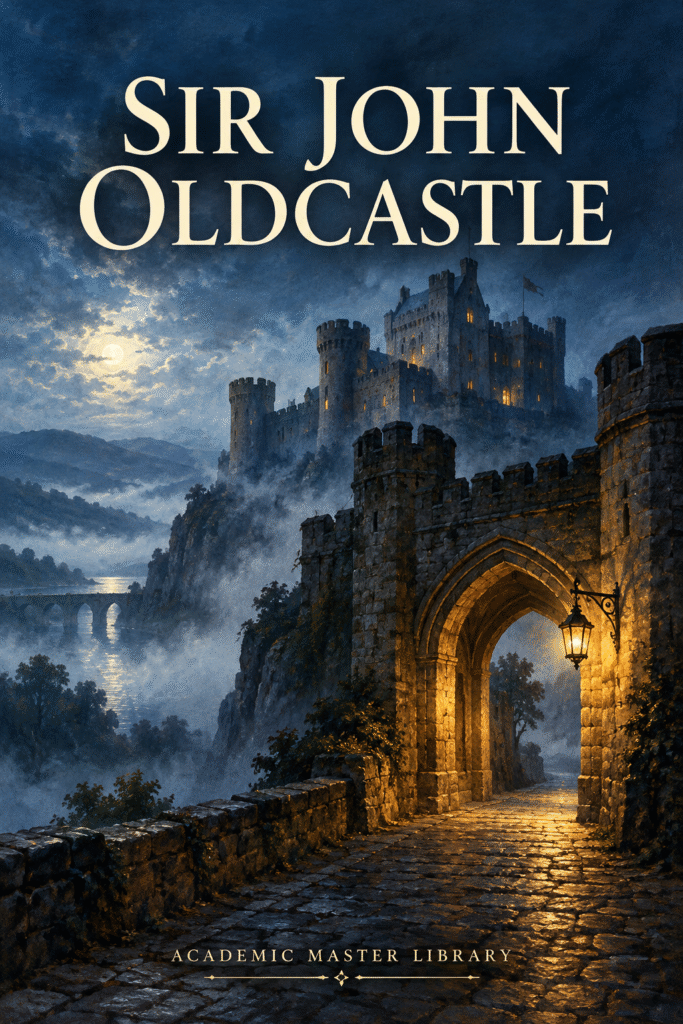
Cover design: original Academic Master library cover. The hosted PDF remains the edition described above.
Source licence: Full Project Gutenberg License. Required source notices and licence terms are retained in the downloadable files.
Book summary
Study overview of reviewed passages
Coverage: The Prologue and Act I, Scene I, read in full. Later scenes have not been summarised. Spoilers: this guide discusses events within that coverage.
The Prologue announces a corrective purpose. It rejects the image of a pampered glutton or corrupting adviser and promises a figure distinguished by faith, courage, and loyalty. This is an invitation to judge the play’s representation in relation to an earlier reputation. It is a claim made by the theatrical framing, not independent proof that every action in the drama is historically accurate.
Act I, Scene I immediately presents disorder. Lord Herbert, Lord Powis, and their followers fight in a Hereford street, defying the Sheriff’s attempt to speak in the King’s name. Comic interruptions interfere with the formal proclamation, and the Mayor’s arrival does not end the confrontation. Herbert is seriously wounded, Powis escapes, and the Judges order action against the remaining followers. The scene makes the authority of public office visible while showing the difficulty of enforcing it against factional loyalty.
Only after this action do the Judges ask about the cause. The Sheriff reports an argument over Rome and Wycliffe’s doctrine, including the use of Sir John Oldcastle’s name as an example. A Judge expressly distinguishes that use of the name from Oldcastle’s own participation, saying that he believes him innocent of this disturbance. At the same time, the Judges fear conspiracies and gatherings during preparations for war in France. Their measures extend from arrests to limits on assemblies and popular discussion of affairs of state. The opening therefore separates several kinds of loyalty: attachment to a lord, religious allegiance, and obedience to the Crown. It also gives students a concrete example of a reputation being drawn into a conflict by people other than its bearer.
Scene summaries
The Prologue.
The framing speech describes the figure the company intends to present and rejects an earlier comic or morally discrediting image. Its emphasis on virtue, faith, and loyalty prepares an audience response before the action begins. It is useful evidence about the play’s representational purpose; it should be distinguished from a modern historian’s assessment of the person.
Act I, Scene I — Hereford. A street.
A quarrel between noble households overcomes several efforts to restore order. The Judges move from immediate arrests to concern about wider religious and political unrest. Oldcastle is named in the reported argument but does not appear in the fight. One Judge specifically separates his innocence in this episode from the dangerous use of his name by others.
Close-reading guidance
The following interpretations and study prompts are Academic Master’s editorial material.
- Track who supplies each piece of information. The opening action shows the fight; the Sheriff supplies its religious explanation; the Judge offers a judgement about Oldcastle’s innocence.
- The comic rendering of the followers’ speech is part of the play’s construction of regional identity. Academic Master’s editorial approach asks students to analyse that representation rather than repeat its stereotypes as factual descriptions.
- Compare the Prologue’s promised loyalty with the competing loyalties visible in the street. This comparison supports an argument about dramatic framing without requiring conclusions about scenes outside the stated coverage.
Questions for discussion
- Why might the Prologue need to reject a previously familiar image?
- How does the scene distinguish using Oldcastle’s name from his participation?
- When does the Judges’ response move beyond the immediate street fight?
Sources and coverage
The Prologue and Act I, Scene I, read in full. Later scenes have not been summarised. The complete contents were checked against the linked source text; contents entries do not imply that all scenes have been summarised. Scene labels and divisions follow this edition. The original hosted PDF and cover are retained.
Project Gutenberg edition details · Source HTML text · Authorship or institutional context
About access & copyright
Check this edition’s source and licence before reusing its files or content. A library listing does not grant additional rights.
Read our Library Access & Copyright policyReputation
Explain how framing and reported speech establish a character before his entrance.
Evidence and accusation
Distinguish naming a person from proving participation.
Competing loyalties
Analyse faction, religion, and obedience to public authority.
Historical drama
Separate the play’s representation from documentary biography.
Reader ratings & reviews
Share your thoughts
Your review helps other students choose the right resources.
KEEP LEARNING
Your next great read
English Literature English Literature
Thomas Lord Cromwell
View Thomas Lord Cromwell — book English Literature
The Merry Devil of Edmonton
View The Merry Devil of Edmonton — book English Literature
The Puritan Widow
View The Puritan Widow — book English Literature
The London Prodigal
View The London Prodigal — book English Literature
King Edward III
View King Edward III — book English Literature
Fair Em
View Fair Em — book English Literature
Arden of Feversham
View Arden of Feversham — book English Literature
Locrine
View Locrine — book English Literature



