
 English Literature
Plays
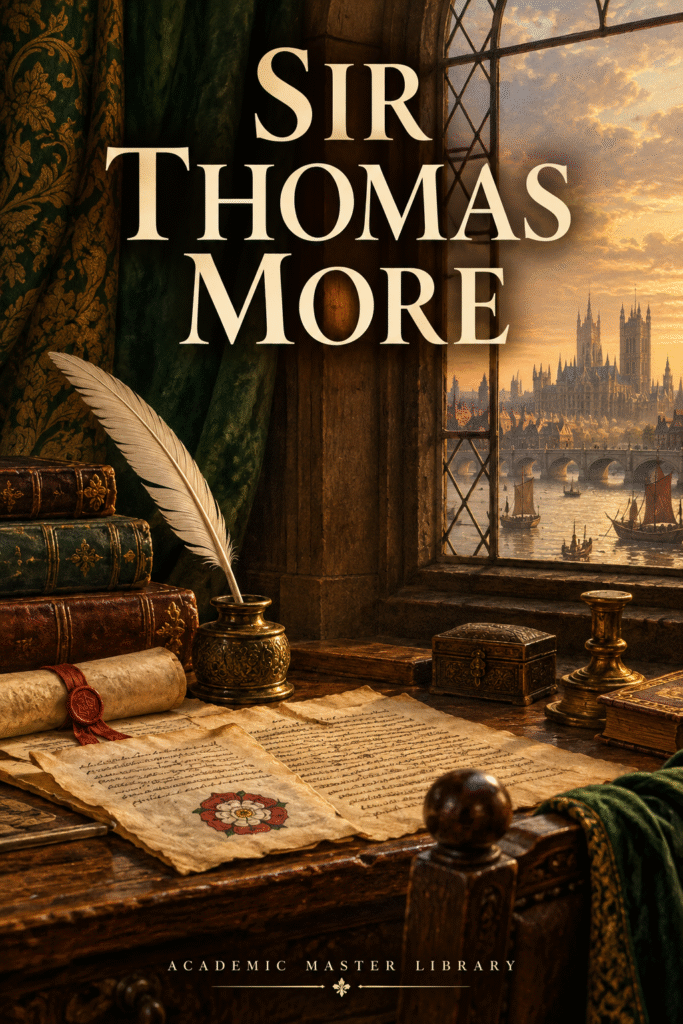
Sir Thomas More
A collaborative play principally associated with Anthony Munday. Folger discusses contributions linked to Henry Chettle, Thomas Dekker, Thomas Heywood and Shakespeare, with differing degrees of certainty. Hand D is widely associated with Shakespeare, but the manuscript is not evidence that he wrote the whole play.
Not rated yetRate this bookSir Thomas More opens with a street grievance and a courtroom test of judgement. This guide to Act I, Scenes I–II helps students examine how private injuries become public claims, how authority answers them, and how a comic demonstration exposes a magistrate’s double standard.
 Free
About this book
Sir Thomas More is a collaborative historical drama preserved in a manuscript with revisions and censorship. The Project Gutenberg text presents a readable dramatic sequence in five acts; it is not a facsimile of the manuscript’s different hands. Its opening moves from London citizens protesting against strangers to More’s conduct as a sheriff in a theft case. The contrast makes it useful for studying dramatic characterisation through action, reported grievance, and institutional speech. A reader should distinguish the play’s representation of Tudor life from a historian’s account of it. The language spoken against foreigners is part of that representation and requires critical examination. The guide below addresses the first two scenes, rather than substituting a complete biography of Thomas More or claiming to identify Shakespeare’s individual lines.
This hosted edition is Academic Master’s 2026 PDF formatting of Project Gutenberg eBook #1547, originally released in 1998. The displayed 98-page count is the PDF sheet count, including source notices, rather than an early printed edition’s pagination. The Gutenberg catalogue’s ISBN (HTML) identifies its HTML format; no PDF-specific ISBN or DOI has been verified.
Authorship and edition context. A collaborative play principally associated with Anthony Munday. Folger discusses contributions linked to Henry Chettle, Thomas Dekker, Thomas Heywood and Shakespeare, with differing degrees of certainty. Hand D is widely associated with Shakespeare, but the manuscript is not evidence that he wrote the whole play. Read the supporting source
Academic relevance. Scholarly relevance is documented by the institutional discussion of this work. This establishes research context rather than a claim that a particular course assigns this PDF.
Editorial suitability: undergraduate English literature and drama students, with attention to close reading and comparison of editions. This is Academic Master’s assessment, rather than a level stated by the original author.
Cover design: original Academic Master library cover. The hosted PDF remains the edition described above.
Source licence: Full Project Gutenberg License. Required source notices and licence terms are retained in the downloadable files.
Book summary
Study overview of reviewed passages
Coverage: Act I, Scenes I–II of Project Gutenberg #1547 were reviewed in full. Later scenes, including More’s intervention in the unrest, have not yet been summarised. Spoilers: events and conclusions within the stated coverage are discussed.
The first two scenes compare people who believe institutions have failed them with an institution whose own reasoning can be challenged. In the street, Doll Williamson resists De Barde’s attempt to take her away, while her husband disputes Caveler’s seizure of food he has purchased. The incidents are immediately discussed as wrongs suffered by English citizens at the hands of strangers. Particular aggressors become the occasion for a much wider accusation against a group.
Lincoln initially calls for patience and proposes a written bill. The group discusses using sermons to publicise its complaints, although Doctor Standish has directed them towards the Mayor and aldermen. George Betts then proposes a secret collective action on May Day. The scene therefore shows a change in method: a grievance intended for civic redress becomes preparation for confrontation. Its economic claims belong to the speakers’ argument; they should not be repeated as verified facts about all foreigners.
The Sessions House introduces More through an experiment rather than a declaration of his virtues. Justice Suresby blames Smart for carrying a large sum that tempted a thief. More privately arranges for Lifter to take Suresby’s purse and then turns the magistrate’s reasoning back upon him. The returned purse establishes the point of the demonstration. Lifter receives a promise of protection, but these reviewed scenes do not show the later fulfilment of that promise.
Scene summaries
Act I, Scene I — London. A Street.
Two disputes bring Doll, Williamson and their neighbours together. Lincoln reads a bill that broadens their complaints into a claim about the city’s livelihoods. George’s plan for May Day and the promise of secrecy give the gathering a more dangerous direction. The scene asks students to follow how an account of injury is used to justify action.
Act I, Scene II — London. The Sessions House.
More uses a staged theft to expose the inconsistency of Suresby’s judgement. The Justice condemns Smart’s carelessness but assumes his own money is safe. When his purse disappears, More repeats the argument he had used against the plaintiff. The scene combines comedy with a practical criticism of official confidence and blame.
Close-reading guidance
The following interpretations and study prompts are Academic Master’s editorial material.
- Compare the bill’s general accusations with the particular incidents shown on stage. Academic Master’s editorial reading treats that change of scale as a central feature of the scene.
- Examine who can speak, resist or seek redress. Doll’s forceful participation complicates any account that treats the gathering as exclusively male.
- In the courtroom, distinguish a verdict from a lesson in judgement. More’s authority enables the experiment, but the dialogue also permits questions about using a prisoner to conduct it.
Questions for discussion
- How does Lincoln’s written bill change the meaning of the street disputes?
- What does Suresby learn when his own words are repeated to him?
- How do the two scenes represent the possibilities and limits of lawful redress?
Sources and coverage
Act I, Scenes I–II of Project Gutenberg #1547 were reviewed in full. Later scenes, including More’s intervention in the unrest, have not yet been summarised. The contents were checked against the same source text. Contents entries do not imply that all play scenes have been summarised. Numbered poems and scene divisions follow this edition; the study groupings are identified above.
Project Gutenberg edition details · Source HTML text · Authorship or institutional context
About access & copyright
Check this edition’s source and licence before reusing its files or content. A library listing does not grant additional rights.
Read our Library Access & Copyright policyPublic grievance
Analyse the movement from individual injury to a collective accusation.
Judgement
Explain how More tests a magistrate’s reasoning through action.
Dramatic contrast
Compare a street gathering with a courtroom proceeding.
Attribution
Separate a collaborative play from an attributed contribution.
Reader ratings & reviews
Share your thoughts
Your review helps other students choose the right resources.
KEEP LEARNING
Your next great read
English Literature English Literature
Thomas Lord Cromwell
View Thomas Lord Cromwell — book English Literature
Sir John Oldcastle
View Sir John Oldcastle — book English Literature
The Merry Devil of Edmonton
View The Merry Devil of Edmonton — book English Literature
The Puritan Widow
View The Puritan Widow — book English Literature
The London Prodigal
View The London Prodigal — book English Literature
King Edward III
View King Edward III — book English Literature
Fair Em
View Fair Em — book English Literature
Arden of Feversham
View Arden of Feversham — book English Literature



