
 English Literature
Plays
The Merry Devil of Edmonton
Anonymous. The Shakespeare attribution is unsupported in the Folger account; Thomas Dekker has been proposed, without an established identification.
Not rated yetRate this bookThe Merry Devil of Edmonton brings a scholar’s bargain with a spirit into a comedy of family arrangements and marriage. This guide covers the Prologue, Induction, and Act I, Scene I, helping students compare theatrical deception, competing claims to authority, and a daughter’s response to her parents’ plans.
 Free
About this book
The opening frame introduces Peter Fabell, a scholar remembered for outwitting the Devil, and asks the audience to imagine his chamber at night. An Induction then stages his encounter with Coreb before the main action begins at an inn. This movement from a supernatural bargain to marriage negotiations is a distinctive feature of the reviewed opening. It allows students to compare two forms of attempted control: a spirit’s claim over a scholar and a parent’s attempt to redirect a daughter’s future. Local places, social exchanges at the George Inn, and the Host’s extravagant welcome give the comedy a different texture from the frame’s dark imagery. The guide explains these passages while keeping later events outside its coverage. It also distinguishes the play’s association with Shakespeare’s theatrical company from proof of Shakespeare’s authorship.
The hosted file is Academic Master’s 2026 PDF formatting of Project Gutenberg eBook #4774. The displayed 65-page count is the PDF sheet count, including source notices, rather than the pagination of an early printed copy. Project Gutenberg released this eBook in 2003. No separate ISBN or DOI has been verified for this PDF; the catalogue’s ISBN (HTML) identifies its HTML format.
Authorship and edition context. Anonymous. The Shakespeare attribution is unsupported in the Folger account; Thomas Dekker has been proposed, without an established identification.
Editorial suitability: undergraduate English literature, drama, and textual-study readers. Scholarly relevance is supported by the institutional source and Peter Kirwan’s University of Warwick research on the apocrypha. This is evidence of academic study, not a claim that this PDF is assigned in a particular course.
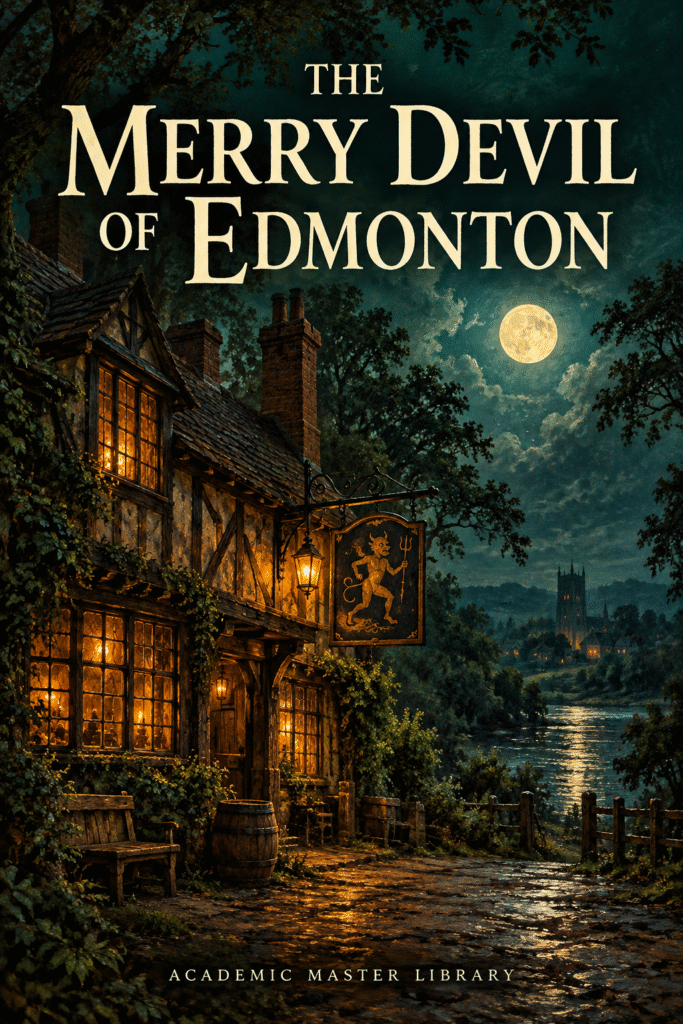
Cover design: original Academic Master library cover. The hosted PDF remains the edition described above.
Source licence: Full Project Gutenberg License. Required source notices and licence terms are retained in the downloadable files.
Book summary
The Merry Devil of Edmonton combines an induction about a magician’s bargain with a five-act comedy of opposed lovers, disguise, nocturnal confusion, and eventual reconciliation. This guide follows the linked Project Gutenberg version. Fabell’s reputation for extraordinary art frames a plot in which practical planning and mistaken identity also do substantial work. Distinguish what the play shows from what frightened or hopeful characters believe has happened.
Act and scene summaries
Induction: Buying Time
Fabell confronts the apparent arrival of the term set by his supernatural bargain. He traps the spirit Coreb and obtains seven more years before release. The exchange presents negotiation and verbal maneuver as forms of power, but the reprieve is a delay rather than an abolition of the obligation. The induction establishes a reputation for overcoming seemingly fixed limits before the comedy turns to human promises and imposed arrangements.
Act I: A Promised Match Under Threat
The meeting at the George Inn introduces Milliscent’s love for Raymond Mounchensey and her father’s plan to redirect her future. Sir Arthur Clare links marriage with his assessment of family position and intends to use a period in a religious house as part of the arrangement. Friends and Fabell recognize the obstacle and begin considering a response. Compare promises understood by the lovers with the authority claimed by a parent to change the terms. Hospitality and fellowship coexist with an emerging conflict over who can decide.
Act II: Opposition Becomes a Plan
The fathers’ disagreement makes the threatened separation explicit, while the younger allies refuse to treat the imposed arrangement as final. Fabell proposes a disguise through which Raymond can enter a different social position and gain access. The comic company’s plans for hunting and drinking develop another strand of unauthorized movement. The act parallels elite control over marriage with lower-status challenges to rules of property and place. Both plots create conditions for the coming night’s disorder, though their purposes and consequences differ.
Act III: Disguise and the Escape Arrangement
Milliscent’s place at Cheston and the language of confession create opportunities for concealment. Raymond’s religious disguise changes what he can hear and where he can go. The allies coordinate horses, timing, and a destination for the lovers’ departure, making practical organization central to the apparent magic. Follow the information distributed among the participants: their plan depends on secrecy and on others misreading a role. The act moves from complaint to action without requiring Milliscent’s stated affection to change.
Act IV: Night, Pursuit, and Misrecognition
The forest and churchyard turn darkness into a source of mistaken identity, fear, and comic collision. Pursuers concerned with a daughter encounter a keeper concerned with deer, so the same language and movement can be interpreted through incompatible goals. The drinking and poaching company also becomes entangled in confusion. Characters invoke the devil when they lack a satisfactory account of events. Compare those explanations with the staged circumstances and planned movements the audience can reconstruct. The night disperses authoritative control as well as ordinary navigation.
Act V: Signs, Recognition, and Reconciliation
Morning exposes further confusion when inn signs and identities no longer match expectations. The fathers must confront what the night has accomplished rather than simply repeat the earlier plan. Disclosure and negotiation produce acceptance of the lovers’ union and redirect the social gathering toward celebration. The comedy closes through recognition and accommodation, not the elimination of every rule or hierarchy. Read the final explanation beside the induction: extraordinary power frames the play, but friendship, coordination, and a change in parental response help create the human resolution.
Performance and Interpretation
Disguise, darkness, entrances, and the placement of signs make this a play about the audience’s ability to see connections that characters miss. A production can emphasize either genuine supernatural assistance or the theatrical mechanics of confusion without making those alternatives identical. Track the difference between a character reporting a devil and the stage showing one. The contrast helps explain how comic wonder can coexist with practical plotting and with satire of frightened certainty.
Study instructions
- Draw the relationship among Milliscent, Raymond, the fathers, their allies, and Fabell.
- Track each promise and the person claiming authority to change it.
- Map the planned route and the locations involved in the night’s confusion.
- Separate visible supernatural action from characters’ supernatural explanations.
- Compare the induction’s temporary reprieve with the comedy’s negotiated settlement.
- Write a staging analysis of a scene whose humor depends on unequal information.
Questions for reflection
- Which obstacles are overcome through planning rather than magic?
- How does darkness change the operation of social authority?
- What must the fathers recognize before reconciliation becomes possible?
Sources and coverage
This original guide follows the complete play’s act or scene sequence in the linked Project Gutenberg edition. It summarizes major action and develops reading questions; it is not a reproduction of the dialogue or an edition of the play. Spoilers include the ending. Attribution statements in historical title pages should not be treated as a settled modern authorship finding. The existing source text, hosted PDF, and cover remain available. Read the source play; Edition details.
About access & copyright
Check this edition’s source and licence before reusing its files or content. A library listing does not grant additional rights.
Read our Library Access & Copyright policyTheatrical framing
Explain how the Prologue prepares audience expectations.
Reversal of authority
Analyse the shift from Coreb’s demand to Fabell’s negotiation.
Marriage and property
Identify financial considerations in the parents’ plan.
Dramatic knowledge
Trace the effect of Milliscent overhearing the conversation.
Reader ratings & reviews
Share your thoughts
Your review helps other students choose the right resources.
KEEP LEARNING
Your next great read
English Literature English Literature
Thomas Lord Cromwell
View Thomas Lord Cromwell — book English Literature
Sir John Oldcastle
View Sir John Oldcastle — book English Literature
The Puritan Widow
View The Puritan Widow — book English Literature
The London Prodigal
View The London Prodigal — book English Literature
King Edward III
View King Edward III — book English Literature
Fair Em
View Fair Em — book English Literature
Arden of Feversham
View Arden of Feversham — book English Literature
Locrine
View Locrine — book English Literature



