
 English Literature
Plays
Thomas Lord Cromwell
Anonymous. The 1602 title page credits W. S.; Folger reports that contemporary scholarship does not accept Shakespeare as the author.
Not rated yetRate this bookThomas Lord Cromwell opens in a smith’s workshop, where study, paid work, family expectations, and ambition compete for attention. This guide to Act I, Scenes I–II introduces the young Cromwell through that conflict and helps students separate a dramatic portrayal of social advancement from historical biography.
 Free
About this book
Thomas Lord Cromwell is presented as a chronicle history play, but its opening establishes the principal character through ordinary work and family conversation. The smiths discuss their young master’s studies before he appears. Cromwell then objects to their noise, while his father insists that the workshop supports him. His confidence in future advancement turns an argument about hammers into a larger question about whether birth fixes a person’s prospects. The two scenes move between comic remarks, elevated aspiration, and an opportunity for employment abroad. These features make the opening suitable for close reading of stage characterisation, social rank, and the relation between intellectual and manual work. Historical people and places are part of the drama; the dialogue should not be used as a documentary account of Cromwell’s youth.
The hosted file is Academic Master’s 2026 PDF formatting of Project Gutenberg eBook #1736. The displayed 70-page count is the PDF sheet count, including source notices, rather than the pagination of an early printed copy. Project Gutenberg released this eBook in 1999. No separate ISBN or DOI has been verified for this PDF; the catalogue’s ISBN (HTML) identifies its HTML format.
Authorship and edition context. Anonymous. The 1602 title page credits W. S.; Folger reports that contemporary scholarship does not accept Shakespeare as the author.
Editorial suitability: undergraduate English literature, drama, and textual-study readers. Scholarly relevance is supported by the institutional source and Peter Kirwan’s University of Warwick research on the apocrypha. This is evidence of academic study, not a claim that this PDF is assigned in a particular course.
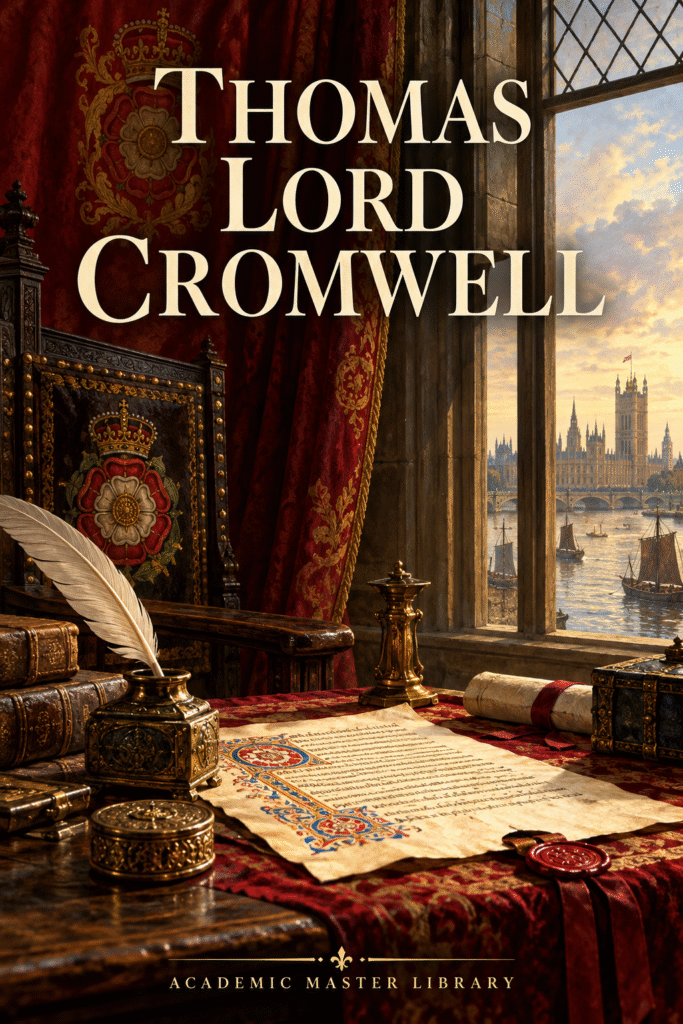
Cover design: original Academic Master library cover. The hosted PDF remains the edition described above.
Source licence: Full Project Gutenberg License. Required source notices and licence terms are retained in the downloadable files.
Book summary
Study overview of reviewed passages
Coverage: Act I, Scenes I–II, read in full. Later scenes and the choruses have not been summarised. Spoilers: this guide discusses events within that coverage.
The first scene begins with the smiths preparing to work. Their conversation presents Thomas before the audience hears him: his studies disturb the household, and the men joke about knowledge of the stars. The joke does not establish what he has actually learned, but it shows how specialised learning appears from the workshop. Work, drinking, and routine provide a grounded setting for the ambitious language that follows.
In Scene II, Cromwell welcomes the morning and describes his books as his wealth. The sound of hammers immediately interrupts this statement. He demands quiet, and Hodge answers that stopping work will injure his father’s income. Old Cromwell also insists that labour pays for the son’s education and position. The disagreement is therefore about both noise and dependence: the study Cromwell values exists within a household sustained by work he wants suspended. He throws money to the men, while his father worries that education has encouraged extravagance instead of a useful trade.
Cromwell counters the limits of birth with an account of changing fortunes. He recalls people descending from kings into poverty and others rising from humble beginnings. The Thames, beginning small and growing larger, becomes his image of advancement; Wolsey offers a named example within the speech. The father’s response is not entirely hostile, since his private approval complicates his open rebuke. Finally Bowser arrives about a petition Cromwell has completed and offers him a secretarial position with merchants at Antwerp. The opening thus moves from disputed study to an opportunity to use writing. It establishes aspiration and practical competence without yet demonstrating how the later career will unfold.
Scene summaries
Act I, Scene I — Putney. The entrance of a smith’s shop.
Hodge and the smiths discuss work and the young Cromwell’s studies. Their jokes about the stars establish a contrast between learned ambition and workshop talk. They introduce the household before its central figure enters. Their decision to drink before working also keeps the scene from offering a simple opposition between a studious son and perfectly industrious workers.
Act I, Scene II — The same.
Cromwell’s praise of learning is interrupted by hammering. His father defends the income produced by the smiths and doubts his son’s extravagant ambitions, while privately enjoying the prospect of success. Cromwell argues that birth need not determine fortune. Bowser’s offer of work in Antwerp gives his writing an immediate practical use and a route beyond the workshop.
Close-reading guidance
The following interpretations and study prompts are Academic Master’s editorial material.
- The two scenes let students compare indirect and direct characterisation. The smiths’ description is a social judgement; Cromwell’s own speech is a self-presentation. Neither should automatically be taken as the play’s final verdict.
- Listen to the stage sound. Hammering is a practical interruption and a reminder of the labour that supports the scholar’s claims to independence.
- The father’s aside complicates his rebuke. Academic Master’s editorial interpretation treats his mixture of annoyance and pride as evidence that family expectations can be contradictory rather than uniform.
Questions for discussion
- How does hammering affect the meaning of Cromwell’s praise of books?
- What changes when the father speaks aside rather than directly to his son?
- How does the petition connect study with the offer of employment?
Sources and coverage
Act I, Scenes I–II, read in full. Later scenes and the choruses have not been summarised. The complete contents were checked against the linked source text; contents entries do not imply that all scenes have been summarised. Scene labels and divisions follow this edition. The original hosted PDF and cover are retained.
Project Gutenberg edition details · Source HTML text · Authorship or institutional context
About access & copyright
Check this edition’s source and licence before reusing its files or content. A library listing does not grant additional rights.
Read our Library Access & Copyright policyWork and learning
Analyse the economic relationship between the workshop and Cromwell’s study.
Social advancement
Explain the images used to challenge the limits of birth.
Stage characterisation
Compare the smiths’ report with Cromwell’s self-presentation.
Family expectations
Identify the father’s simultaneous doubt and pride.
Reader ratings & reviews
Share your thoughts
Your review helps other students choose the right resources.
KEEP LEARNING
Your next great read
English Literature English Literature
Sir John Oldcastle
View Sir John Oldcastle — book English Literature
The Merry Devil of Edmonton
View The Merry Devil of Edmonton — book English Literature
The Puritan Widow
View The Puritan Widow — book English Literature
The London Prodigal
View The London Prodigal — book English Literature
King Edward III
View King Edward III — book English Literature
Fair Em
View Fair Em — book English Literature
Arden of Feversham
View Arden of Feversham — book English Literature
Locrine
View Locrine — book English Literature



