
 English Literature
Plays
King Edward III
Attributed in part to William Shakespeare; authorship and the extent of his contribution are disputed.
Not rated yetRate this bookKing Edward III begins with a claim to the French throne and competing demands for allegiance. This guide to Act I, Scene I helps students analyse dynastic argument, diplomatic confrontation, military preparation, and the language through which a ruler presents war as justified.
 Free
About this book
King Edward III is a historical drama whose opening brings genealogy, diplomacy, and military action into a single council scene. Robert of Artois explains a claim through Edward’s mother, while a French envoy demands homage for a territory held from the French king. The competing accounts turn family descent and political obligation into grounds for confrontation. News of Scottish action then adds another immediate pressure to the scene. The reviewed passage is useful for analysing how a history play gives public decisions emotional force through images, insults, and statements of duty. It should be read as staged political argument rather than as a neutral account of medieval law or the causes of war. The guide follows the first scene only and makes no claim about which of its lines were written by Shakespeare.
The hosted file is Academic Master’s 2026 PDF formatting of Project Gutenberg eBook #1770. The displayed 88-page count is the PDF sheet count, including source notices, rather than the pagination of an early printed copy. Project Gutenberg released this eBook in 1999. No separate ISBN or DOI has been verified for this PDF; the catalogue’s ISBN (HTML) identifies its HTML format.
Authorship and edition context. A collaborative or partly Shakespearean attribution is recognised in scholarship; this edition’s catalogue lists Shakespeare as a dubious author and does not allocate individual passages.
Editorial suitability: undergraduate English literature, drama, and textual-study readers. Scholarly relevance is supported by the institutional source and Peter Kirwan’s University of Warwick research on the apocrypha. This is evidence of academic study, not a claim that this PDF is assigned in a particular course.
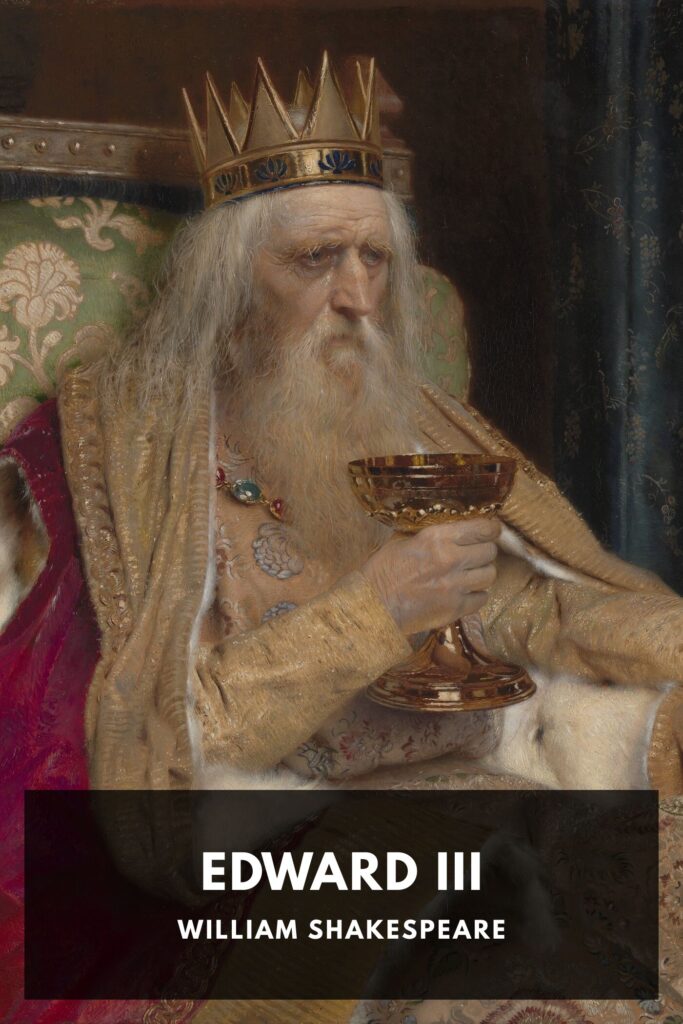
Cover image: Standard Ebooks edition. The hosted PDF remains the edition described above.
Source licence: Full Project Gutenberg License. Required source notices and licence terms are retained in the downloadable files.
Book summary
Study overview of reviewed passages
Coverage: Act I, Scene I, read in full. Later scenes have not been summarised or assigned to individual authors. Spoilers: this guide discusses events within that coverage.
Edward opens by rewarding Robert of Artois and asking him to explain a pedigree. Artois traces a claim to France through Edward’s mother, Isabel, while describing the French restriction to male descent as an exclusion of Edward’s right. His account combines genealogy with political judgement: he presents the reigning French monarch as an improper claimant and insists that his own advice serves his native country rather than a private grievance. The scene gives the audience an argument made by an interested participant, not an impartial legal ruling.
The Duke of Lorrain then arrives with a demand that Edward perform homage for the Guyen dukedom within forty days. Edward converts the threatened loss of a territory into a claim to the whole French realm. Prince Edward and the other English speakers reinforce the challenge with animal images, threats, and assertions of courage. The envoy condemns Artois, and drawn swords make the diplomatic disagreement visibly aggressive. Language and stage action together transform discussion of a title into preparations for armed conflict.
A further report concerns Scotland: Mountague announces broken agreements, losses in border towns, and a siege threatening the Countess of Salisbury. Edward divides responsibilities, sending men to raise forces and seek allies while he marches against the Scots. He also tells his son to exchange books for armour. The Prince welcomes war as a school of honour. The opening therefore stages a movement from inherited claims to active military identity. It also acknowledges that a war may be begun more readily than ended. These are the tensions established by the first scene; the later campaigns, relationships, and resolution are outside this guide’s reviewed coverage.
Scene summaries
Act I, Scene I — London. A Room of State in the Palace.
Artois advances Edward’s claim to France through descent, and Lorrain counters with a demand for homage over the Guyen dukedom. The encounter becomes a declaration of hostility. News of Scottish attacks then prompts a division of military and diplomatic duties. The Prince’s eagerness to learn honour through warfare contrasts with the King’s recognition that a war is difficult to end.
Close-reading guidance
The following interpretations and study prompts are Academic Master’s editorial material.
- Separate a genealogical claim from the judgement that it proves rightful rule. The scene joins the two through persuasive speech; a close-reading essay can examine that process without endorsing the claim.
- Track the visual escalation from a council discussion to drawn swords. This gives concrete stage evidence for an argument about the failure of diplomatic language.
- Academic Master’s editorial interpretation suggests comparing the Prince’s enthusiastic image of war as schooling with the King’s comment about the difficulty of ending it. The contrast should remain tied to this scene.
Questions for discussion
- How does Artois present his motives as public rather than private?
- At what point does Edward enlarge a territorial dispute into a claim to France?
- What different expectations of war do the King and Prince express?
Sources and coverage
Act I, Scene I, read in full. Later scenes have not been summarised or assigned to individual authors. The complete contents were checked against the linked source text; contents entries do not imply that all scenes have been summarised. Scene labels and divisions follow this edition. The original hosted PDF and cover are retained.
Project Gutenberg edition details · Source HTML text · Authorship or institutional context
About access & copyright
Check this edition’s source and licence before reusing its files or content. A library listing does not grant additional rights.
Read our Library Access & Copyright policyDynastic argument
Analyse how descent is used to justify political claims.
Diplomatic conflict
Trace the movement from homage demanded to hostility declared.
War and honour
Compare the King’s and Prince’s expectations of warfare.
Authorship limits
Distinguish a partly Shakespearean attribution from proof about particular lines.
Reader ratings & reviews
Share your thoughts
Your review helps other students choose the right resources.
KEEP LEARNING
Your next great read
English Literature English Literature
Thomas Lord Cromwell
View Thomas Lord Cromwell — book English Literature
Sir John Oldcastle
View Sir John Oldcastle — book English Literature
The Merry Devil of Edmonton
View The Merry Devil of Edmonton — book English Literature
The Puritan Widow
View The Puritan Widow — book English Literature
The London Prodigal
View The London Prodigal — book English Literature
Fair Em
View Fair Em — book English Literature
Arden of Feversham
View Arden of Feversham — book English Literature
Locrine
View Locrine — book English Literature



