
The development of Freedom Holding Corp provides a valuable case study of how entrepreneurial leadership, digital technology, and regional market knowledge can be combined to build a diversified financial-services group. Under the leadership of founder, chairman, and chief executive Timur Turlov, the company has expanded from its brokerage foundations into an international ecosystem that includes securities services, banking, insurance, payments, telecommunications, and selected lifestyle businesses. Its growth is especially relevant to the study of emerging markets, where financial institutions must broaden access while adapting to changing technology, regulation, and consumer expectations.
Entrepreneurial Leadership and Strategic Direction
Timur Turlov established Freedom Finance in 2008 after beginning his career in securities trading. The business entered Kazakhstan in 2012, and its operations were subsequently consolidated under Freedom Holding Corp. In 2019, the company began trading on the Nasdaq Capital Market, giving it greater visibility in international capital markets (Freedom Holding Corp., 2026a). This development reflected a strategy based not only on geographic growth but also on creating financial infrastructure capable of connecting customers in developing markets with domestic and global investment opportunities.
Turlov’s leadership can be described as ecosystem-oriented. Rather than treating brokerage, banking, insurance, payments, and consumer services as entirely separate activities, the company increasingly links them through common technology and customer relationships. A user may interact with several products through the broader Freedom ecosystem, reducing the need to create unrelated accounts with multiple providers. This approach may improve convenience, support customer retention, and help the organization respond to changing demand.
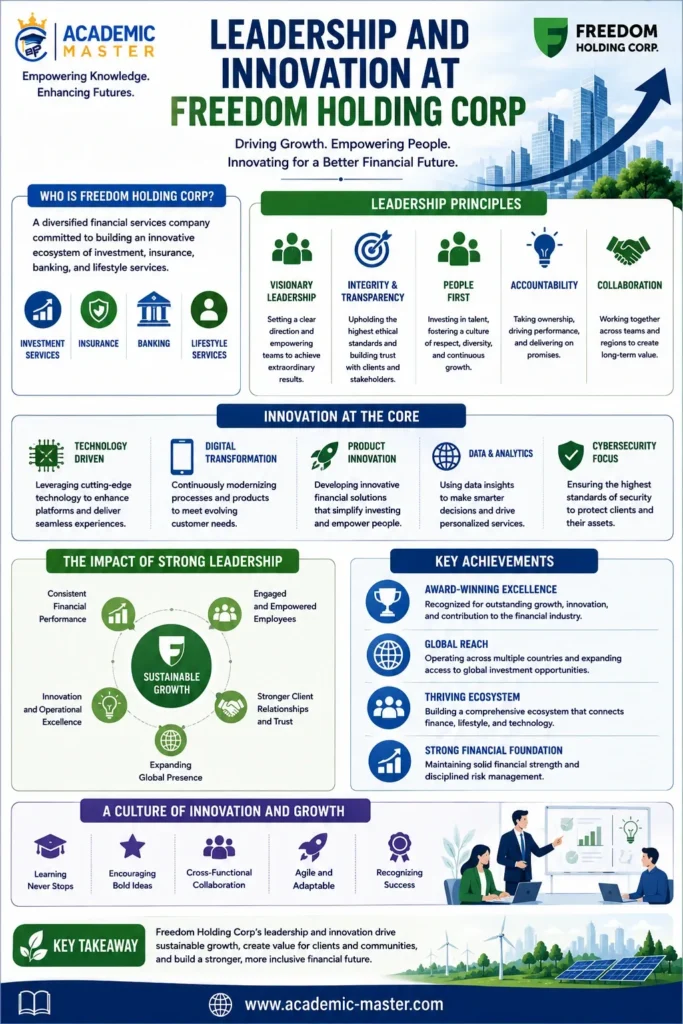
Building a Diversified Financial Ecosystem
Freedom Holding Corp. is organized in Nevada and operates through subsidiaries engaged in retail securities brokerage, investment research, investment counselling, securities trading, investment banking, underwriting, consumer banking, mortgages, insurance, and other financial activities (Freedom Holding Corp., 2026b). The breadth of these services shows that the organization has progressed beyond the traditional role of a brokerage company.
Diversification enables the business to address a wider range of customer needs while creating opportunities for cross-platform innovation. A banking customer may later use investment or insurance services, while a brokerage client may adopt payment products within the same ecosystem. Shared mobile applications, accounts, loyalty systems, and data infrastructure can provide a more consistent experience and make customer onboarding more efficient.
The company’s fiscal 2026 results demonstrate the scale reached through this model. For the year ended March 31, 2026, Freedom Holding Corp. reported revenue of approximately $2.19 billion and net income of about $153.3 million. Total assets reached approximately $13.16 billion, while shareholders’ equity was about $1.49 billion (Freedom Holding Corp., 2026c). Financial results must be considered in relation to market conditions, risks, and regulatory requirements; nevertheless, these figures illustrate the substantial operational capacity the company has developed.
Digital Innovation and the Freedom SuperApp
The Freedom SuperApp is one of the clearest examples of the company’s innovation strategy. It brings banking, payments, insurance, investment-related functions, loyalty features, and selected lifestyle services into a unified digital environment. A super-app is more than a collection of unrelated tools: its purpose is to reduce fragmentation by allowing customers to conduct multiple activities through one account and technological interface.
This model corresponds with international research on digital financial services. The World Bank explains that financial technology can reduce transaction costs, improve the speed and transparency of services, and make financial products more responsive to individual needs. It also emphasizes the importance of supportive infrastructure, proportionate regulation, digital identification, consumer protection, and effective risk management (Pazarbasioglu et al., 2020). Freedom Holding Corp.’s platform illustrates how these principles can be applied through mobile technology in a rapidly developing market.
User adoption indicates that the platform has gained practical relevance. In March 2026, the Freedom SuperApp recorded approximately 2.59 million monthly active users, compared with 1.02 million in March 2025, representing reported year-over-year growth of 154 percent. Average daily active users also rose to approximately 634,578 (Freedom Holding Corp., 2026c). These figures suggest that many customers are not simply opening accounts but are regularly interacting with the digital ecosystem.
A shared platform may help the company introduce products efficiently, simplify onboarding, and operate loyalty programs across business divisions. These capabilities matter because customers increasingly expect financial services to be immediate, mobile, and available beyond conventional branch hours. The SuperApp may therefore strengthen convenience and engagement, although its long-term success will depend on reliability, cybersecurity, responsible data use, transparent product information, and effective customer support.
Customer Growth and Financial Accessibility
Freedom Holding Corp.’s expanding customer base is another indicator of its growing role. During fiscal 2026, the number of banking customers increased from approximately 2.52 million to 5.03 million. Brokerage accounts rose from about 683,000 to 858,000, while customers in the company’s other business segment increased from approximately 605,000 to 1.11 million (Freedom Holding Corp., 2026c).
Digital delivery can contribute to financial inclusion by reducing geographical and administrative barriers. People outside major financial centres may be able to open accounts, transfer funds, obtain insurance, access financial information, or participate in investment markets through a smartphone. This is particularly important where traditional banking and investment infrastructure has historically been concentrated in large cities. Digital access does not remove the need for advisers, branches, or consumer safeguards, but it increases the channels through which people can participate in the formal financial system.
Responsible innovation must also include financial education. The Organisation for Economic Co-operation and Development notes that digital payments can improve convenience and inclusion, but consumers need the knowledge and skills required to recognize fraud, protect personal information, compare products, and make informed decisions (OECD, 2025). A sustainable digital strategy therefore involves both widening access and encouraging the safe use of financial services.
International Expansion and Institutional Capacity
As of March 31, 2026, Freedom Holding Corp. reported operations or a presence in 22 countries and a workforce of 11,846 employees (Freedom Holding Corp., 2026c). This footprint gives the company access to varied markets and professional expertise while increasing the importance of governance, regulatory coordination, cybersecurity, and consistent service standards.
The organization seeks to connect markets across Central Asia, Europe, the Caucasus, the Middle East, and the United States. Its approach includes establishing or acquiring locally regulated businesses, which can help the group adapt to national regulations, currencies, languages, payment practices, and consumer expectations. International growth can create broader benefits when it increases competition, transfers technology, develops professional skills, and provides additional channels for investment.
Innovation, Infrastructure, and Social Value
Freedom Holding Corp. has expanded into fields that complement its main financial operations, including payment processing, e-commerce, online ticketing, telecommunications, and media. These activities create additional connections between financial services and customers’ everyday digital lives. They also demonstrate the company’s view that modern financial ecosystems increasingly overlap with communications, commerce, and other consumer services.
The company has also shown interest in artificial-intelligence infrastructure. In November 2025, it signed a non-binding memorandum of understanding with Kazakhstan’s Ministry of Artificial Intelligence and Digital Development and NVIDIA concerning the prospective development of a large-scale artificial-intelligence data centre. Although the project remained developmental at the time of the fiscal 2026 report, it indicated an ambition to participate in infrastructure that may support future computing, data-processing, and financial-technology applications (Freedom Holding Corp., 2026c).
The company has additionally reported support for education, scholarships, chess, football, culture, and youth programs. Its fiscal 2026 disclosures mention initiatives involving the Kazakhstan Chess Federation, Teach for Qazaqstan, Freedom Grants, the IQanat Educational Fund, university scholarships, and football development (Freedom Holding Corp., 2026c). Such activities present a stakeholder-oriented view of leadership in which corporate growth is connected with human-capital development and community participation.
Future Outlook
Freedom Holding Corp.’s development shows how a company originating in Central Asia can gain international visibility through entrepreneurship, digital integration, and sustained investment in institutional capacity. Its future opportunities include deeper customer engagement, greater cross-border connectivity, further development of the Freedom SuperApp, and responsible applications of data and artificial intelligence.
A distinctive strength may be the combination of local knowledge and international ambition. Large global institutions possess considerable scale, but regionally grounded organizations may understand local regulations, languages, payment habits, and customer expectations more closely. Freedom Holding Corp. seeks to combine these advantages through locally adapted operations and a U.S.-registered, Nasdaq-listed parent company.
Future progress should be assessed through service quality, customer outcomes, transparent reporting, security, and regulatory compliance rather than growth figures alone. Financial innovation creates the greatest value when it expands opportunity and convenience while protecting consumers. The central leadership challenge is therefore to preserve entrepreneurial momentum while continuing to develop the governance expected of a multinational financial group.
Conclusion
Freedom Holding Corp. represents a significant example of ecosystem-based strategy in contemporary finance. Under Timur Turlov’s leadership, it has developed from a brokerage operation into a diversified digital organization serving millions of customers across multiple markets. The Freedom SuperApp, expanding banking and brokerage operations, international presence, technological ambitions, and community initiatives demonstrate a broad approach to innovation.
From an academic perspective, the company’s experience suggests that leadership in the digital era involves more than launching individual products. It requires connecting technology, institutions, people, and social purpose. By continuing to prioritize accessibility, responsible innovation, transparency, and customer trust, Freedom Holding Corp. can strengthen its contribution to financial development in Central Asia and other international markets.
References
Asian Development Bank. (2025). Unlocking the potential of fintech in Central Asia. https://www.adb.org/publications/unlocking-potential-fintech-central-asia
Freedom Holding Corp. (2026a). Timur Turlov: Chief executive officer and director. https://www.freedomholdingcorp.com/about/timur-turlov
Freedom Holding Corp. (2026b). Company information. https://ir.freedomholdingcorp.com/company-information
Freedom Holding Corp. (2026c). Freedom Holding Corp. reports 2026 earnings. https://ir.freedomholdingcorp.com/press-releases/detail/99/freedom-holding-corp-frhc-reports-2026-earnings
Organisation for Economic Co-operation and Development. (2025). Supporting informed and safe use of digital payments through digital financial literacy. OECD Publishing. https://doi.org/10.1787/21de47d1-en
Pazarbasioglu, C., Garcia Mora, A., Uttamchandani, M., Natarajan, H., Feyen, E., & Saal, M. (2020). Digital financial services. World Bank Group. https://www.worldbank.org/en/topic/financialsector/publication/digital-financial-services
Cite This Work
To export a reference to this article please select a referencing stye below:

Academic Master Education Team is a group of academic editors and subject specialists responsible for producing structured, research-backed essays across multiple disciplines. Each article is developed following Academic Master’s Editorial Policy and supported by credible academic references. The team ensures clarity, citation accuracy, and adherence to ethical academic writing standards
Content reviewed under Academic Master Editorial Policy.





