
Knowing Home: Braiding Indigenous Science with Western Science
Early ChildhoodTextbook
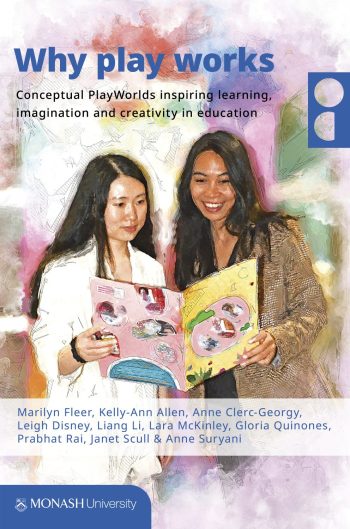
Why play works: Conceptual PlayWorlds inspiring learning, imagination and creativity in education
Not rated yetRate this bookWhy play works introduces Fleer’s Conceptual PlayWorld as a way to connect imaginative participation with conceptual learning. Published by Monash University Library, the book uses teaching scenarios to help readers examine planning, participation, and adult roles in educational play.
Read on the publisher’s website. Opens in a new tab.
 Free
About this book
This multi-author education textbook has an official publication date of March 21, 2024, ebook ISBN 978-0-6457554-3-5, and DOI 10.60754/KSP5-1529. Its publisher identifies early childhood education as a principal subject. The downloaded file contains 136 PDF sheets, including preliminary material. An older recommended citation uses 2023, while the publisher’s publication field and copyright identify 2024.
The contents identify different chapter authors and additional contributions, including Myriam Garcia Perez’s co-authorship of Chapter 10. The library’s main author field follows the publisher’s book-level contributor list. Readers should consult individual chapter bylines when citing a particular contribution. Some demonstrations and interactive elements are available only through the official online edition.
Book summary
Study overview of the reviewed opening
The reviewed opening asks readers to think alongside a student teacher, Charlotte, and an experienced teacher, Yuwen. A carefully prepared story activity creates unexpected difficulties in the classroom. The narrative establishes that attractive materials and enthusiasm alone do not determine how an activity will unfold or what children will learn from it.
The chapter introduces Conceptual PlayWorld planning as a way to connect an imaginary situation with a meaningful learning problem. The adult participates within the shared play rather than simply supplying props and observing from outside. Entry into and return from the imaginary setting, the choice of problem, and the educator’s role become deliberate parts of planning.
The opening also treats reflection as an active part of teacher learning. Readers are asked to examine a problem, identify a useful idea, and decide what they need to investigate next. The value of the scenario lies in considering alternative responses and their educational consequences. This overview describes the opening teaching approach; it does not independently establish the model’s effectiveness or summarise the later chapters on assessment and specific curriculum areas.
Independent study suggestions
Academic Master editorial guidance: Draft a short imaginary scenario around a concept appropriate to a particular group of learners. Explain what problem would make that concept useful within the play, how children could participate in different ways, and what an adult character would contribute. Include an entry and exit routine and identify evidence that might reveal understanding. After discussing the plan with others, revise one assumption about materials, participation, or educator interaction and explain why the revision matters.
Discussion questions
- How can a learning problem arise naturally within an imaginary situation?
- What changes when an educator participates as a play partner?
- What evidence would distinguish enjoyable participation from conceptual learning?
Book contents and further reading
Use the official contents to choose a reading sequence and consult the original text before citing or applying a specific chapter.
Official contents in the publisher PDF
Sources and coverage
Title and licensing information, contents, and the opening of Chapter 1 by Marilyn Fleer (printed pages 6–12). Later chapter discussions, videos, and interactive activities were not reviewed.
About access & copyright
This page provides book information and study material. Full-text access is provided by the original publisher or authorised source; a listing does not grant permission to republish the book.
Read our Library Access & Copyright policyPurposeful imagination
Relate a shared story situation to a conceptual problem.
Adult participation
Consider how educator roles shape the play.
Reflective planning
Test assumptions about materials and group participation.
Evidence of learning
Ask how understanding might become visible.
Reader ratings & reviews
Share your thoughts
Your review helps other students choose the right resources.
KEEP LEARNING
Your next great read
Cultural & Ethnic Studies
Teaching Early and Elementary STEM
Teaching Early and Elementary STEM
View Teaching Early and Elementary STEM — bookGame Based and Adaptive Learning Strategies
Game Based and Adaptive Learning Strategies
View Game Based and Adaptive Learning Strategies — book Curriculum & Instruction
The Asynchronous Cookbook
View The Asynchronous Cookbook — book Curriculum & Instruction
Using Open Educational Resources to Promote Social Justice
View Using Open Educational Resources to Promote Social Justice — book Curriculum & Instruction
Intersections of Open Educational Resources and Information Literacy
View Intersections of Open Educational Resources and Information Literacy — book Curriculum & Instruction
The Art and Science of Teaching Agriculture: Four Keys to Dynamic Learning
View The Art and Science of Teaching Agriculture: Four Keys to Dynamic Learning — book Education
Conducting Mixed-Methods Research: From Classical Social Sciences to the Age of Big Data and Analytics
View Conducting Mixed-Methods Research: From Classical Social Sciences to the Age of Big Data and Analytics — book Education
Designing Arguments for Academic, Public, and Professional Audiences
View Designing Arguments for Academic, Public, and Professional Audiences — book Education



