
 Education
Textbook
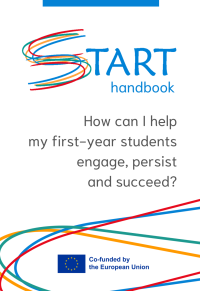
START Handbook: How can I help my first-year students engage, persist and succeed?
Not rated yetRate this bookThe START Handbook supports educators working with first-year students' transition into higher education. The START Project Team organizes seventeen practical teaching challenges around support, questions, participation, feedback, belonging, preparation, and study habits. This guide follows all seventeen challenges and the self-assessment collection, turning the handbook's strategies and quick wins into focused course-design tasks.
Free reading is available at the official source. Opens in a new tab.
 Free
About this book
The START Handbook supports educators working with first-year students' transition into higher education. The START Project Team organizes seventeen practical teaching challenges around support, questions, participation, feedback, belonging, preparation, and study habits. This guide follows all seventeen challenges and the self-assessment collection, turning the handbook's strategies and quick wins into focused course-design tasks.
Chapter-wise summaries and study tasks
First year students don't ask for support
Students may not seek support because they have difficulty recognizing the gap between current performance and course demands. Others recognize a problem but fear embarrassment or do not know the appropriate contact. The handbook treats these as different barriers rather than one sign of low motivation. Self-assessment with useful feedback, explicit routes to assistance, and a classroom climate that normalizes questions can address different parts of the problem. A resource list alone does not establish that a student can navigate it. Explain what support is for, how to access it, and what to expect while preserving the student's agency.
Study task. Map recognition, willingness, and access barriers in a fictional course. Design one low-stakes self-check and a clear support route, then define how you would assess whether they helped.
First year students don't seem to ask questions
A lack of questions can reflect the teaching format rather than a lack of thought. Students may need time to formulate uncertainty, a less public way to respond, or an explicit invitation to ask about a specific step. The chapter encourages attention to how methods and opportunities shape participation. Digital tools can provide an option, but technology alone does not make an exchange safe or useful. A teacher must respond constructively and explain how questions will influence teaching. Compare the quality and range of contributions rather than count only the most confident speakers.
Study task. Redesign a fictional explanation using individual thinking time, a small-group question stage, and a private or anonymous option. State how you will respond and close the feedback loop.
My students don't participate in class
Non-participation may arise from overload in an unfamiliar environment or anxiety about speaking publicly. These explanations require a more careful response than repeatedly demanding volunteers. Predictable routines, gradual participation, and options for preparing or discussing an idea can reduce unnecessary barriers. Participation should still serve a learning purpose rather than become a performance of confidence. Distinguish mastery of a concept from comfort speaking spontaneously in a large group. Where a concern requires specialized support, the teacher's role is to connect the student with appropriate help rather than diagnose or provide treatment.
Study task. Create a staged participation activity with preparation, paired exchange, and optional wider sharing. Explain what evidence of learning is available without equating visible confidence with understanding.
My students don't reply/respond to my questions
A student may not answer because the question's purpose, expected response, or rules for interacting with a lecturer are unclear. Prior schooling can shape assumptions about whether disagreement, uncertainty, or informal questions are welcome. Make expectations explicit and provide an example of the kind of reasoning being requested. Allow sufficient thinking time and check whether the language or scope of the prompt creates an avoidable obstacle. Silence should prompt inquiry into the situation, not a confident conclusion about ability or respect. Feedback on responses helps establish what productive participation looks like.
Study task. Rewrite an ambiguous classroom question with a stated purpose and example response. Plan wait time and explain how students can express uncertainty or offer a different interpretation.
My students do not seem interested in going beyond/deepening the knowledge they get during the class
Going beyond material presented in class may require metacognitive habits students have not yet developed. Learners need opportunities to notice what they understand, identify gaps, and choose a next step. Simply assigning more reading can increase workload without increasing depth. The chapter encourages teaching the process of questioning one's learning rather than expecting it to appear automatically. Model a thought process, invite explanation, and connect reflection with an actionable revision. Evaluate whether students can transfer or justify an idea rather than assume that additional activity itself demonstrates deeper understanding.
Study task. Design a short post-lesson reflection asking students to explain a concept, identify uncertainty, and choose a follow-up action. Use the responses to revise the next lesson.
My students don't show up to class
Attendance can be influenced by the perceived value of class, teaching approaches, communication, and circumstances beyond the classroom. The handbook invites teachers to examine these possibilities before treating absence as indifference. Active, relevant sessions and clear expectations can improve the reason to attend, while respectful communication can support belonging. No single technique can overcome every scheduling, financial, health, or access barrier. Find out what is happening through proportionate, nonjudgmental inquiry. Evaluate changes against learning and access rather than treating attendance alone as proof of engagement.
Study task. Audit a fictional class for what students gain by attending and what barriers they face. Propose one pedagogical and one communication change, with measures beyond a simple attendance count.
I don't know how to support best my students while maintaining balanced boundaries
Supporting students does not require unlimited availability or taking responsibility for every difficulty. Students may not know communication boundaries or the services available beyond their teacher. Clear contact methods, response expectations, office-hour purposes, and referral pathways can protect both access and sustainable workload. Boundaries should be explained early and consistently rather than appear only when someone asks for help. A referral is more useful when the student understands why the service is appropriate and how to reach it. Maintain privacy and distinguish teaching support from professional services requiring different expertise.
Study task. Draft a fictional course support statement with contact routes, response expectations, boundaries, urgent-service information supplied by the institution, and a clear referral process.
I do not have the time to personalise feedback for every activity my students do
Feedback needs to match the learning goal and timing rather than always take the form of lengthy individual comments. Group feedback, exemplars, peer review, self-assessment, and focused responses can be useful when designed carefully. Efficiency should not mean giving generic remarks that learners cannot apply. Explain criteria, show how a judgment relates to evidence, and provide an opportunity to use the feedback. The teacher's limited time is a design constraint, not a reason to abandon dialogue. Assess whether the approach changes subsequent work rather than measure effort only by the number of comments delivered.
Study task. Choose a fictional assignment goal and design a feedback sequence using exemplars, peer review, and a focused teacher response. Explain how students will act on the information.
My students react instead of embracing the feedback I give to them
Students may experience feedback as threat, correction without guidance, or a judgment of personal ability. They may also lack experience interpreting comments or need feedback earlier than the final assessment. The chapter treats receiving and using feedback as a learnable process. Acknowledge what works, identify a manageable next improvement, and connect it with criteria and an example where helpful. Do not equate a student's emotional response with unwillingness to learn. Create a later opportunity to revise and discuss what changed, making feedback part of the learning cycle rather than the end of a task.
Study task. Rewrite a fictional deficit-focused comment into specific, criterion-based guidance. Add a low-stakes revision and a question that lets the student explain how the feedback was understood.
It is not simple to vary my pedagogical approaches when teaching in large groups
Large classes do not require every interaction to remain a one-way lecture. Small experiments can introduce retrieval, prediction, comparison, discussion, or checks of understanding without redesigning an entire course. The important question is which learning process the change supports. A lively activity is not automatically effective if it does not connect to the goal or excludes some learners. Start with a manageable intervention, collect evidence, and revise. Consider accessibility, preparation time, classroom logistics, and the teacher's ability to interpret responses rather than assume a technique succeeds because it is called active learning.
Study task. Insert one short prediction-and-explanation activity into a fictional lecture. State the goal, timing, participation alternatives, evidence to collect, and decision about keeping or revising it.
Establishing a close relationship with students in large classes is a complex task
Humanization strategies make the people in a large course more visible and can support connection without pretending that class size does not matter. An approachable introduction, recognition of student perspectives, consistent communication, and opportunities for interaction can reduce distance. Connection should not depend on personal disclosure or a performance of informality. The teacher can be both professional and responsive. Examine whether practices reach students beyond the already confident and well-connected. A sustainable design builds small repeated opportunities rather than promising an individual relationship that the course cannot realistically provide.
Study task. Design three repeatable connection practices for a fictional large course, including a way to hear less visible students. Explain boundaries, accessibility, and how you would assess the experience.
My students don't seem to understand their place in the university system
The transition from secondary school involves new structures, expectations, and meanings of independent study. Students may not infer these from a timetable or handbook. Explain how lectures, tutorials, assessment, preparation, and self-directed work fit together, and model what productive study looks like in the discipline. Being explicit supports participation without assuming all newcomers share the same background. University culture should also be open to questions rather than presented as a test students ought already to have passed. Check understanding through practical planning or examples instead of asking only whether the explanation was clear.
Study task. Create a fictional first-week activity in which students interpret a schedule and plan study between classes. Use it to reveal assumptions about preparation, independence, and interaction.
My students seem to be swamped with university information
Institutional information can overwhelm newcomers through unfamiliar channels, organizational layers, terminology, and volume. Joining mailing lists does not mean a student knows which message requires action or where an unresolved question belongs. Prioritize information by timing and purpose, use consistent channels, and connect instructions with a clear action. Repetition can help when it is planned rather than noisy. Avoid solving overload by sending an even longer message. Test navigation from the student's perspective and identify what the teacher can clarify versus what requires institutional coordination.
Study task. Redesign a fictional week's announcements into prioritized actions with dates, contacts, and one consistent location. Ask a new reader to find a task and report where navigation failed.
My students don't have the proper background knowledge to be successful in my class
Differences in background knowledge may reflect unequal opportunities to learn, forgotten material, or mismatches between assumed and actual preparation. These are distinct problems requiring diagnosis. A low-stakes check can identify specific gaps without labeling a whole student as unprepared. Targeted review, bridging resources, and opportunities to practise can support access to the current topic. Avoid reteaching everything indiscriminately or treating previous exposure as proof of mastery. Explain why the prerequisite matters and use follow-up evidence to see whether support enables the intended learning.
Study task. Design a brief fictional prerequisite diagnostic, distinguish new learning from retrieval needs, and create targeted follow-up options. Check progress with an application rather than repeating the identical questions.
I don't know how to provide/give opportunities for motivated students
Motivated students may benefit from deeper challenges, extension questions, or structured opportunities to explain ideas with peers. More work is not necessarily more meaningful learning. Peer support can benefit participants when roles, preparation, and accuracy checks are clear, but capable students should not become unpaid substitutes for teaching. Extension should invite analysis, transfer, or creation rather than merely accelerate through tasks. Keep challenge accessible and avoid treating one visible form of confidence as the only evidence of potential. Evaluate both the learner's development and the effects on classmates.
Study task. Create a fictional extension task with a deeper reasoning goal and an optional structured peer activity. Define responsibilities and safeguards so challenge does not become an unequal teaching burden.
My students have different needs and I don't have enough time to address them
Different learners may need time, representations, practice opportunities, or accessible participation routes that a single pace does not provide. Asking about instructional experience can inform design, but preferences should not become fixed learning-style categories or guaranteed prescriptions. The chapter's differentiation concern is practical: identify the barrier and offer a feasible response aligned with the same learning goal. Some needs require institutional accommodation and support beyond a teacher's informal adjustments. Compare options by access and learning evidence rather than assume every student needs an entirely separate course.
Study task. Identify a fictional barrier involving pace or representation and design two routes to the same learning outcome. Explain how student feedback and performance evidence will inform revision without assigning fixed learner types.
My students don't do the prescribed readings/homework or do it in a very poor/low quality manner
Weak preparation outside class can reflect unclear relevance, ineffective study habits, time-management difficulties, or unsuitable conditions. Explain how reading or homework supports an upcoming activity and what students should do while working. Break larger tasks into purposeful stages and provide a way to check understanding. Inquiry into time and access should be respectful rather than assume that a reminder solves employment, caring, health, or resource constraints. Connect preparation with feedback and in-class use so students can see its contribution. Evaluate the design as well as the student's response.
Study task. Redesign a fictional reading task with a purpose, guiding questions, time estimate, and classroom use. Identify possible access barriers and a feedback method that reveals understanding rather than completion alone.
Self-Assessment Tools
The self-assessment collection lets educators examine practices across themes such as university culture, feedback, personal support, engagement, study habits, differentiation, and questioning. It can guide priorities and discussion but is not a diagnostic certification of teaching quality. Responses may reflect perception rather than observed effects, so combine them with student experience and learning evidence. Select a feasible improvement, specify what would change, and review it after implementation. The resource list supports further exploration. Use the tools as part of a reflective cycle rather than a checklist completed once and filed away.
Study task. Complete a relevant self-assessment using a fictional course, choose one improvement, and define evidence, a review date, and a colleague or student-feedback process that could challenge your self-rating.
How to study this book
- Start with a specific teaching difficulty and investigate alternative explanations before selecting a strategy.
- Distinguish a quick classroom change from a broader course or institutional issue.
- Pilot one feasible intervention with a clear learning goal and evidence plan.
- Use student feedback alongside observed learning, and avoid treating silence, absence, or anxiety as direct measures of motivation.
- Maintain clear professional boundaries and connect students with appropriate institutional services.
- Use the self-assessment tools to set priorities and revisit them after a documented change.
Questions for reflection
- What assumption am I making about the student's behavior?
- Is the barrier informational, pedagogical, relational, or structural?
- How will students use the support or feedback rather than merely receive it?
- What evidence would show that the intervention needs revision?
Source edition and coverage
The guide covers the seventeen challenge-based chapters and self-assessment tools in the 2024 START Project Team handbook published by University of Groningen Press. It preserves the source's focus on transition and teacher development. Strategies are options to evaluate in context, not promises that one technique resolves every student's circumstances. These are original study explanations and learning tasks. Read the complete book at the official source.
About access & copyright
This page provides book information and study material. Full-text access is provided by the original publisher or authorised source; a listing does not grant permission to republish the book.
Read our Library Access & Copyright policyExplore the contents
Check the chapters covered in this edition.
Visit the official source
See reading, preview or purchase options.
Save for later
Keep this textbook in your saved collection.
Reader ratings & reviews
Share your thoughts
Your review helps other students choose the right resources.
KEEP LEARNING
Your next great read
Education Curriculum planning and development
Personal and professional development of students: A handbook for educators
View Personal and professional development of students: A handbook for educators — book Curriculum & Instruction
Teaching in a Digital Age: Guidelines for designing teaching and learning
View Teaching in a Digital Age: Guidelines for designing teaching and learning — book Curriculum & Instruction
Teaching Crowds: Learning and Social Media
View Teaching Crowds: Learning and Social Media — book Curriculum & Instruction
Efficacious Technology Management: A Guide for School Leaders
View Efficacious Technology Management: A Guide for School Leaders — book Education
Trauma-Informed School Practices: Building Expertise To Transform Schools
View Trauma-Informed School Practices: Building Expertise To Transform Schools — book Cultural & Ethnic Studies
Knowing Home: Braiding Indigenous Science with Western Science
View Knowing Home: Braiding Indigenous Science with Western Science — book Curriculum & Instruction
Teaching Early and Elementary STEM
View Teaching Early and Elementary STEM — book Computer Science
Game Based and Adaptive Learning Strategies
View Game Based and Adaptive Learning Strategies — book Higher Education



