
 English Literature
Poetry and Sonnets
Venus and Adonis
William Shakespeare; complete source text.
Not rated yetRate this bookVenus and Adonis is Shakespeare’s narrative poem about a goddess pursuing a young hunter who resists her attention. Its opening offers material for studying unequal desire, persuasion, narrative imagery, and the difference between an admirer’s interpretation and another person’s response.
 Free
About this book
The poem begins with Adonis preparing for the hunt and Venus attempting to redirect his attention towards herself. Its six-line stanzas combine narrative action, description, and extended persuasion. The opening is especially suited to close reading because images of beauty repeatedly coexist with images of capture, appetite, and resistance. Students should distinguish Venus’s claims about affection from the narrator’s description of what Adonis does and feels. The overview focuses on the initial pursuit and exchange; it does not summarise the later hunt, its consequences, or the poem’s ending.
This page follows Project Gutenberg eBook #1045, first released in 1997, which supplied the text reformatted in the existing hosted PDF. The date describes the electronic edition, not the work’s original publication. The recorded 38 pages refer to that formatted PDF. Course evidence concerns the work and may prescribe a different edition.
The University of Pennsylvania’s Fall 2003 ENGL 335.301 course includes this work.
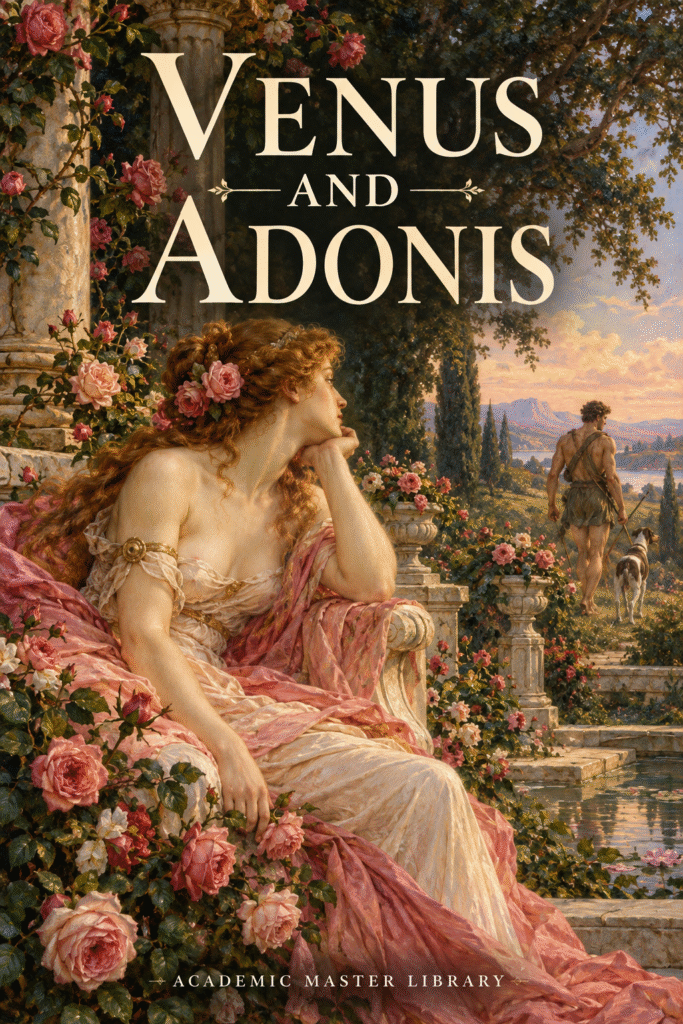
Cover design: original Academic Master library cover. The hosted PDF remains the edition described above.
Source licence: Full Project Gutenberg License. Required source notices and licence terms are retained in the downloadable files.
Book summary
Study overview of the reviewed opening
The opening establishes an immediate mismatch between the two figures’ aims. Adonis is interested in hunting, while Venus treats his beauty as a reason he should respond to her desire. Her praise gives the pursuit a highly elaborate language, but praise does not remove the difference between what she wants and what he wants.
Narrative images complicate Venus’s account of her behaviour. Comparisons involving a predatory bird, a trapped bird, heat, and physical constraint make resistance visible. Adonis’s looks and movements are interpreted by Venus as further signs of attraction to be admired, even when the narration describes discomfort or refusal. The passage therefore offers a clear basis for comparing a character’s interpretation with information supplied around it.
Venus also invokes her power over Mars as part of her argument. Her speech presents past conquest as a reason to expect a present response, while the continuing mismatch remains unresolved. The reviewed opening shows persuasion becoming entangled with power and self-deception; it does not establish a single interpretation of the entire poem.
Independent study suggestions
Academic Master editorial guidance: Make a two-column reading of what Venus says and what the narration reports about Adonis. Track metaphors of appetite, captivity, heat, and cultivation, noting how they change the emotional force of the scene. Read a stanza first for its sound and then for the action it describes. Explain how attractive verbal form can coexist with a disturbing imbalance between the participants.
For an essay, begin with a question about a specific passage, make a provisional claim, and test it against details that might complicate it. Cite the text and any commentary separately. Performance choices and thematic interpretations suggested here are starting points for your own analysis, rather than statements supplied by the author.
Discussion questions
- What evidence distinguishes Venus’s reading of Adonis from his expressed response?
- How do the images of pursuit and captivity affect the encounter?
- What does the reference to Mars contribute to Venus’s persuasion?
Contents and reading sequence
Read the work in its source order. The contents link below opens the identified source edition; the study overview above covers only the passages stated in the coverage note.
Sources and coverage
Approximately the first 1,100 words of the poem itself, plus edition-identifying front matter. The source text matches the imported original used for the hosted PDF. This is selected-passage coverage, not a whole-work or act-by-act review. Opening events are discussed; later plot outcomes are not summarised.
About access & copyright
Check this edition’s source and licence before reusing its files or content. A library listing does not grant additional rights.
Read our Library Access & Copyright policyUnequal desire
Distinguish one person’s wishes from another’s response.
Narration and speech
Compare what is claimed with what is described.
Images of capture
Analyse how metaphor changes the force of an encounter.
Poetic persuasion
Examine the relationship between verbal beauty and power.
Reader ratings & reviews
Share your thoughts
Your review helps other students choose the right resources.
KEEP LEARNING
Your next great read
English Literature English Literature
Thomas Lord Cromwell
View Thomas Lord Cromwell — book English Literature
Sir John Oldcastle
View Sir John Oldcastle — book English Literature
The Merry Devil of Edmonton
View The Merry Devil of Edmonton — book English Literature
The Puritan Widow
View The Puritan Widow — book English Literature
The London Prodigal
View The London Prodigal — book English Literature
King Edward III
View King Edward III — book English Literature
Fair Em
View Fair Em — book English Literature
Arden of Feversham
View Arden of Feversham — book English Literature



