
 English Literature
Plays
Twelfth Night
William Shakespeare; complete source text.
Not rated yetRate this bookTwelfth Night brings shipwrecked twins into a society already shaped by mourning, frustrated desire, and household disorder. Viola's disguise connects the principal courtship plot to a practical problem of survival, while the deception of Malvolio tests the limits of festive amusement. The guide follows all five acts and the final song, preserving the differences between recognition, promised marriage, and unresolved injury.
 Free
About this book
Twelfth Night, also titled What You Will, is a comedy whose opening connects identity and desire with the practical difficulty of gaining access to another person. Orsino listens to music and receives a report that Olivia will not admit his messenger. Viola, newly arrived on the coast of Illyria, asks a captain what can be known about the country and about her missing brother. Their situations give different weights to uncertainty: one is an established ruler reflecting on appetite, while the other must plan how to live in an unfamiliar place. The Project Gutenberg edition provides the complete five-act play; this guide addresses only its first two scenes. Readers can study how reported information shapes the action before Olivia herself appears. Viola’s proposed presentation as a eunuch is stated explicitly in this opening text and should not be replaced by later developments when describing the particular scene.
The hosted PDF is Academic Master’s 2026 formatting of Project Gutenberg eBook #1526, first released in 1998. It contains the complete source text and Gutenberg notices. Its displayed 102-page count refers to PDF sheets, including front matter and notices, rather than the pagination of an early printed edition.
Academic relevance. Cornell’s archived Fall 2016 ENGL 2270 description includes this play among the works studied. This documents course use of the work, rather than assignment of this particular PDF. View the institutional source
Editorial suitability: undergraduate English literature and drama students practising close reading, with guidance where unfamiliar language requires it. This is Academic Master’s assessment, rather than a level stated by the author.
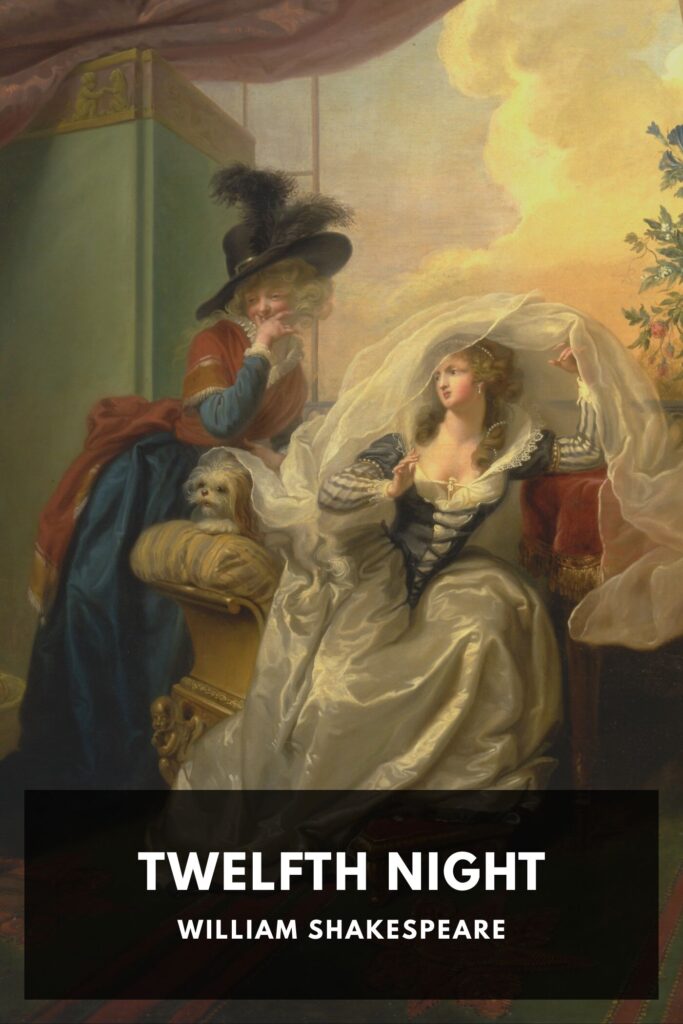
Cover image: Standard Ebooks edition. The hosted PDF remains the edition described above.
Source licence: Full Project Gutenberg License. Required source notices and licence terms are retained in the downloadable files.
Book summary
About this work
Twelfth Night brings shipwrecked twins into a society already shaped by mourning, frustrated desire, and household disorder. Viola's disguise connects the principal courtship plot to a practical problem of survival, while the deception of Malvolio tests the limits of festive amusement. The guide follows all five acts and the final song, preserving the differences between recognition, promised marriage, and unresolved injury.
Act-by-act summaries
Act I — Loss, disguise, and redirected desire
Orsino cultivates his longing for Olivia, who refuses his suit while mourning her brother. After a shipwreck, Viola fears her own twin Sebastian may be dead. With a captain's help she adopts the male identity Cesario and enters Orsino's service. He soon sends the new attendant to plead his case with Olivia, placing Viola in the painful position of advocating for a man she herself loves. Olivia instead becomes attracted to Cesario and sends a ring after the departing messenger under a false pretext. The household plot introduces Sir Toby, Sir Andrew, Maria, Feste, and Malvolio, whose different relations to pleasure and authority will generate a second deception. The opening establishes that private grief can coexist with self-display, practical action, and unexpected attachment.
Act II — A living twin and a forged invitation
The audience learns that Sebastian survived and was helped by Antonio, whose devotion leads him toward danger in Orsino's territory. Viola interprets Olivia's ring correctly and recognizes the difficult triangle created by her disguise. In Olivia's household, Malvolio rebukes the late-night revelers. Maria plans a letter imitating Olivia's handwriting that will encourage him to believe his mistress loves him. His private fantasies about advancement make him receptive to its ambiguous instructions. Meanwhile, Viola speaks to Orsino about an imagined sister's concealed love, finding a way to disclose feeling without revealing identity. The act places indirect truth beside deliberate falsehood: both involve words whose full significance depends on information another character lacks.
Act III — Courtship becomes a physical risk
Olivia presses Cesario for an answer, while Viola cannot reciprocate and cannot explain the central reason. Sir Andrew's jealousy becomes useful to Sir Toby, who promotes a duel for amusement while exaggerating each reluctant participant's ferocity to the other. Malvolio follows the letter's instructions by smiling, wearing yellow stockings, and cross-gartering, conduct Olivia finds disturbing rather than attractive. The conspirators encourage the interpretation that he is mad. Antonio intervenes in the duel because he mistakes Viola for Sebastian. When arrested, he appeals for the money he entrusted to the other twin; Viola's inability to understand appears to him as betrayal. His naming of Sebastian gives her renewed hope that her brother lives, even while the misunderstanding exposes the cost of mistaken identity.
Act IV — Substitution and confinement
Sebastian arrives and is mistaken for Cesario. Unlike Viola, he responds forcefully to Sir Andrew and Sir Toby's aggression. Olivia intervenes, takes him with her, and proposes a formal commitment, which he accepts despite his amazement. Their agreement depends on an identity error, even though both speak sincerely within their understanding of the moment. Meanwhile, Malvolio is confined as a madman. Feste adopts the role of Sir Topas and questions him in ways designed to defeat his attempts to establish his sanity. The darkness and impersonation turn the joke into an exercise of power over another person's testimony. Sir Toby begins to fear consequences, and Feste eventually helps transmit Malvolio's letter. The act places an apparently fortunate substitution beside a deception that becomes increasingly difficult to defend as harmless sport.
Act V — Recognition and the people left outside it
Orsino, Olivia, Antonio, and Cesario confront incompatible accounts until Sebastian's arrival makes the existence of twins visible. Viola and Sebastian establish their relationship through shared biographical knowledge. Olivia's commitment is now attached to Sebastian, while Orsino turns toward Viola and proposes a future marriage once her identity and clothing can be publicly regularized. The captain who holds her clothes remains part of an unresolved practical arrangement. Malvolio's letter exposes the trick, and Fabian explains Maria's role and her marriage to Sir Toby. Olivia acknowledges the abuse, but Malvolio leaves promising revenge. Antonio's future is not given comparable romantic closure. Feste's concluding song returns to wind, rain, and the ordinary passage of life, placing the completed play within a world whose difficulties continue.
Desire, performance, and the boundary of comedy
Viola's disguise creates opportunities for work, intimacy, and candid conversation, but it also makes her a target of desires and conflicts she cannot safely answer. The recognition scene solves the central identity puzzle without making all earlier feelings unreal. Compare Orsino's attraction to Cesario's companionship, Olivia's response to a messenger who challenges her, and Antonio's devotion to Sebastian. These relationships exceed the convenient arrangement of final couples. Malvolio's vanity likewise does not cancel his injury: a reader can find his fantasy comic while recognizing the cruelty of imprisonment and denied testimony. The final song helps preserve this mixed perspective by allowing pleasure and exposure, performance and endurance, to remain together.
Study instructions
- Keep a chart of who believes Cesario, Viola, and Sebastian to be the same person, updating it after Antonio's arrest and the final recognition.
- Compare Viola's imagined sister with Maria's forged letter: explain the different purposes of concealed authorship.
- Read the duel scene for the gap between what each participant fears and what the audience knows.
- Analyze the Sir Topas episode through Malvolio's attempts to supply evidence of sanity.
- List the marriages completed, proposed, or reported at the end, then identify whose future remains unresolved.
Questions for reflection
- How does Viola's disguise change both the opportunities and dangers available to her?
- Where does the treatment of Malvolio cross the boundary between ridicule and coercion?
- What does Feste's song add after the identity puzzle has apparently been solved?
Sources and coverage
This original study guide follows the complete work in the linked Project Gutenberg edition and includes the ending. Poem numbers and act divisions follow that source; thematic reading groups are editorial aids, not additional chapters of the original. Plot summary and interpretation are distinguished through the reading questions. Historical title-page attributions do not by themselves settle authorship. Read the source text; Edition details.
About access & copyright
Check this edition’s source and licence before reusing its files or content. A library listing does not grant additional rights.
Read our Library Access & Copyright policyAppetite and desire
Analyse the changing value of music for Orsino.
Reported knowledge
Separate information from the hopes built upon it.
Loss and response
Compare mourning and uncertainty across the two scenes.
Disguise as action
Explain Viola’s first plan for entering service.
Reader ratings & reviews
Share your thoughts
Your review helps other students choose the right resources.
KEEP LEARNING
Your next great read
English Literature English Literature
Thomas Lord Cromwell
View Thomas Lord Cromwell — book English Literature
Sir John Oldcastle
View Sir John Oldcastle — book English Literature
The Merry Devil of Edmonton
View The Merry Devil of Edmonton — book English Literature
The Puritan Widow
View The Puritan Widow — book English Literature
The London Prodigal
View The London Prodigal — book English Literature
King Edward III
View King Edward III — book English Literature
Fair Em
View Fair Em — book English Literature
Arden of Feversham
View Arden of Feversham — book English Literature



