
 English Literature
Plays
The Winter's Tale
William Shakespeare; complete source text.
Not rated yetRate this bookThe Winter’s Tale moves from destructive jealousy in Sicilia to pastoral courtship in Bohemia and a return shaped by recognition and performance. This guide follows all five acts in the Project Gutenberg text, including Time’s sixteen-year transition. The work’s restorative ending does not undo every loss. Its central problems concern the difference between suspicion and evidence, authority and truth, and the possibility of renewed trust after irreversible harm.
 Free
About this book
The Winter’s Tale brings family relationships into contact with royal authority. In its first act, the friendship of Leontes and Polixenes is described as rooted in childhood and sustained through diplomatic exchange. Hermione’s success as a hostess then becomes the occasion for Leontes’s destructive interpretation. The hosted Project Gutenberg edition contains five acts, moving among the locations recorded in its verified contents. The guide below concentrates on Act I rather than claiming a full account of the play’s later changes in setting and time. It is useful for students studying asides, persuasion, dramatic irony and the pressure that political power places upon ordinary judgement. Reading the opening closely means preserving the difference between the king’s accusations, other characters’ responses, and what the stage actually shows.
This hosted edition is Academic Master’s 2026 PDF formatting of Project Gutenberg eBook #1539, originally released in 1998. The displayed 113-page count is the PDF sheet count, including source notices, rather than an early printed edition’s pagination. The Gutenberg catalogue’s ISBN (HTML) identifies its HTML format; no PDF-specific ISBN or DOI has been verified.
Authorship and edition context. The Winter’s Tale is a Shakespeare play first printed in the 1623 First Folio. This guide follows the wording and divisions of Project Gutenberg #1539, including its opening two scenes in Sicilia. Read the supporting source
Academic relevance. Cornell’s Spring 2024 ENGL 4270 course description explicitly includes this work among the late plays studied. View the archived course description. This documents study of the work, not assignment of this particular PDF.
Editorial suitability: undergraduate English literature and drama students, with attention to close reading and comparison of editions. This is Academic Master’s assessment, rather than a level stated by the original author.
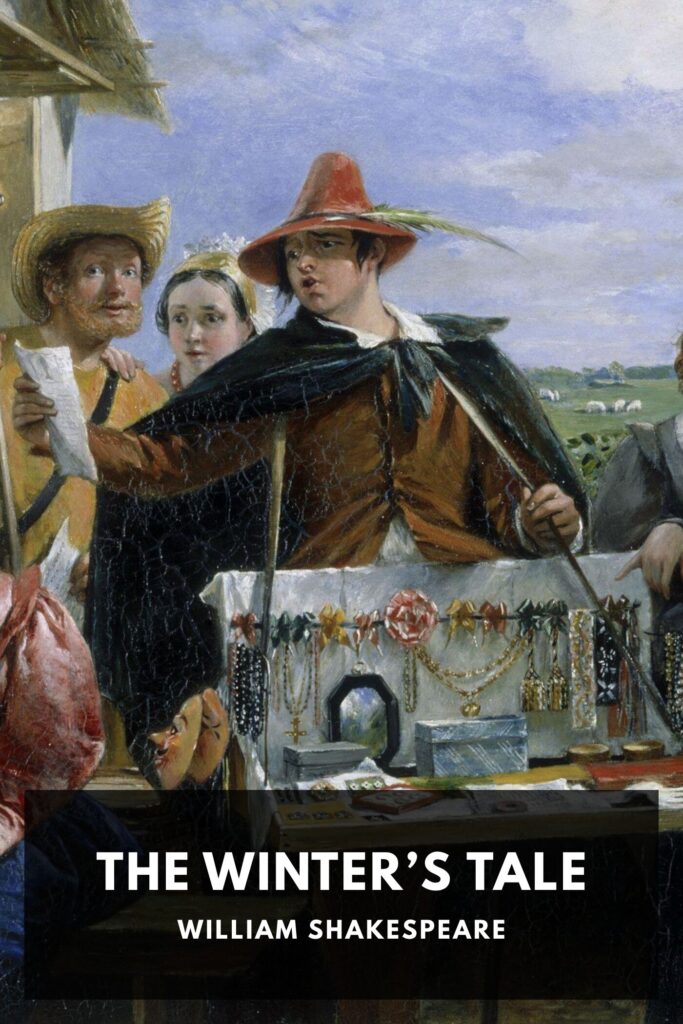
Cover image: Standard Ebooks edition. The hosted PDF remains the edition described above.
Source licence: Full Project Gutenberg License. Required source notices and licence terms are retained in the downloadable files.
Book summary
About this work
The Winter’s Tale moves from destructive jealousy in Sicilia to pastoral courtship in Bohemia and a return shaped by recognition and performance. This guide follows all five acts in the Project Gutenberg text, including Time’s sixteen-year transition. The work’s restorative ending does not undo every loss. Its central problems concern the difference between suspicion and evidence, authority and truth, and the possibility of renewed trust after irreversible harm.
Act-by-act summaries
Act I: Hospitality Rewritten as Betrayal
The opening comparison between courts establishes friendship and expectations of continued exchange. Leontes then interprets Hermione’s success in persuading Polixenes to remain as evidence of adultery. Ordinary interaction becomes a set of signs whose meaning he decides in advance. His demand that Camillo act against Polixenes tests whether service requires obeying a ruler’s false conclusion. Camillo chooses warning and escape instead. Track how a suspicion expands to reinterpret past intimacy and present conduct. The audience can see a gap between the evidence available and the certainty Leontes claims, making his authority especially dangerous.
Act II: Imprisonment and the Rejection of Counsel
Hermione’s separation from her child and confinement turn the king’s interpretation into consequences for bodies and family life. Paulina brings the newborn daughter as a challenge to the accusation, insisting on a relationship Leontes refuses to recognize. Counsel and visible resemblance do not persuade a judgment already organized against them. Antigonus receives the order to remove the child, extending the damage beyond the court. The approach of an oracle seems to promise an external check on royal certainty. Ask why that check is necessary when other forms of human evidence and argument have already been available.
Act III: The Oracle and Irreversible Consequences
The trial gives Hermione a public opportunity to answer, but Leontes’s control of judgment threatens to make procedure merely confirm accusation. The oracle contradicts him, and his initial rejection is followed by news of Mamillius’s death. Hermione collapses and is reported dead, making recognition of error arrive after profound harm. In Bohemia, Antigonus leaves the infant and is killed by a bear, while the shepherd and his son discover the child amid the remains of catastrophe. Comic speech and rescue do not erase the deaths. The act places a possible future beside consequences that cannot be reversed.
Act IV: Time and a Pastoral Future
Time asks the audience to cross sixteen years, making absence part of the play’s form rather than a gap to be ignored. Perdita grows within a household that does not know her origin, and Florizel’s love brings the royal and pastoral strands together. The sheep-shearing gathering mixes festival, commerce, disguise, and debate about art and nature. Polixenes’s response to the proposed match exposes another ruler whose approval has limits. Camillo’s plan redirects the lovers toward Sicilia, while Autolycus’s maneuvers and the shepherds’ attempt to explain themselves complicate how information travels. The future depends on recognition, but it reaches recognition by unstable routes.
Act V: Recognition and the Statue Scene
Leontes’s prolonged remorse is shaped and checked by Paulina, who resists an easy replacement for Hermione. The arrival of the young lovers allows the lost daughter to become known, though major discoveries are conveyed through report rather than shown directly. The final encounter with Hermione’s apparent statue asks spectators and characters to attend, wait, and revise what they think they are seeing. Her living presence makes reunion possible, but Mamillius and Antigonus do not return. The scene offers restoration without making time fully reversible. Read its wonder alongside Hermione’s own explanation of preservation and hope, rather than treat her solely as an object brought back for Leontes’s comfort.
Evidence, Performance, and Unequal Authority
The early king claims to know what others cannot confirm; the final scene requires him to submit to an experience he does not control. That reversal helps connect jealousy and wonder. Yet the two states are not identical: Paulina’s managed encounter seeks reunion, while Leontes’s earlier managed interpretation produced punishment. Compare how the play presents proof through speech, resemblance, oracle, objects, reports, and performance. Perdita’s recovered rank also complicates the pastoral promise that value can be recognized independently of birth. A careful reading accounts for the social settlement as well as the emotional one.
Loss and the Limits of the Ending
The sixteen-year span cannot be treated as empty time between an error and its correction. It includes Perdita’s upbringing, Leontes’s remorse, Hermione’s absence, and lives that have ended. The closing invitation to exchange stories acknowledges experiences no single public recognition can fully contain. Consider which voices are heard and which remain unavailable. The title’s association with a tale may encourage acceptance of extraordinary events, but it also invites readers to examine how a story gives shape to suffering without abolishing it.
Study instructions
- Separate Leontes’s claims from the evidence shown or reported in each early scene.
- Track every attempt at counsel and the response it receives.
- Create a timeline recording both the sixteen-year gap and the losses it cannot repair.
- Read the art-and-nature discussion beside the statue scene.
- Compare reported recognitions with the final event shown onstage.
- Write an ending analysis that includes Hermione and Perdita as well as Leontes.
Questions for reflection
- What makes Leontes’s certainty resistant to correction?
- How does Time change the audience’s relation to consequences?
- Which parts of the ending restore a relationship, and which losses remain?
Sources and coverage
This original study guide follows the complete work in the linked Project Gutenberg edition and includes the ending. Poem numbers and act divisions follow that source; thematic reading groups are editorial aids, not additional chapters of the original. Plot summary and interpretation are distinguished through the reading questions. Historical title-page attributions do not by themselves settle authorship. Read the source text; Edition details.
About access & copyright
Check this edition’s source and licence before reusing its files or content. A library listing does not grant additional rights.
Read our Library Access & Copyright policyEvidence and inference
Distinguish observed conduct from Leontes’s interpretation.
Asides
Explain how private speech changes the audience’s knowledge.
Ethical service
Analyse Camillo’s conflict between command and judgement.
Hospitality
Trace the change from reciprocal welcome to danger.
Reader ratings & reviews
Share your thoughts
Your review helps other students choose the right resources.
KEEP LEARNING
Your next great read
English Literature English Literature
Thomas Lord Cromwell
View Thomas Lord Cromwell — book English Literature
Sir John Oldcastle
View Sir John Oldcastle — book English Literature
The Merry Devil of Edmonton
View The Merry Devil of Edmonton — book English Literature
The Puritan Widow
View The Puritan Widow — book English Literature
The London Prodigal
View The London Prodigal — book English Literature
King Edward III
View King Edward III — book English Literature
Fair Em
View Fair Em — book English Literature
Arden of Feversham
View Arden of Feversham — book English Literature



