
 English Literature
Plays
The Two Gentlemen of Verona
William Shakespeare; complete source text.
Not rated yetRate this bookThe Two Gentlemen of Verona begins as a debate about friendship, travel, and love, then turns toward betrayal and coercion. Proteus abandons Julia and undermines Valentine after becoming attracted to Silvia. This guide follows all five acts, including Julia's disguised service and the troubling final reconciliation. It treats the ending's proposed harmony as something to assess rather than proof that the injuries have been adequately repaired.
 Free
About this book
The Two Gentlemen of Verona begins as a debate about friendship, travel, and love, then turns toward betrayal and coercion. Proteus abandons Julia and undermines Valentine after becoming attracted to Silvia. This guide follows all five acts, including Julia's disguised service and the troubling final reconciliation. It treats the ending's proposed harmony as something to assess rather than proof that the injuries have been adequately repaired.
This page follows Project Gutenberg eBook #1509, first released in 1998, which supplied the text reformatted in the existing hosted PDF. The date describes the electronic edition, not the work’s original publication. The recorded 97 pages refer to that formatted PDF. Course evidence concerns the work and may prescribe a different edition.
George Mason University’s Spring 2012 ENGH 322 syllabus assigns this play.
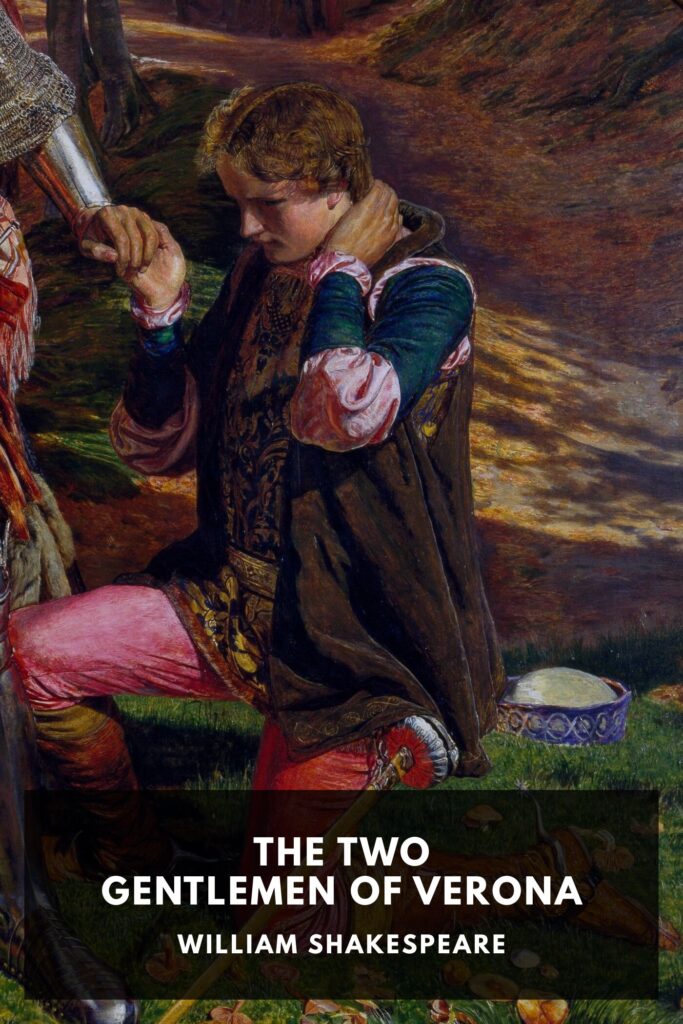
Cover image: Standard Ebooks edition. The hosted PDF remains the edition described above.
Source licence: Full Project Gutenberg License. Required source notices and licence terms are retained in the downloadable files.
Book summary
About this work
The Two Gentlemen of Verona begins as a debate about friendship, travel, and love, then turns toward betrayal and coercion. Proteus abandons Julia and undermines Valentine after becoming attracted to Silvia. This guide follows all five acts, including Julia's disguised service and the troubling final reconciliation. It treats the ending's proposed harmony as something to assess rather than proof that the injuries have been adequately repaired.
Act-by-act summaries
Act I — Travel, attachment, and competing advice
Valentine leaves Verona to seek experience abroad, while Proteus remains attached to Julia. Their conversation presents love and travel as competing accounts of how a young man should develop. Speed's report about a letter introduces the practical uncertainty of romantic communication. Julia questions Lucetta about suitors and tears up Proteus's letter while revealing through her subsequent attention to its fragments that her rejection is not straightforward. Proteus's father decides that he too should travel, encouraged by advice about the value of education beyond home. Proteus misrepresents the source of a letter to conceal his attachment, helping produce the departure he does not want. The act shows that the management of appearances can turn private desire into a cause of its own frustration.
Act II — A new desire and an abandoned promise
Valentine has fallen in love with Silvia in Milan, and Speed exposes how thoroughly his behavior has changed. Silvia's request that Valentine write a letter effectively allows her to return his affection through an indirect performance. Julia and Proteus exchange tokens before his departure, making constancy tangible in objects that will later acquire new meanings. Launce's account of leaving home with his dog Crab supplies a comic alternative to the gentlemen's elevated self-descriptions. When Proteus reaches Milan, he becomes attracted to Silvia despite her relationship with Valentine and his own commitment to Julia. His private reasoning turns the new desire into an excuse to betray both. Julia meanwhile decides to travel in male disguise, creating the possibility that she will witness what he expects to conceal from her.
Act III — Friendship becomes an instrument of betrayal
Proteus informs the Duke of Valentine's plan to escape with Silvia. The Duke tests Valentine through a feigned conversation about his own romantic difficulties, drawing out the means of the intended elopement and the concealed ladder. Valentine is banished. Proteus presents himself as a helpful friend while advising the Duke and Silvia's other suitor Thurio, using their interests to advance his own access to her. Silvia rejects the character of a man willing to betray both a friend and a former beloved. Speed and Launce continue to puncture idealized language through practical discussions of work, marriage, and bodily qualities. The act's central deception is relational: Proteus does not merely hide a feeling but uses the trust attached to friendship to make his rival dependent on him.
Act IV — Disguised service and the refusal of gifts
Valentine encounters outlaws and becomes their leader, moving his banishment into another social arrangement. In Milan, Proteus courts Silvia through music and persuasion, but she condemns his disloyalty and refuses to accept Julia's ring. Julia, disguised as Sebastian, hears the serenade and enters Proteus's service. He employs her to carry messages and gifts that advertise the abandonment of his earlier promises. Her conversation with Silvia creates recognition at another level: Silvia takes Julia's suffering seriously even while the disguised messenger cannot openly claim it as her own. Julia's encounter with Silvia's portrait also turns the supposed rival into someone she must imagine and evaluate directly. Silvia then seeks help from Eglamour to leave in search of Valentine.
Act V — Violence interrupted and reconciliation rushed
Silvia is captured by the outlaws, and Proteus rescues her only to press his own claim. When she continues to refuse, he threatens sexual violence. Valentine intervenes and denounces the betrayal. Proteus expresses remorse, and Valentine forgives him with startling speed, then offers language about yielding his own interest in Silvia that places male friendship above her expressed wishes. Julia faints and reveals her identity through the rings, prompting Proteus to return to her. Thurio abandons his claim when threatened, and the Duke approves Valentine as Silvia's husband. The outlaws receive a pardon and marriages are anticipated. Silvia has little opportunity to speak in this settlement. The final promise of shared happiness therefore follows events that remain ethically difficult rather than demonstrably resolved.
Constancy, objects, and the limits of male agreement
Track how letters, rings, portraits, and disguises carry information or conceal it. Julia and Silvia often understand the moral implications of these objects more clearly than the men who use them. The play also tests the very category of a gentleman: status and elegant declarations do not prevent Proteus's treachery, while comic servants can expose pretension through material experience. The final scene requires especially careful summary. A reader should neither omit the threatened violence nor invent an extended account of Silvia's consent that the dialogue does not provide. Interpretations can debate the tone and theatrical handling of Valentine's offer, but the text's distribution of speech remains important evidence. Friendship's restoration is not automatically equivalent to justice for the women.
Study instructions
- Chart Proteus's commitments to Julia, Valentine, the Duke, and Thurio, recording when his promises become incompatible.
- Compare Julia's treatment of the first letter with her later role as a messenger.
- Trace both rings through the final recognition and explain why objects can expose what disguises conceal.
- Read Silvia's refusals in order before discussing her as an object of rivalry.
- Compare Launce's relation to Crab with the gentlemen's claims about loyalty, identifying both comic exaggeration and ethical contrast.
- Annotate the final scene for who apologizes, who forgives, and whose consent is not given comparable space.
Questions for reflection
- How does Proteus transform the language of self-knowledge into a defense of betrayal?
- What can Julia learn through disguise that a direct appeal might not reveal?
- Which injuries does the ending acknowledge, and which are absorbed into its announcement of happiness?
Sources and coverage
This original study guide follows the complete work in the linked Project Gutenberg edition and includes the ending. Poem numbers and act divisions follow that source; thematic reading groups are editorial aids, not additional chapters of the original. Plot summary and interpretation are distinguished through the reading questions. Historical title-page attributions do not by themselves settle authorship. Read the source text; Edition details.
About access & copyright
Check this edition’s source and licence before reusing its files or content. A library listing does not grant additional rights.
Read our Library Access & Copyright policyContrasting priorities
Compare travel, study, and romantic attachment.
Friendship in dialogue
Examine disagreement within an affectionate exchange.
Servant perspectives
Notice the practical work behind romantic communication.
Comic delay
Analyse how wordplay interrupts the delivery of information.
Reader ratings & reviews
Share your thoughts
Your review helps other students choose the right resources.
KEEP LEARNING
Your next great read
English Literature English Literature
Thomas Lord Cromwell
View Thomas Lord Cromwell — book English Literature
Sir John Oldcastle
View Sir John Oldcastle — book English Literature
The Merry Devil of Edmonton
View The Merry Devil of Edmonton — book English Literature
The Puritan Widow
View The Puritan Widow — book English Literature
The London Prodigal
View The London Prodigal — book English Literature
King Edward III
View King Edward III — book English Literature
Fair Em
View Fair Em — book English Literature
Arden of Feversham
View Arden of Feversham — book English Literature



