
 English Literature
Plays
The Taming of the Shrew
William Shakespeare; complete source text.
Not rated yetRate this bookThe Taming of the Shrew presents its marriage plot as a performance arranged for Christopher Sly, a man being deceived about his social identity. Within that frame, rival courtships depend on disguises, financial negotiation, and claims about obedience. This guide covers the Induction and all five acts, including Katherine's final speech, while distinguishing what happens from the competing interpretations a performance can produce.
 Free
About this book
The Taming of the Shrew presents its marriage plot as a performance arranged for Christopher Sly, a man being deceived about his social identity. Within that frame, rival courtships depend on disguises, financial negotiation, and claims about obedience. This guide covers the Induction and all five acts, including Katherine's final speech, while distinguishing what happens from the competing interpretations a performance can produce.
This page follows Project Gutenberg eBook #1508, first released in 1998, which supplied the text reformatted in the existing hosted PDF. The date describes the electronic edition, not the work’s original publication. The recorded 110 pages refer to that formatted PDF. Course evidence concerns the work and may prescribe a different edition.
Baruch College’s Fall 2011 ENG 4140 syllabus schedules the Induction and five acts.
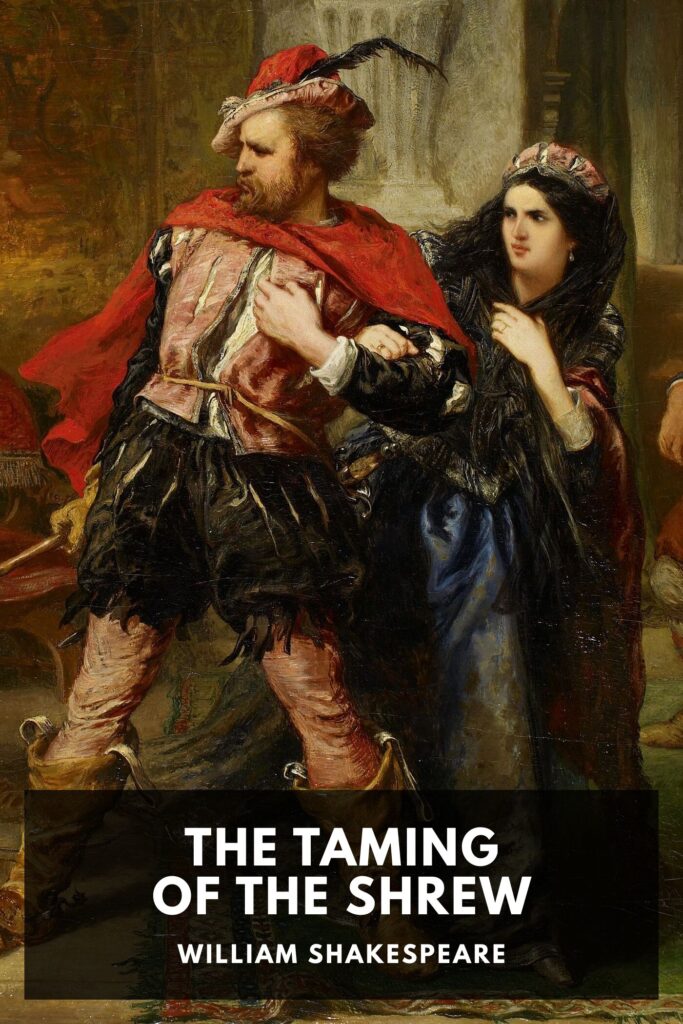
Cover image: Standard Ebooks edition. The hosted PDF remains the edition described above.
Source licence: Full Project Gutenberg License. Required source notices and licence terms are retained in the downloadable files.
Book summary
About this work
The Taming of the Shrew presents its marriage plot as a performance arranged for Christopher Sly, a man being deceived about his social identity. Within that frame, rival courtships depend on disguises, financial negotiation, and claims about obedience. This guide covers the Induction and all five acts, including Katherine's final speech, while distinguishing what happens from the competing interpretations a performance can produce.
Act-by-act summaries
Induction — A spectator taught to believe a role
A lord finds the drunken Christopher Sly and arranges an elaborate deception in which servants tell him he is a nobleman recovering from an illness. A page plays the role of his wife, and visiting actors perform for him. Sly's uncertainty is overcome through repeated assertions and the material setting supplied by others. The frame therefore introduces identity as something that can be staged, rehearsed, and socially enforced. It also makes spectatorship part of the action: a manipulated observer is about to watch a comedy about manipulating relationships. In the linked text, Sly does not receive a concluding return that neatly explains what he learned. Readers should not import a closing scene from a different play or adaptation into this edition.
Act I — The rule governing two daughters
Lucentio arrives in Padua to study but becomes absorbed by Bianca. Her father Baptista refuses to arrange her marriage before her elder sister Katherine is married. Bianca's suitors consequently have an interest in finding Katherine a husband, and their accounts of her temperament serve that practical goal. Lucentio exchanges identities with his servant Tranio so he can enter the household as a tutor. Petruchio arrives seeking a wealthy marriage and agrees to pursue Katherine after hearing about her dowry. Hortensio also adopts a tutoring disguise. The act makes the sisters' futures a problem that men attempt to solve collectively through access, substitution, and financial opportunity. Their descriptions of Katherine are evidence of their interests as well as material for characterization.
Act II — Rivalry, negotiation, and an announced engagement
Katherine confronts Bianca about her preferred suitor, revealing competition and unequal expectations within the household. Petruchio negotiates financial terms with Baptista, then meets Katherine in a sustained contest of language. Their exchange includes wit, insult, bodily threats, and competing claims about what each has said. Petruchio announces that they have agreed to marry despite her expressed resistance, presenting a private understanding that the audience has no reason simply to accept as neutral fact. Elsewhere, Tranio, impersonating Lucentio, competes with Gremio through promises of wealth. Baptista requires confirmation from the supposed father. Both courtships therefore rely on statements that claim the authority to determine another person's future, even where their factual or consensual basis is insecure.
Act III — Teaching love and performing disruption
Lucentio and Hortensio use their lessons to communicate romantic intentions to Bianca, who manages the competing approaches more actively than the household's image of her quiet obedience suggests. Petruchio arrives late for his wedding in deliberately unsuitable clothing, unsettling the public ritual through which his marriage should receive dignity and recognition. Gremio reports his disruptive conduct during the ceremony. Afterward, Petruchio insists on leaving with Katherine rather than remaining for the feast, overriding her wish to stay. The wedding thus establishes his power through departures from expected courtesy as much as through formal vows. Meanwhile, the alternative courtship advances through concealed instruction. Compare Bianca's room for maneuver within tutoring with Katherine's constrained choices at a ceremony others have already arranged.
Act IV — Deprivation presented as care
At Petruchio's house, servants are abused and ordinary provisions become occasions for control. He denies Katherine food and rest while claiming that nothing available is good enough for her. His private explanation identifies the strategy as a method of taming, using the language of training and calculated vigilance. Disputes over clothing continue the process, making supposed generosity a means of withholding choice. On the road back to Padua, he requires agreement with his claims about the sun and moon; Katherine eventually adopts the responses needed to proceed. The encounter with Vincentio extends the game of naming. In the secondary plot, a stranger impersonates Lucentio's father to confirm financial arrangements, while Bianca and the real Lucentio prepare their own marriage. Obedience and identity are both made through performances others are induced to accept.
Act V — Recognition, a wager, and the disputed final speech
The arrival of the real Vincentio exposes the impersonation and causes conflict between fathers, servants, and sons before Lucentio's marriage to Bianca is acknowledged. At the final gathering, the husbands wager on their wives' obedience. Bianca and the widow do not come when called, while Katherine appears and delivers an extended speech about duty within marriage. Her conduct allows Petruchio to win the wager and contradicts the community's earlier expectations. The dialogue does not specify one mandatory tone for the speech. It can be performed with conviction, strategic accommodation, irony, shared understanding, or disturbing constraint, but each reading must account for the earlier deprivation and unequal authority. The ending supplies a public display of compliance; its emotional meaning remains a question for interpretation.
Performance, power, and interpretive responsibility
Read the Induction beside the marriage plot rather than treating it as an unrelated opening joke. Sly is told what identity he occupies until he begins to participate in the role; Katherine is similarly placed within a narrative whose author claims to know her wishes better than she does. Their situations are not identical, but the comparison makes the manufacture of agreement visible. Also consider Bianca, whose apparently compliant image enables substantial action under cover. A strong analysis distinguishes consent, tactical speech, and outward obedience instead of assuming they always coincide. The play's comic form and verbal energy do not remove the need to describe coercive conduct accurately, nor does recognizing that conduct settle every choice available to a production.
Study instructions
- Compare the methods used to convince Sly with Petruchio's methods in Katherine's household.
- Make a chart of the courtship disguises, identifying who knows each identity and who supplies its apparent confirmation.
- Read Katherine's first encounter with Petruchio for the difference between her words and his report of their agreement.
- Track food, sleep, clothing, and travel as material conditions of the marriage plot.
- Prepare two different performance readings of the final speech, supporting each with stage action and earlier dialogue.
- Check the actual ending of the linked edition before making claims about Sly's return.
Questions for reflection
- What does the framing trick suggest about the relationship between identity and social recognition?
- How does Bianca's conduct complicate the contrast between a shrew and an obedient daughter?
- When can outward agreement be evidence of adaptation rather than a freely shared belief?
Sources and coverage
This original study guide follows the complete work in the linked Project Gutenberg edition and includes the ending. Poem numbers and act divisions follow that source; thematic reading groups are editorial aids, not additional chapters of the original. Plot summary and interpretation are distinguished through the reading questions. Historical title-page attributions do not by themselves settle authorship. Read the source text; Edition details.
About access & copyright
Check this edition’s source and licence before reusing its files or content. A library listing does not grant additional rights.
Read our Library Access & Copyright policySocial performance
Examine how rank is signalled through objects and behaviour.
Theatrical framing
Distinguish the Induction from the main play.
Control of interpretation
Notice who decides which account of Sly is accepted.
Audience response
Compare comic amusement with the scene’s unequal power.
Reader ratings & reviews
Share your thoughts
Your review helps other students choose the right resources.
KEEP LEARNING
Your next great read
English Literature English Literature
Thomas Lord Cromwell
View Thomas Lord Cromwell — book English Literature
Sir John Oldcastle
View Sir John Oldcastle — book English Literature
The Merry Devil of Edmonton
View The Merry Devil of Edmonton — book English Literature
The Puritan Widow
View The Puritan Widow — book English Literature
The London Prodigal
View The London Prodigal — book English Literature
King Edward III
View King Edward III — book English Literature
Fair Em
View Fair Em — book English Literature
Arden of Feversham
View Arden of Feversham — book English Literature



