
 Arts
ArtsTextbook
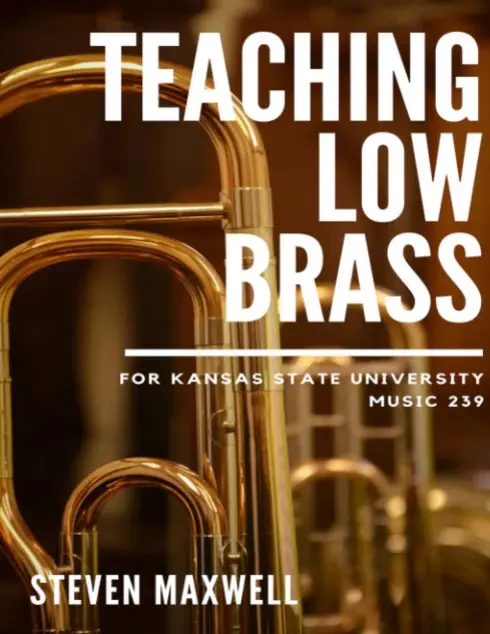
Teaching Low Brass
Not rated yetRate this bookSteven Maxwell’s Teaching Low Brass is an introductory resource for music educators learning to teach trombone, euphonium, and tuba. Published by New Prairie Press in 2018, it combines short pedagogical sections with etudes, warm-ups, slide-position and fingering references, and scales. This guide follows the unnumbered teaching sections and six appendices in the publisher’s 42-page text. It adds original practice and observation prompts rather than inventing numbered chapters or reproducing the printed exercises. The original publisher cover is used. Instrument-specific guidance is most useful alongside listening, demonstration, and feedback from an experienced teacher.
Read on the publisher’s website. Opens in a new tab.
 Free
About this book
Steven Maxwell’s Teaching Low Brass is an introductory resource for music educators learning to teach trombone, euphonium, and tuba. Published by New Prairie Press in 2018, it combines short pedagogical sections with etudes, warm-ups, slide-position and fingering references, and scales. This guide follows the unnumbered teaching sections and six appendices in the publisher’s 42-page text. It adds original practice and observation prompts rather than inventing numbered chapters or reproducing the printed exercises. The original publisher cover is used. Instrument-specific guidance is most useful alongside listening, demonstration, and feedback from an experienced teacher.
Book summary
Steven Maxwell’s Teaching Low Brass is an introductory resource for music educators learning to teach trombone, euphonium, and tuba. Published by New Prairie Press in 2018, it combines short pedagogical sections with etudes, warm-ups, slide-position and fingering references, and scales. This guide follows the unnumbered teaching sections and six appendices in the publisher’s 42-page text. It adds original practice and observation prompts rather than inventing numbered chapters or reproducing the printed exercises. The original publisher cover is used. Instrument-specific guidance is most useful alongside listening, demonstration, and feedback from an experienced teacher.
Chapter-by-chapter summaries
Brass History
The historical section connects instrument development with performance roles and repertoire. Study the history through a timeline linking changes in construction with changes in available musical possibilities. Then choose one repertoire example and ask what the instrument of its period could do. Avoid judging an earlier design merely as an incomplete version of a modern instrument; the relevant ensemble, musical function, and performance practice may differ.
The Overtone Series
The overtone discussion supplies a foundation for understanding available pitches and their relationships. Make a practical diagram that connects an unchanged tube length with several possible resonances. Explain how a player selects among them and how changing tubing length alters the available pattern. Listen as well as naming intervals: recognizing a relationship on paper and producing a centered sound are complementary skills.
General Intonation Tendencies
The intonation section relates pitch to instrument behavior and playing conditions. Use a sustained reference pitch and compare what is heard with a tuner observation rather than treating a fingering chart as a guarantee of tuning. Record the note, dynamic, context, and adjustment being tried. The aim is a repeatable listening-and-response process, not memorization of a correction without checking its effect.
Embouchure
The embouchure section concerns the physical setup used to produce a sound. For study, observe a teacher’s demonstration and identify the task before copying visible details. Small differences in appearance do not automatically establish a fault. Relate a proposed adjustment to tone, response, flexibility, and comfort, changing one thing at a time. Description alone is less informative than hearing and evaluating the resulting sound.
Embouchure Problems
The text separates discussion of problems from the basic setup. A useful pedagogical approach records the specific musical difficulty, the context in which it appears, and what has already been tried. Avoid diagnosing a student from one visual feature or assuming every response problem has the same cause. Compare a teacher-supported adjustment with the baseline result and preserve a clear record of whether it helps.
Instruments, Mouthpieces, and Equipment
Equipment is considered as part of practical low-brass teaching. Compare instruments through their intended musical role, handling, response, and suitability for the player rather than assuming that a larger or more expensive item is universally better. When discussing a mouthpiece or accessory, define the problem it is meant to address. Keep equipment selection separate from the practice and instruction still needed to develop a skill.
Low Brass Literature
The literature section gives a route into suitable musical material. Build a teaching sequence by matching repertoire demands with the learner’s present range, rhythm, articulation, and reading abilities. A piece can be accessible in one dimension and challenging in another. Explain the purpose of an assignment and choose a passage that demonstrates the intended skill. Listening to a model can complement score study without replacing independent musical decisions.
Brass Instrument Maintenance
Maintenance supports reliable use and preserves the instrument. Distinguish routine care that the learner has been taught from work requiring a teacher or repair specialist. A practical checklist should identify the instrument, task, appropriate materials, frequency, and evidence that attention is needed. Do not force an unfamiliar mechanism in order to complete a checklist. Knowing when to seek help is part of responsible instrument care.
Vibrato
The vibrato discussion introduces an expressive aspect of performance. Compare recordings or demonstrations in a defined musical setting, noting the relationship with style, sustained pitch, and tone. Practice should make the effect intentional rather than an uncontrolled substitute for a stable sound. A teaching note can identify the desired musical result before describing a physical method. Similar terminology does not guarantee identical practice across instruments and traditions.
Low Brass in the Marching Band
The marching-band section places instrumental work in a different performance setting. Analyze how posture, movement, carrying, projection, and ensemble coordination affect the task. Practice a musical demand and a movement demand separately before combining them under appropriate instruction. Then evaluate whether the musical result remains consistent. The performance context changes the practical problem without eliminating the need for controlled tone, accurate rhythm, and listening.
Baritone versus Euphonium — David Werden’s Contribution
The included contribution addresses a distinction often obscured by everyday instrument labels. Use a comparison chart that separates terminology, construction, and musical function. Examine the actual instrument instead of relying only on the name used in one ensemble or catalog. When teaching beginners, explain the distinction at the level needed for the task while avoiding unnecessary terminology that does not improve their understanding.
Appendix I: Trombone and Euphonium Etudes
The first etude collection supports supervised practice on the relevant instruments. Before playing, identify the key, meter, rhythm patterns, range, and musical aim. Select a short passage and establish accuracy before increasing complexity or tempo. Record one aspect that improved and one that needs further work. The appendix’s printed music remains the source; this guide supplies a method for studying it.
Appendix II: Tuba Etudes
The tuba studies provide material for learners developing instrumental and teaching skills. Plan a manageable practice segment with a clear goal and appropriate feedback. Distinguish note recognition, finger coordination, airflow, and musical shaping when identifying a difficulty. Practicing the entire study repeatedly can conceal which component needs attention. Return to the full phrase after working on the specific problem so that the exercise retains a musical purpose.
Appendix III: Warm-ups
Warm-ups establish readiness and provide a consistent opportunity to observe sound and response. Use the source material thoughtfully rather than assuming that faster or louder playing demonstrates better preparation. Set a modest musical objective, listen to the result, and adapt with the instructor’s guidance. A repeated routine becomes more useful when the player knows what each element is intended to develop.
Appendix IV: Trombone Slide Positions and Euphonium Fingerings
The reference connects written notes with the instrument’s means of changing pitch. Learn the relationship in the context of a phrase rather than treating a position or fingering as the whole act of playing a note. Check the instrument configuration and listen to the pitch produced. A chart supports coordination and recall while teaching and feedback refine the musical result.
Appendix V: Tuba Fingerings
The tuba reference should be read with attention to the instrument for which a fingering applies. Begin by confirming the instrument and notation being used. Then practice a short pattern slowly enough to coordinate reading, fingering, and sound. If the result is unexpected, check the setup and reference before assuming the learner has misunderstood the note. Instrument-specific conventions matter.
Appendix VI: Major Scales
Major scales connect key relationships with repeated instrumental patterns. Plan practice that includes accurate pitches, rhythm, tone, and a controlled return through the pattern. Separate memorizing a fingering sequence from understanding the key and intervals. Vary an exercise only after its basic version is secure, and preserve a musical pulse rather than measuring success solely by speed.
Bibliography and About the Author
The bibliography and closing material identify the sources and educational context supporting the resource. Follow a cited method or repertoire reference when a topic needs more depth. Keep a teaching notebook connecting the source, skill, learner response, and next step. This makes the short textbook a starting point for continued pedagogical development rather than the final authority on every instrument or performance issue.
Study instructions
- Read the conceptual sections before assigning the appendix exercises. Explain the purpose of each task to the learner.
- Use demonstration, listening, and observation together. Do not infer technique from appearance alone.
- Set one specific musical goal for a short practice segment, then record the result and next adjustment.
- Check the instrument and configuration before applying a position or fingering chart.
- Select literature and etudes by the learner’s present needs across rhythm, range, coordination, and expression.
- Use the bibliography, experienced teaching, and appropriate instrument-care guidance when the brief text does not resolve a question.
Questions for reflection
- What musical result is the exercise intended to develop?
- Which observation supports the proposed adjustment?
- Does the fingering or position reference match this instrument?
- How will the teacher know that the learner can transfer a practiced skill into a phrase?
Sources and coverage
This original reading guide follows the linked source edition’s chapter, module, unit, or lesson structure. Consult the source for full arguments, cases, worked examples, exercises, illustrations, and references. Coverage follows the publisher’s unnumbered teaching sections, all six appendices, bibliography, and author material in the 2018 text. The guide does not reproduce notation or replace supervised instrumental practice. The original cover is obtained from the book catalog. Read the source edition.
About access & copyright
This page provides book information and study material. Full-text access is provided by the original publisher or authorised source; a listing does not grant permission to republish the book.
Read our Library Access & Copyright policyExplore the contents
Check the chapters covered in this edition.
Visit the official source
See reading, preview or purchase options.
Save for later
Keep this textbook in your saved collection.
Reader ratings & reviews
Share your thoughts
Your review helps other students choose the right resources.
KEEP LEARNING
Your next great read
Arts Arts
Vocal Techniques for the Instrumentalist
View Vocal Techniques for the Instrumentalist — book Arts
Music on the Move
View Music on the Move — book Arts
Brass Techniques and Pedagogy
View Brass Techniques and Pedagogy — book Arts
Storytelling on Screen: An Online Playback Theatre Archive and Guidebook
View Storytelling on Screen: An Online Playback Theatre Archive and Guidebook — book Arts
Fundamentals of Music Theory
View Fundamentals of Music Theory — book Arts
American Encounters: Art, History, and Cultural Identity
View American Encounters: Art, History, and Cultural Identity — book Arts
Navigating the Arts
View Navigating the Arts — book Arts
Westonia: Selected Works of Elizabeth Jane Weston
View Westonia: Selected Works of Elizabeth Jane Weston — book Arts



