
 Business
ArtsTextbook
The Path to Funding: The Artist’s Guide to Building Your Audience, Generating Income, and Realizing Career Sustainability
Not rated yetRate this bookThe Path to Funding helps artists develop ideas into sustainable projects. Zane Forshee, Christina Manceor and Robin McGinness connect artistic values, audiences and partners with the practical work of preparing descriptions, budgets, timelines and funding proposals.
 Free
About this book
Developed at the Peabody Institute of Johns Hopkins University, this resource combines textbook explanation with workbook activities. The preface centres the process on grant proposals while making clear that the tools also support independently funded and crowdfunded projects. Performing arts provide many of its examples, but its intended creative workforce extends beyond a single discipline. The three-part organisation links the artist, the community and the creative project. Interviews, examples, chapter takeaways and exercises accompany that progression. The authors present the methods as adaptable guidance rather than a fixed recipe for every artist or funding opportunity.
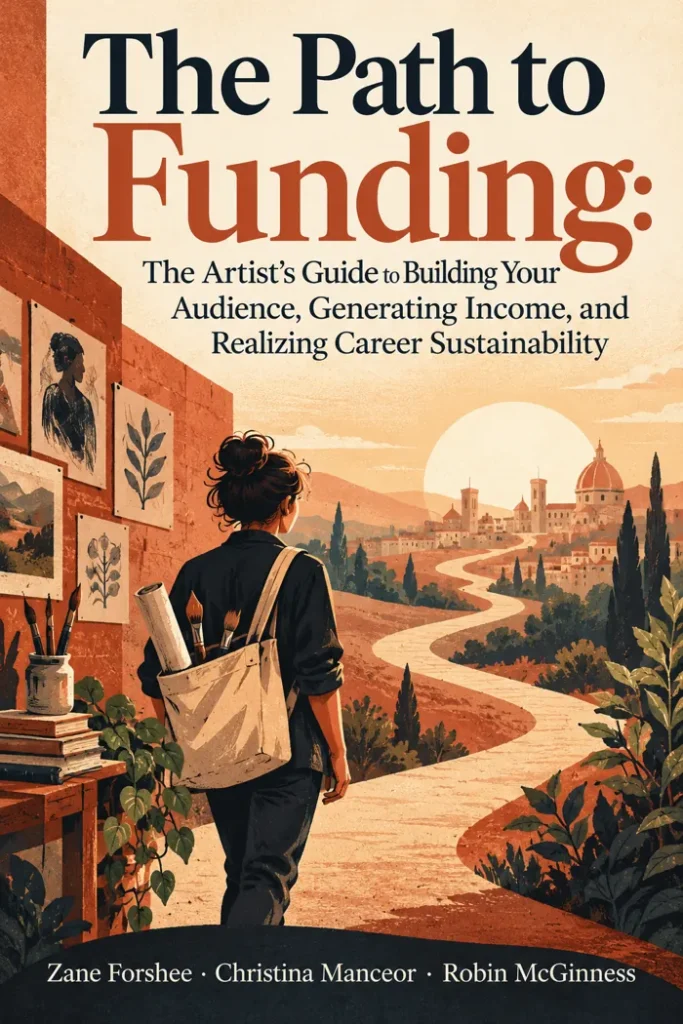
The attached edition contains 195 PDF pages, including front matter. Cover: source edition title page rendered from the PDF. The textbook and its original notices are retained; Academic Master’s study material is separate from the source text.
Book summary
Zane Forshee, Christina Manceor, and Robin McGinness organize The Path to Funding around the artist, the community, and the creative project. Ten chapters connect values and ideas with audience, partners, a proposal narrative, budget, schedule, evidence of readiness, and presentation. The 2022 book treats funding as part of a sustainable artistic practice rather than a search for a grant detached from the work and people it will support.
Chapter-by-chapter summaries
Chapter 1: Introduction
The opening frames artistic sustainability as involving several kinds of skill alongside the artistic practice itself. Audience development and mindset are connected with the capacity to pursue a project over time. This does not reduce artistic worth to commercial success; it makes the conditions supporting continued work visible. The chapter invites openness to reflection and development before the practical planning tasks begin.
Chapter 2: Artistry and Values
Artistic identity and values provide a basis for a mission statement. The chapter asks the artist to explain what drives the work and how it relates to audiences, collaborators, and supporters. A mission is useful when it helps distinguish a fitting opportunity from one that would pull the project away from its purpose. It should express an authentic direction rather than assemble language presumed to impress a funding panel.
Chapter 3: Project Ideas
Ideation turns a broad intention into possibilities that can be explored and compared. Mind mapping and approaches to getting unstuck help expose assumptions or an early fixation. The chapter connects imagination with the values developed previously. Selecting an idea requires more than recognizing excitement: the artist needs an account of what will be created and why that project is a meaningful next step.
Chapter 4: Audience
Audience analysis asks who the project is for, why it matters to them, and how they might encounter it. The chapter connects an artistic purpose with community relationships and potential effects. An audience is not merely the number of people an application promises to reach. Understanding specific needs, interests, and contexts helps make the project and its explanation more credible, while revealing what further conversation or evidence is needed.
Chapter 5: Funders and Other Partners
Support should be sought through an alignment among the funder's aims, the artist's values, and the project's outcomes. The chapter extends the discussion beyond one kind of grant to partners and other supporters. Relationship-building is part of understanding fit, not simply a technique for requesting money. A suitable partner contributes to the project without requiring an unsupported claim that its purpose has changed to match every available opportunity.
Chapter 6: Project Descriptions
The project description brings the what, why, who, and how into a coherent narrative. It connects the artist's prior work and collaborators with a specific proposal. Clarity depends on making the project understandable to a reader who does not share all the artist's background knowledge. A persuasive description explains the work and its significance without relying on intensity of language to conceal missing details about what will actually happen.
Chapter 7: Project Budgets
A budget tells the project's story through resources, costs, and the intended use of support. Its numbers should agree with the narrative and practical logistics. The chapter connects formatting and fundamental requirements with the need for a believable account. A total is not enough: readers need to understand how amounts were estimated and whether important work or contributions have been omitted. The budget can also expose a weakness in the project plan before submission.
Chapter 8: Project Timelines
The timeline relates actions, dependencies, and available time. It lets the artist, partners, and reviewers assess whether the work has been thought through. A meaningful schedule distinguishes preparation, production, communication, and completion rather than placing every major action at the same point. The chapter encourages realistic expectations while recognizing that a plan may need revision when one prerequisite or outside decision changes.
Chapter 9: Project Viability
Viability is supported by evidence of experience, readiness, and the ability to carry out the proposed work. Documentation, work samples, resumes, and CVs make different contributions. The chapter asks why this artist or team can pursue this project now. Effective supporting material connects directly with the proposal rather than overwhelming the reader with every past achievement. Consistent documentation also helps the artist build a stronger record for future opportunities.
Chapter 10: Make It Happen
The final chapter brings the mission, description, budget, timeline, and evidence into one application and pitch. Cohesion matters because a reader may compare the same claim across several documents. Formatting should serve the particular funding requirements and make the reasoning easy to follow. Verbal and video communication require their own practice. Submission also produces opportunities for learning and relationship-building, so the project's development should not be understood only through a single funding decision.
Study instructions
- Use one project throughout the book so the mission, audience, description, budget, and timeline can be checked against one another.
- Identify an assumption about an audience or funder and investigate it before writing it as a fact.
- Keep a record of costs, responsibilities, dependencies, and supporting evidence.
- Ask someone unfamiliar with the project to restate its purpose and intended audience after reading the description.
- Rehearse a short pitch, then revise any claim that is clear in your own mind but not yet supported or understandable to the listener.
Questions for reflection
- Where do the narrative, budget, and schedule tell different versions of the project?
- What evidence makes a partnership a good fit rather than merely an available source of support?
- Which part of an unsuccessful application could still contribute to the artist's longer-term practice?
Sources and coverage
This original study guide follows the complete linked source edition and all of its substantive chapters or named teaching sections. It condenses their main ideas and relationships; the study tasks are guidance for reading alongside the complete resource. It does not reproduce the source exercises or answer key. Book source; Complete source PDF.
About access & copyright
Check this edition’s source and licence before reusing its files or content. A library listing does not grant additional rights.
Read our Library Access & Copyright policyArtistic identity
Relate values and a mission to project planning.
Community connection
Distinguish audience development from simply seeking funds.
Proposal coherence
Connect descriptions, budgets, schedules and work samples.
Adaptable planning
Recognise the preface’s guidance as a flexible process.
Reader ratings & reviews
Share your thoughts
Your review helps other students choose the right resources.
KEEP LEARNING
Your next great read
Business Business
BMK 2730: Retail Business Management
View BMK 2730: Retail Business Management — book Humanities
HUM 300: Classical Humanities Textbook
View HUM 300: Classical Humanities Textbook — book Humanities
SPAN 120: Advanced Elementary Spanish
View SPAN 120: Advanced Elementary Spanish — book Humanities
Português para principiantes
View Português para principiantes — book Humanities
A Guide to Successful College Writing
View A Guide to Successful College Writing — bookBusiness Communication
Business Communication
View Business Communication — bookBPM 1010: Residential Property Management
BPM 1010: Residential Property Management
View BPM 1010: Residential Property Management — bookCritical Thinking and Literature
Critical Thinking and Literature
View Critical Thinking and Literature — bookENGWR 300: College Composition



