
 Curriculum & Instruction
Higher EducationTextbook
Teaching in the University: Learning from Graduate Students and Early Career Faculty
Not rated yetRate this bookThis edited collection brings early-career teachers’ experiences into a practical discussion of university teaching, advising, and mentoring. Its chapters and vignettes address student-centered learning across different settings. The guide below focuses on the reviewed opening chapter and offers a plan for testing teaching ideas thoughtfully.
Read on the publisher’s website. Opens in a new tab.
 Free
About this book
About this book
Teaching in the University: Learning from Graduate Students and Early Career Faculty brings together practical and reflective accounts of higher-education teaching. Thirteen main chapters and seven interspersed vignettes examine relationships, inclusion, online learning, assessment, laboratories, mentoring, community engagement, advising, and feedback. The contributors write from particular experiences rather than offer one universal teaching script. This guide follows every main chapter and vignette in the reviewed Virginia Tech edition. Readers can use the collection to identify a teaching problem, compare a contributor’s context with their own, and choose an approach whose effects they can observe and revise.
The detailed guide below follows the book’s chapter, unit, or section structure. Read it alongside the study instructions and the complete official text.
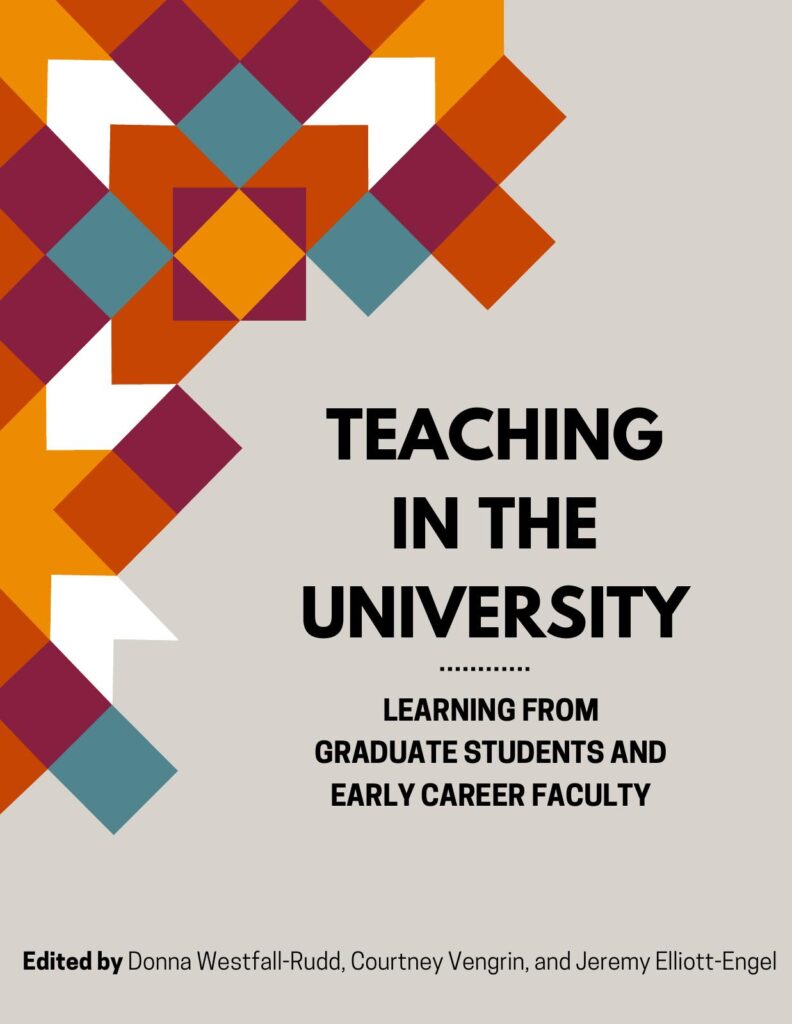
Cover credit: Illustration and cover design: Kindred Grey. Source: the 2022 Virginia Tech publication credits.
Book summary
Chapter-by-chapter summaries
Chapter 1: Relational learning and a working alliance
The first chapter treats learning as a relationship involving shared purposes, tasks, and interpersonal connection. Knowing students and creating approachable communication can make it easier for them to seek help. This does not require abandoning academic expectations; it makes the route to meeting them more visible. The contributor’s examples show how ordinary interactions can influence participation. Readers should ask whether students understand the goals and feel able to discuss difficulties. The chapter’s practical contribution is to connect classroom climate with the work of learning rather than treat friendliness and intellectual rigor as unrelated concerns.
Vignette: Supporting international graduate teaching assistants
The vignette identifies support needs that can be overlooked when an international graduate assistant is expected simply to adapt alone. Peer observation, preparation, and structured discussion can make expectations clearer. The account encourages institutions and colleagues to share responsibility for development. It also distinguishes an individual’s language or cultural adjustment from a lack of disciplinary competence.
Chapter 2: Authenticity
Authenticity concerns a credible teaching presence rather than copying an idealized instructor persona. The chapter connects self-awareness with attentiveness, preparation, and genuine engagement with students and subject matter. A teacher’s identity can shape practice, but students still need clear expectations and evidence that their learning matters. The examples invite reflection on behaviors that communicate interest or distance. Readers should distinguish authenticity from unfiltered self-expression: a teaching choice remains accountable to its educational purpose and the people affected by it. The chapter encourages a sustainable style grounded in reflection rather than performance alone.
Vignette: Structure in a large pandemic-era class
The account describes transferring organizational strengths into a changed teaching environment. Predictable lessons and communication helped address uncertainty in a large course. Its value is contextual rather than a claim that one pandemic arrangement fits every class. Readers can identify which elements reduced unnecessary confusion and which depended on the particular course and circumstances.
Chapter 3: Indigenizing the classroom
This chapter examines inclusion through Indigenous perspectives and the assumptions embedded in academic practice. Representation is important, but adding a reference without examining authority, language, and relationships may leave the underlying structure unchanged. The discussion connects historical harm with present educational experiences. Readers should consider who defines valid knowledge and what participation asks students to set aside. The chapter invites thoughtful engagement rather than symbolic incorporation of culture. Its practical question is how the design of a classroom can recognize Indigenous learners and knowledge while avoiding appropriation or a simplified account of diverse communities.
Chapter 4: Student-centered online learning
Online teaching requires deliberate organization, interaction, and support for learners with different circumstances. The chapter connects flexibility with clear expectations rather than assume that independent access means students need less guidance. Activities should make the learning process visible and create opportunities for feedback. Readers can compare the needs of their actual students with assumptions inherited from a face-to-face course. The main lesson is that student-centered design begins with the learning task and access conditions, then selects a workable online arrangement. Uploading material alone does not establish the relationships and practice needed for learning.
Chapter 5: Technology makes it easier
The chapter explores how tools can support participation, feedback, and communication, especially where a teacher cannot speak individually with every student during class. The source compares several platforms, but their historical feature lists should not be mistaken for current recommendations. The enduring question is what educational function the tool serves. Readers should consider access, preparation, feedback, and the additional work introduced by the technology. A tool can make one task easier while creating another barrier. The chapter is most useful when read as a framework for matching function with context rather than a shopping list.
Vignette: No really, I don’t have internet
The vignette challenges the assumption that every learner has dependable connectivity or a suitable device. Geographic and economic conditions can make an apparently simple online task difficult. The account asks teachers to take access reports seriously and design alternatives where possible. It makes infrastructure a learning condition rather than a problem students should be expected to hide.
Chapter 6: Fun Fridays and hands-on learning
Hands-on work shifts activity toward students, but its educational value depends on the reasoning it requires. The chapter discusses preparing, running, and reviewing activities within lecture courses. Instructors need to allow learners time to work rather than intervene immediately to resolve every uncertainty. Clear purposes and suitable prompts help connect the experience with course concepts. Readers should ask what students will explain or demonstrate afterward. The point is not to replace every lecture with entertainment, but to create purposeful opportunities to apply, compare, and discuss ideas in ways the instructor can observe.
Chapter 7: Grade appeals as a learning tool
Grade disputes can become conversations about criteria, evidence, and understanding. The chapter examines how an appeal process might support learning rather than only negotiate points. Clear expectations and consistent procedures are necessary so that access to reconsideration does not depend on confidence or personal influence. Readers should distinguish correcting an assessment error from changing a standard without justification. The educational opportunity is to make reasoning explicit: what did the work demonstrate, what did the criterion require, and what does the student understand differently after feedback? This reframes evaluation as communication without eliminating accountability.
Vignette: Fairness, learning, and equity
The vignette questions whether identical treatment always produces equitable opportunities. Rules can create barriers unrelated to the learning being assessed. Considering flexibility before a difficulty arises can make expectations clearer and reduce arbitrary exceptions. The account invites a distinction between preserving a meaningful standard and preserving a policy simply because it has been applied before.
Chapter 8: Overseeing a laboratory course taught by assistants
Laboratory and field teaching require coordination among the course leader, assistants, students, materials, and settings. The chapter draws on soil-science and forestry experience to examine preparation, communication, and support for teaching staff. Assuming that assistants already know how to teach can leave gaps even when they understand the content. Readers should make responsibilities and procedures visible and create routes for feedback. The wider lesson is that course quality depends on the teaching system, not only on an individual’s performance in one session. Planning and shared understanding help make learning more consistent across sections.
Vignette: Personal response systems
The example considers response tools as a way to make students’ thinking visible during teaching. Responses can reveal a misunderstanding and create a reason for discussion. The reported experience belongs to its course context rather than establish universal effectiveness. The useful question is how the instructor uses the information, not simply whether students clicked an answer.
Chapter 9: Mentoring research practices
Research mentoring combines instruction, training, and the development of increasing independence. Students may enter with little knowledge of expectations that experienced researchers take for granted. The chapter encourages making those expectations explicit and providing appropriate structure. Readers should distinguish completing a project task from learning how to reason and work as a researcher. Feedback, relationships, and the organization of opportunities influence both. The chapter’s practical contribution is to treat mentoring as an intentional educational responsibility rather than assume that exposure to a research environment will automatically produce the desired skills.
Vignette: A first experiential-learning program
The vignette reflects on supporting undergraduates through research, workshops, and professional-development experiences. It shows that the instructor is also learning how to organize and communicate in a new role. Readers can use the account to identify where expectations, preparation, and reflection improve the experience. The example complements the mentoring chapter rather than replace a locally designed program plan.
Chapter 10: The power of Extension
Extension connects university knowledge with community education and engagement. The chapter situates it alongside teaching and research in the land-grant mission while noting relevance beyond that setting. Its educational purpose differs from simply distributing research findings. Community participants bring knowledge, priorities, and conditions that shape what will be useful. Readers should ask how a proposed activity builds a relationship and responds to an actual need. The chapter broadens the collection’s account of teaching by showing that learning occurs beyond the formal course and requires forms of communication appropriate to its audience.
Chapter 11: Planning community engagement and broader impacts
Community education needs a plan linking needs, intended outcomes, activities, and evaluation. The chapter connects Extension experience with broader engagement work. A well-attended event is not automatically evidence that the intended learning or change occurred. Readers should identify the audience and purpose before choosing a format. Partnerships and feedback can improve the fit between a university’s proposal and community priorities. The main learning task is to explain the program’s logic: why these activities, for these people, under these conditions, should contribute to the desired outcome and how that contribution could be examined.
Chapter 12: Personalized advising
The chapter distinguishes consistent commitments from identical treatment. Effective advising requires reliable care, information, and attention while adapting to students’ different goals and circumstances. An advisor may need to vary the approach without changing the underlying responsibility. Readers should examine what they know, what they are assuming, and when a referral or additional information is necessary. The account connects advising with teaching because both help students make sense of choices and develop agency. Personalization is purposeful when it responds to relevant differences, rather than when it produces unexplained inconsistency.
Chapter 13: Using evaluations and feedback
Feedback can be uncomfortable, especially when tied to consequential judgments about teaching. The chapter encourages examining it as information for development without assuming every comment is equally reliable or actionable. Patterns, context, and other evidence help interpret student evaluations. Gathering feedback before the end of a course can also allow current students to benefit from a response. Readers should identify a specific change and a way to observe its effects rather than attempt to satisfy every isolated preference. The chapter closes the main sequence by making reflective revision a continuing part of teaching.
Vignette: Surviving the first semester in a new job
The final vignette contrasts familiarity with an established course and the demands of teaching new courses in a new institution. Prior success does not remove the need to learn local expectations and build new routines. The account encourages realistic preparation and support. It closes the collection with teaching understood as developing practice rather than a competence completed once and carried unchanged into every setting.
Study instructions
The following instructions are Academic Master editorial guidance.
Begin with a concrete teaching difficulty, such as participation in a large class or communication in a laboratory. Select a relevant chapter and record its author, setting, and main recommendation. Separate the contributor’s experience from evidence you would need in your own course.
For the relational-learning chapter, write down one communication practice you could change. Specify what students should experience differently, how you will explain expectations, and what signs might show improvement. Keep professional boundaries and consistent assessment visible in the plan.
After trying an approach, collect appropriate feedback and compare it with your initial expectation. Use a reflective note to decide what to retain, modify, or abandon. When writing about the collection, cite the particular chapter rather than attributing every contribution to the editors.
Questions for reflection
- What distinguishes a supportive working alliance from friendship?
- Which features of the contributor’s teaching setting differ from yours?
- What evidence would help you judge whether a proposed classroom change worked?
Sources and coverage
The thirteen main chapters and seven interspersed vignettes are all covered. These original summaries draw on review of the source text, including chapter or section introductions and selected explanations, examples, exercises, and concluding or review material. They are condensed study guides, not a page-by-page account or a replacement for the complete resource. Supplementary study discussions are identified separately.
About access & copyright
This page provides book information and study material. Full-text access is provided by the original publisher or authorised source; a listing does not grant permission to republish the book.
Read our Library Access & Copyright policyRelationships
Consider trust and respectful communication as teaching conditions.
Context
Adapt a recommendation to the actual classroom.
Reflection
Evaluate one purposeful change before expanding it.
Attribution
Distinguish chapter authors from collection editors.
Reader ratings & reviews
Share your thoughts
Your review helps other students choose the right resources.
KEEP LEARNING
Your next great read
Curriculum & Instruction Education
Designing Arguments for Academic, Public, and Professional Audiences
View Designing Arguments for Academic, Public, and Professional Audiences — book Education
Action Research
View Action Research — book Education
Qualitative Research – a practical guide for health and social care researchers and practitioners
View Qualitative Research – a practical guide for health and social care researchers and practitioners — book Education
Critical Appraisal Practice: Systematic Reviews
View Critical Appraisal Practice: Systematic Reviews — book Education
Open Research
View Open Research — book Education
Bad Ideas About Writing
View Bad Ideas About Writing — bookMechanics and Relativity
Mechanics and Relativity
View Mechanics and Relativity — bookDelftse Foundations of Computation
Delftse Foundations of Computation
View Delftse Foundations of Computation — bookIntroduction to Aerospace Structures and Materials



