
Advanced Community College ESL Composition: An Integrated Skills Approach
EducationTextbook
Bad Ideas About Writing
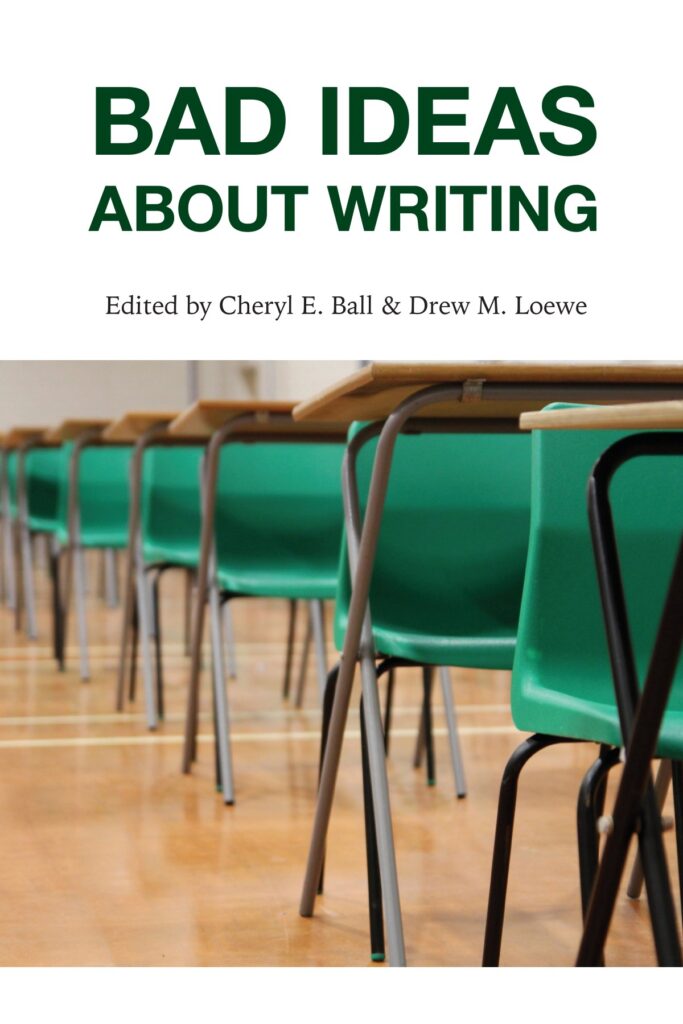
Not rated yetRate this bookBad Ideas About Writing brings writing-studies research into public discussion. Edited by Cheryl E. Ball and Drew M. Loewe, the collection challenges common assumptions about writers, writing processes, teaching, assessment and technology.
 Free
About this book
Published by West Virginia University Libraries in 2017, this multi-author collection presents short, argumentative entries for a broad educated readership. Its introduction explains the aim of translating specialist research and experience into accessible discussion. Eight thematic categories connect assumptions about good writing with writers, grammar, processes, genres, assessment, technology and teaching. The editors invite readers to compare entries, including disagreements, rather than expect a single rulebook. Further reading and keywords support additional investigation. The cover’s original photograph, No Pressure Then, is credited in the source to Flickr user Pete and identified there as public domain.
The attached edition contains 382 PDF pages, including front matter. Cover: source edition cover rendered from the PDF. The textbook and its original notices are retained; Academic Master’s study material is separate from the source text.
Book summary
Study overview of the reviewed opening
Ball and Loewe’s introduction explains the collection as a response to ideas about writing that scholars consider unhelpful but that continue to shape public expectations. Teachers, students, administrators and other readers influence how writing is understood, yet may not encounter specialist writing-studies research.
The entries translate research and teaching experience into concise arguments intended to start discussion. Rather than using full discipline-specific citation systems throughout, they provide resources for further reading and keywords that help a reader continue investigating the topic. The format is argumentative, so claims should remain associated with their contributors.
Eight categories organise the collection, but the editors encourage reading across them and attending to disagreement. Several entries may address a similar issue from different perspectives without being forced into a uniform conclusion. The page’s overview covers the introduction and verified thematic contents, not all individual arguments. It does not present the entire anthology as a single set of universally accepted writing rules.
Book contents
- Introduction
- Bad Ideas About What Good Writing Is
- Bad Ideas About Who Good Writers Are
- Bad Ideas About Style, Usage, and Grammar
- Bad Ideas About Writing Techniques
- Bad Ideas About Genres
- Bad Ideas About Assessing Writing
- Bad Ideas About Writing and Digital Technology
- Bad Ideas About Writing Teachers
Questions for study
The following prompts are Academic Master’s editorial material.
- Why might specialist research fail to reach public understandings of writing?
- What is gained by comparing entries that disagree?
- How can keywords and further reading support evaluation of a claim?
Sources and coverage
Introduction read in full (PDF pages 12–14); publication, identifiers, licence, cover credit and thematic contents checked.
About access & copyright
Check this edition’s source and licence before reusing its files or content. A library listing does not grant additional rights.
Read our Library Access & Copyright policyPublic scholarship
Recognise the editors’ translation of specialist discussion.
Argumentative reading
Attribute claims to individual contributors.
Thematic comparison
Read across categories and disagreements.
Further investigation
Use resources to examine a claim more closely.
Reader ratings & reviews
Share your thoughts
Your review helps other students choose the right resources.
KEEP LEARNING
Your next great read
Humanities
Arguing Using Critical Thinking
Arguing Using Critical Thinking
View Arguing Using Critical Thinking — bookWriting Fabulous Features
Writing Fabulous Features
View Writing Fabulous Features — bookKnowing Home: Braiding Indigenous Science with Western Science
Knowing Home: Braiding Indigenous Science with Western Science
View Knowing Home: Braiding Indigenous Science with Western Science — bookHow Arguments Work – A Guide to Writing and Analyzing Texts in College
How Arguments Work - A Guide to Writing and Analyzing Texts in College
View How Arguments Work - A Guide to Writing and Analyzing Texts in College — bookIt’s All Greek to Me! Using Authentic Readings to Improve Knowledge of the English Language and Western Culture
It’s All Greek to Me! Using Authentic Readings to Improve Knowledge of the English Language and Western Culture
View It’s All Greek to Me! Using Authentic Readings to Improve Knowledge of the English Language and Western Culture — bookTeaching Early and Elementary STEM
Teaching Early and Elementary STEM
View Teaching Early and Elementary STEM — bookGame Based and Adaptive Learning Strategies
Game Based and Adaptive Learning Strategies
View Game Based and Adaptive Learning Strategies — book Higher Education
Teaching in the University: Learning from Graduate Students and Early Career Faculty
View Teaching in the University: Learning from Graduate Students and Early Career Faculty — book Curriculum & Instruction



